
Old English : The Ancient Language of Early England
Mythlok Perspective
In Mythlok’s View, Old English stands not as a lost language but as a transitional echo between worlds. It carries the fading breath of pagan Europe while embracing the rising order of Christian thought. Unlike the fluid mythscapes of Celtic traditions or the structured cosmologies of Norse belief, Old English exists in tension, grounded yet symbolic. It mirrors the shift from oral myth to written doctrine. Much like early Japanese Kojiki texts or Vedic hymns, it captures a civilization rewriting its identity while quietly preserving its past.
Old English
Introduction
Old English, also known as Anglo-Saxon, represents the earliest recorded stage of the English language, spoken between the 5th and 11th centuries. It emerged after Germanic tribes such as the Angles, Saxons, and Jutes settled in Britain following the collapse of Roman authority. Though fundamentally Germanic, Old English developed in a landscape already rich with Celtic traditions, creating subtle layers of cultural and linguistic interaction.
To modern readers, Old English feels almost like a foreign language. Its grammar was heavily inflected, its vocabulary largely unfamiliar, and its poetic style relied on rhythm and alliteration rather than rhyme. Yet beyond its linguistic complexity, Old English offers something deeper. It preserves fragments of an older worldview where myth, fate, and heroism shaped human understanding. Even under strong Christian influence, traces of earlier belief systems endured within its literature, giving us a rare glimpse into a transitional cultural era.
Geographic Context
Old English developed across much of what is now England and parts of southern Scotland, particularly within the Anglo-Saxon kingdoms such as Wessex, Mercia, and Northumbria. These regions were established after waves of migration from continental Europe in the 5th century. Over time, these kingdoms became the dominant political and cultural centers of early medieval Britain.
However, Old English did not exist in isolation. Celtic-speaking populations continued to thrive in regions like Wales, Cornwall, and Ireland. Border areas, especially western England, became zones of interaction where linguistic and cultural exchanges occurred. While Old English largely replaced Celtic languages in the east and south, remnants of Celtic influence persisted in place names, speech patterns, and possibly even grammar.
This coexistence shaped the cultural environment in which Old English literature emerged. It was not a complete replacement of older traditions, but rather a layered transformation where new identities absorbed elements of the old.
Script/Writing System
The writing system of Old English reflects its dual heritage of pagan tradition and Christian influence. Early inscriptions used runes, specifically the futhorc, an expanded Germanic runic system adapted for local sounds. These runes were often carved into stone, wood, or metal objects and were associated with both communication and symbolic meaning.
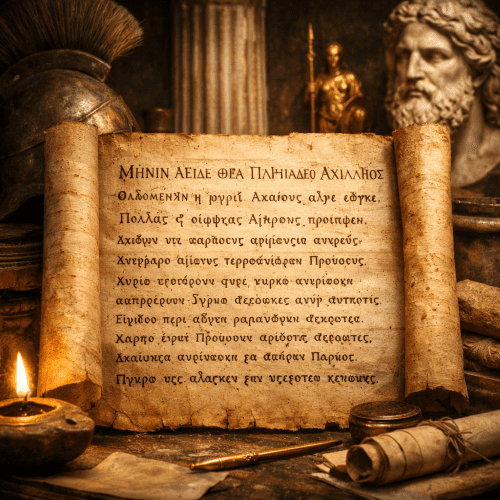
With the spread of Christianity in the 7th century, the Latin alphabet gradually replaced runes as the primary writing system. Missionaries from Ireland and continental Europe introduced a modified Latin script, which included additional characters such as thorn (þ) and wynn (ƿ) to represent unique sounds.
Manuscripts were written in Insular script, a distinctive style developed in British monastic communities. This transition from runic inscriptions to manuscript culture marked a shift from oral and symbolic traditions to structured literary preservation. Yet, even within Christian texts, echoes of earlier symbolic systems continued to exist.
Mythological Texts Written
Pure mythological texts in Old English are rare, largely due to the dominance of Christian scribes who recorded most surviving works. However, mythic elements still survive within poetry and narrative literature, often woven into stories that blend pagan and Christian themes.
The most famous example is Beowulf, an epic poem that tells the story of a hero battling monsters such as Grendel and a dragon. While the narrative is framed within a Christian worldview, its themes, settings, and characters clearly draw from older Germanic mythic traditions. The presence of fate, heroic glory, and supernatural creatures reflects a worldview that predates Christian doctrine.
Other works, such as those found in the Exeter Book and the Junius Manuscript, contain riddles, allegories, and poetic imagery that hint at mythic thinking. These texts do not present structured mythologies like those found in later Celtic or Norse traditions, but they preserve fragments of belief systems embedded within storytelling. In many ways, Old English literature acts as a bridge. It does not fully preserve ancient myths, but it ensures they are not entirely lost.
Transmission & Preservation
The survival of Old English literature is largely due to the efforts of monastic scribes who recorded oral traditions into written form. Before this transition, stories were passed down by scops, or poets, who performed in royal courts and communal gatherings. These performances relied on memory, rhythm, and repetition.
Only a small portion of this oral tradition was ever written down. Today, most poetry survives in just four major manuscripts, highlighting how much has been lost over time. Fires, invasions, and the dissolution of monasteries in the 16th century further reduced what remained.
Scribes played a crucial role in preservation, but they also shaped the material. Pagan elements were often reinterpreted through a Christian lens, altering their original meaning. Despite this, the core themes of heroism, fate, and the supernatural endured, allowing glimpses of earlier belief systems to survive within the texts.
Symbolism & Cultural Role
Old English literature reflects a world where symbolism was deeply tied to daily life and belief. Before Christian conversion, the Anglo-Saxons followed a pagan system that included gods like Woden, Thunor, and Tiw. Even after conversion, traces of these figures remained in language and cultural practices, such as the naming of weekdays.
Symbols like dragons, treasure hoards, and mead halls carried layered meanings. Dragons represented chaos and destruction, while treasure symbolized both wealth and the burden of greed. Mead halls served as centers of community, loyalty, and identity.
The concept of wyrd, often translated as fate, was central to its thought. It reflected an understanding that life was shaped by forces beyond human control, yet still demanded courage and honor. This idea parallels other ancient belief systems where destiny and personal action coexist in tension.
Comparative Analysis
When compared to Celtic traditions, Old English literature reveals both contrasts and subtle connections. Celtic myths, particularly those preserved in Welsh and Irish sources, often focus on otherworldly journeys, transformation, and fluid identities. In contrast, Old English narratives emphasize grounded heroism, physical conflict, and communal loyalty.
Linguistically, the influence of Celtic languages on it remains debated. While direct borrowing is limited, some scholars suggest deeper structural influences, particularly in syntax and speech patterns. Place names provide clearer evidence of interaction, especially in regions where Celtic populations remained strong.
Old English was also influenced by Latin and Old Norse, particularly during periods of Viking contact. This created a linguistic environment shaped by multiple cultural forces, each contributing to the evolution of early English identity.
Modern Influence
The legacy of Old English continues to shape modern culture in subtle but powerful ways. Many everyday English words have roots in Old English, and its influence can still be felt in the structure of the language.
In literature, it has inspired countless works of fantasy and historical fiction. Writers like J.R.R. Tolkien drew heavily from Old English poetry, particularly Beowulf, to create rich, mythic worlds. Concepts such as heroic destiny, ancient languages, and symbolic landscapes can all be traced back to this early tradition.
Modern media, including films and video games, often revisit Old English themes, blending them with Norse and Celtic elements. Even today, Old English remains a subject of academic study and cultural fascination, serving as a foundation for understanding the deeper roots of English storytelling.



Sources
Schrijver, P. (2009). Celtic influence on Old English: Phonological and phonetic continuity. English Language and Linguistics, 13(2), 193–211. https://www.cambridge.org/core/journals/english-language-and-linguistics/article/celtic-influence-on-old-english-phonological-an...
Lardbucket. (2012). Chapter 1: Old English literature. https://2012books.lardbucket.org/books/british-literature-through-history/s01-old-english-literature.html
Wikipedia contributors. (2024). Old English literature. Wikipedia. https://en.wikipedia.org/wiki/Old_English_literature
Britannica. (2025). English literature – Old English, poetry, manuscripts. https://www.britannica.com/art/English-literature/The-Old-English-period
Arrant Pedantry. (2014). Celtic and the history of the English language. https://www.arrantpedantry.com/2014/12/01/celtic-and-the-history-of-the-english-language/
Wikipedia contributors. (2024). Celtic mythology. Wikipedia. https://en.wikipedia.org/wiki/Celtic_mythology
Frequently Asked Questions
What is Old English and when was it spoken?
Old English is the earliest form of the English language, spoken from the 5th to the 11th century in early medieval England.
Why is Old English so different from modern English?
It has a completely different grammar system, vocabulary, and pronunciation, making it largely unintelligible to modern speakers.
What are the main Old English texts?
The most famous is Beowulf, along with collections like the Exeter Book and the Junius Manuscript.
Did Old English include mythology?
Yes, although mostly preserved indirectly, with mythic elements embedded in poetry and storytelling.
How did Old English influence modern culture?
It shaped the foundation of the English language and inspired modern fantasy literature, especially works like Tolkien’s Middle-earth.