


Kongolo : The Founding Ancestor of Songye and Luba Traditions
At a glance
| Description | |
|---|---|
| Origin | Songye Mythology |
| Classification | Mortals |
| Family Members | N/A |
| Region | Democratic Republic of the Congo |
| Associated With | Ancestry, Political origins, Kingship |
The Mythlok Perspective
In Mythlok’s Perspective, Kongolo shares an interesting place with Woot of Kuba mythology—both are remembered as foundational figures whose stories connect ancestry with the origins of political order. But while Woot is primarily remembered as a culture hero and ancestral founder, Kongolo carries a more complex legacy of kingship, conflict and succession. Together, their stories show how Central African mythology often uses founding figures to explain not only where a people came from, but how authority came to exist.
Kongolo
Introduction
Kongolo is a legendary ancestral figure associated with the Songye people of the Democratic Republic of the Congo and with the origins of Luba political tradition. Songye and Luba histories have long been closely connected, and some traditions describe Kongolo as a common mythical ancestor whose lineage reaches back to the sixteenth century. The Science Museum Group identifies Kongolo specifically as a shared mythical Songye ancestor connected with the Luba, while noting the historical overlap between the artistic traditions of the two peoples.
Kongolo is also remembered in Luba oral traditions as Nkongolo, a founding ruler associated with the establishment of an early Luba kingdom. These traditions place his political centre at Mwibele, near Lake Boya, and connect his story with the later rise of Kalala Ilunga. Encyclopaedia Africana describes Nkongolo as a legendary figure whose historicity remains uncertain, with scholars sometimes interpreting him as a symbol of a pre-existing dynasty rather than a single identifiable historical individual.
This distinction is important when discussing Kongolo in Songye mythology. The traditions surrounding him are not a single fixed biography. They combine ancestral memory, political origin stories, royal genealogy and mythology. Research on the Songye also cautions against assuming that there is one uniform Songye tradition, since Songye communities historically consisted of different local political and cultural traditions.
Physical Traits
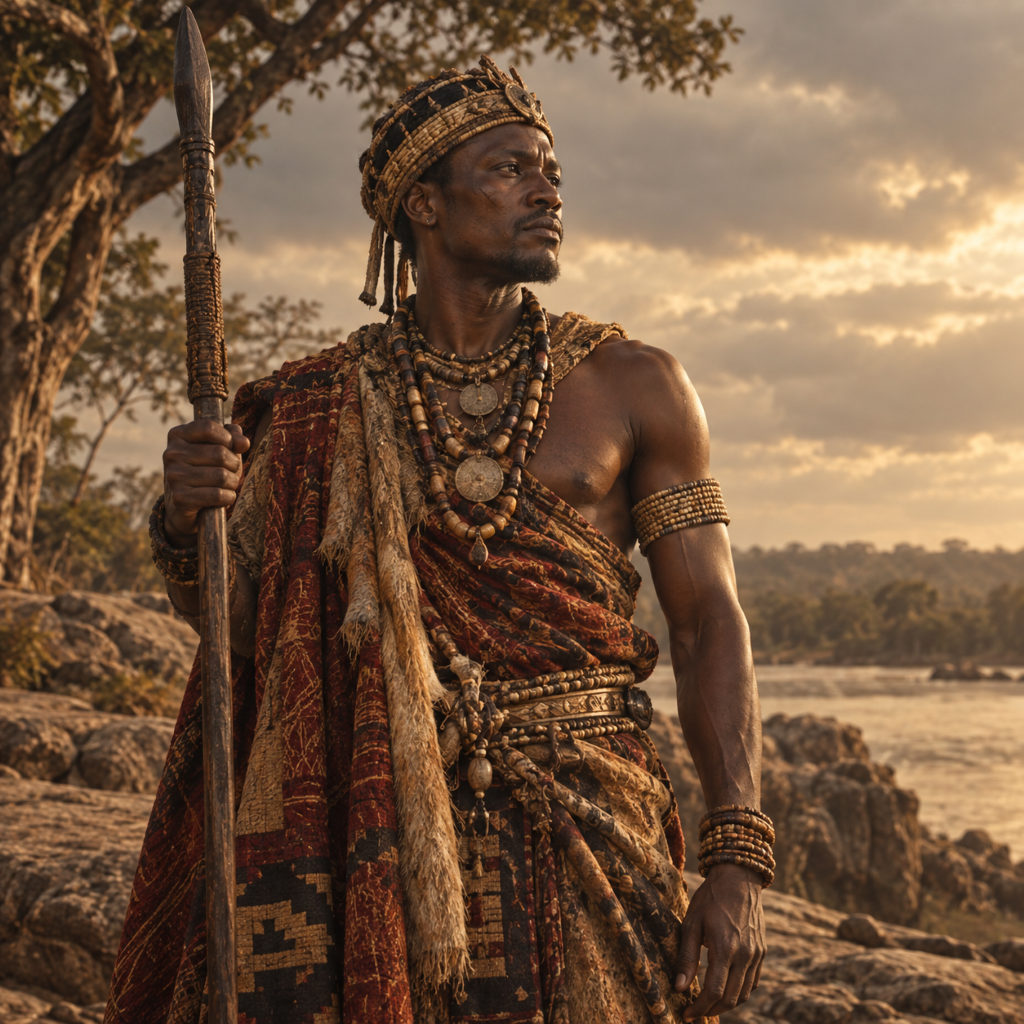
Kongolo does not have one universally documented physical appearance in Songye tradition. Descriptions of his appearance are particularly associated with Luba accounts of Nkongolo rather than with a standardized Songye representation.
In Luba royal traditions, Nkongolo is described as having red or pale skin and is associated with the rainbow. Encyclopaedia Africana explains that his name is traditionally interpreted as meaning “rainbow” and that his unusual colouring is connected symbolically with the serpent and rainbow imagery of the regional cosmological tradition.
These details should not automatically be transferred to every Songye account of Kongolo. The available evidence identifies Kongolo as a shared ancestral figure but does not establish a standardized Songye portrait showing him as a red-skinned man, serpent or supernatural creature. Similarly, there is no reliable evidence for a specific Kongolo statue or mask that can be treated as his definitive visual representation.
This distinction is especially relevant because Songye and Luba artistic traditions have sometimes been difficult to separate. Museum collections contain objects whose cultural attribution has changed over time, and researchers have documented significant stylistic interaction between the two communities. Kongolo is therefore best visualized as an ancestral or royal founder rather than as a character with a fixed physical design. When the red-skinned or rainbow imagery is used, it should be identified specifically as part of Luba traditions surrounding Nkongolo.
Family
Kongolo’s family relationships are primarily known through Luba royal origin traditions rather than through a single, universally accepted Songye genealogy. In the Luba tradition, Kongolo or Nkongolo becomes connected with the eastern hunter Mbidi Kiluwe. According to the traditional account, Mbidi marries Kongolo’s sisters Bulanda and Mabela. Their descendants become central to the story of Kalala Ilunga, the warrior who eventually challenges Kongolo’s authority. Encyclopaedia Africana records the tradition in which Kalala Ilunga becomes a powerful military leader under his uncle before the relationship between the two deteriorates.
Kalala Ilunga’s eventual return with an army and defeat of Kongolo forms one of the central episodes in the Luba royal origin tradition. The story presents a transition from Kongolo’s older political order to the sacred kingship associated with Kalala Ilunga and the later Luba ruling dynasty.
The family story should nevertheless be treated as mythology and oral tradition rather than as a conventional historical genealogy. Scholars have questioned whether figures such as Nkongolo and Kalala Ilunga represent individual historical rulers, dynastic ancestors, political offices or symbolic characters preserved through generations of oral tradition. Encyclopaedia Africana, for example, describes Nkongolo as potentially representing a dynasty rather than a single historical person.
For Songye mythology, Kongolo’s most important family significance is therefore his position within a wider ancestral relationship linking Songye and Luba traditions, rather than a precisely documented family tree.
Other names
Kongolo is also known as Nkongolo, particularly in Luba traditions. The name Kongolo is associated with the ancestral figure remembered in Songye traditions, while Nkongolo is especially prominent in accounts of Luba royal origins. The name Nkongolo is traditionally interpreted as “rainbow.” This meaning is significant because the Luba origin tradition connects the figure with rainbow and serpent symbolism. Encyclopaedia Africana records Nkongolo as a legendary Luba ruler associated with the beginnings of the Luba political order.
The form “Kongolo Mwamba” also appears in modern accounts of the figure. However, these different forms should not automatically be interpreted as separate characters. Variations in spelling and naming are common when oral traditions are recorded across different languages and transcription systems.
Powers and Abilities
Kongolo is not consistently portrayed as a god possessing a defined collection of supernatural powers. His importance comes primarily from his role as an ancestral founder, political figure and symbol of early kingship. His principal mythic attributes are associated with founding, authority and ancestry. Songye tradition connects him with the shared ancestral history of the Songye and Luba, while Luba traditions remember Nkongolo as a ruler associated with the formation of an early Luba political kingdom.
The Luba tradition gives Kongolo a stronger supernatural and symbolic dimension. His association with the rainbow and serpent imagery places him within a cosmological framework in which political authority is connected with forces beyond ordinary human life. His red or pale appearance is likewise symbolic rather than simply a description of physical appearance.
Kongolo’s most important mythic “power” is therefore the authority of ancestry. His position at the beginning of an origin tradition allows later rulers and communities to connect themselves with an older source of political legitimacy.
His story also represents a transformation in kingship. The conflict between Kongolo and Kalala Ilunga is traditionally interpreted as more than a family dispute. It contrasts an older form of rulership with the political and ritual order attributed to the later Luba dynasty. Scholarly interpretations have consequently treated the story as a reflection of political legitimacy as well as mythology.
Modern Day Influence
Kongolo remains important to the study of Songye and Luba history, mythology and political traditions. His story provides a window into how Central African communities have used oral traditions to explain ancestry, migration, political authority and the origins of kingdoms.
Modern museums and researchers continue to discuss Kongolo when examining the close historical relationship between Songye and Luba cultures. The Science Museum Group specifically identifies him as a common mythical ancestor and notes that Songye and Luba objects have sometimes been confused or misattributed in Western collections.
Songye visual culture also provides an important context for understanding the world surrounding Kongolo. Songye communities are particularly known for masks, power figures and objects associated with social, ritual and protective functions. However, these objects should not automatically be described as representations of Kongolo. Research emphasizes that Songye masking traditions changed across regions and historical periods, making a single standardized interpretation difficult.
Kongolo’s continuing importance is therefore less about a modern cult or a specific festival dedicated to him and more about his place within the cultural memory of Central Africa. His story connects ancestral identity with the development of political institutions and demonstrates how mythology can preserve ideas about legitimacy and social order.
For Songye mythology, Kongolo is best understood as a foundational ancestral figure whose tradition overlaps significantly with Luba origin narratives. His story should not be reduced to the image of a red-skinned serpent king, because that description belongs more specifically to the Luba tradition of Nkongolo. The broader evidence presents a more complex figure: an ancestral name shared across traditions, a legendary founder associated with early Luba kingship, and a powerful symbol of the historical relationship between the Songye and Luba peoples.
Related Images


Source
African Art Archive. (2026). Songye people—Masks, figures & identification. https://africanarchive.org/en/staemme/songye
Gordon, D. M. (2018). Kingdoms of South-Central Africa: Sources, historiography, and history. In T. Spear (Ed.), Oxford research encyclopedia of African history. Oxford University Press. https://doi.org/10.1093/acrefore/9780190277734.013.146
Hersak, D. (1986). Songye masks and figure sculpture. Ethnographica.
Merriam, A. P. (1974). An African world: The Basongye village of Lupupa Ngye. Indiana University Press.
Reefe, T. Q. (1981). The rainbow and the kings: A history of the Luba Empire to 1891. University of California Press.
Science Museum Group. (n.d.). Songye people. https://collection.sciencemuseumgroup.org.uk/people/cp119507/songye-people
Vansina, J. (1966). Kingdoms of the Savanna. University of Wisconsin Press.
Womersley, H. (1984). Legends and history of the Luba. Crossroads Press.
Frequently Asked Questions
Who is Kongolo in Songye mythology?
Kongolo is a legendary ancestral figure associated with Songye origins and shared traditions with the Luba, where he is also remembered as Nkongolo.
Is Kongolo a Songye or Luba figure?
What does Kongolo mean?
Kongolo is also known as Nkongolo in Luba traditions, where the name is traditionally interpreted as “rainbow” and linked with serpent symbolism.
Who defeated Kongolo?
In Luba royal tradition, Kongolo was defeated by his nephew Kalala Ilunga after a conflict over political authority and succession.
Was Kongolo a real historical king?
Kongolo is remembered as a legendary founder, but scholars caution that oral traditions do not establish him as a clearly documented historical individual.


