
Kiaklo : The Zuni Sacred Seeker and Bearer of Ritual Law
Listen
At a glance
| Description | |
|---|---|
| Origin | Zuni Mythology |
| Classification | Spirits |
| Family Members | Ka’wimosa (Father) |
| Region | United States of America |
| Associated With | Sacred knowledge, Migration, Ceremonial law, Mediation between worlds |
The Mythlok Perspective
From the Mythlok lens, Kiaklo represents a form of heroism rarely centered in popular retellings. He does not conquer chaos; he learns its structure. His myth positions knowledge as a stabilising force rather than a weapon, echoing similar figures across Indigenous traditions where survival depends on correct relationship rather than dominance. Kiaklo’s endurance-based authority contrasts sharply with war-driven mythic models, offering a quieter but enduring vision of power grounded in memory, accuracy, and restraint.
Kiaklo
Introduction
Zuni traditions from the Pueblo world of present-day New Mexico preserve a deeply layered cosmology where migration, balance, and sacred knowledge shape collective identity. Within this worldview, Kiaklo emerges as a pivotal cultural figure whose story is inseparable from the Zuni search for stability and meaning. Rather than functioning as a god of domination or spectacle, Kiaklo represents endurance, learning, and responsibility. His journey northward during the era of emergence positions him as a scout and messenger, one who willingly enters danger so that communal life can be ordered and sustained. The Kiaklo narrative reflects a Zuni understanding that survival depends not on conquest but on correct relationships with the land, ancestors, and ritual law. As such, Kiaklo is remembered less as a supernatural conqueror and more as a bearer of wisdom that anchors society.
Physical Traits
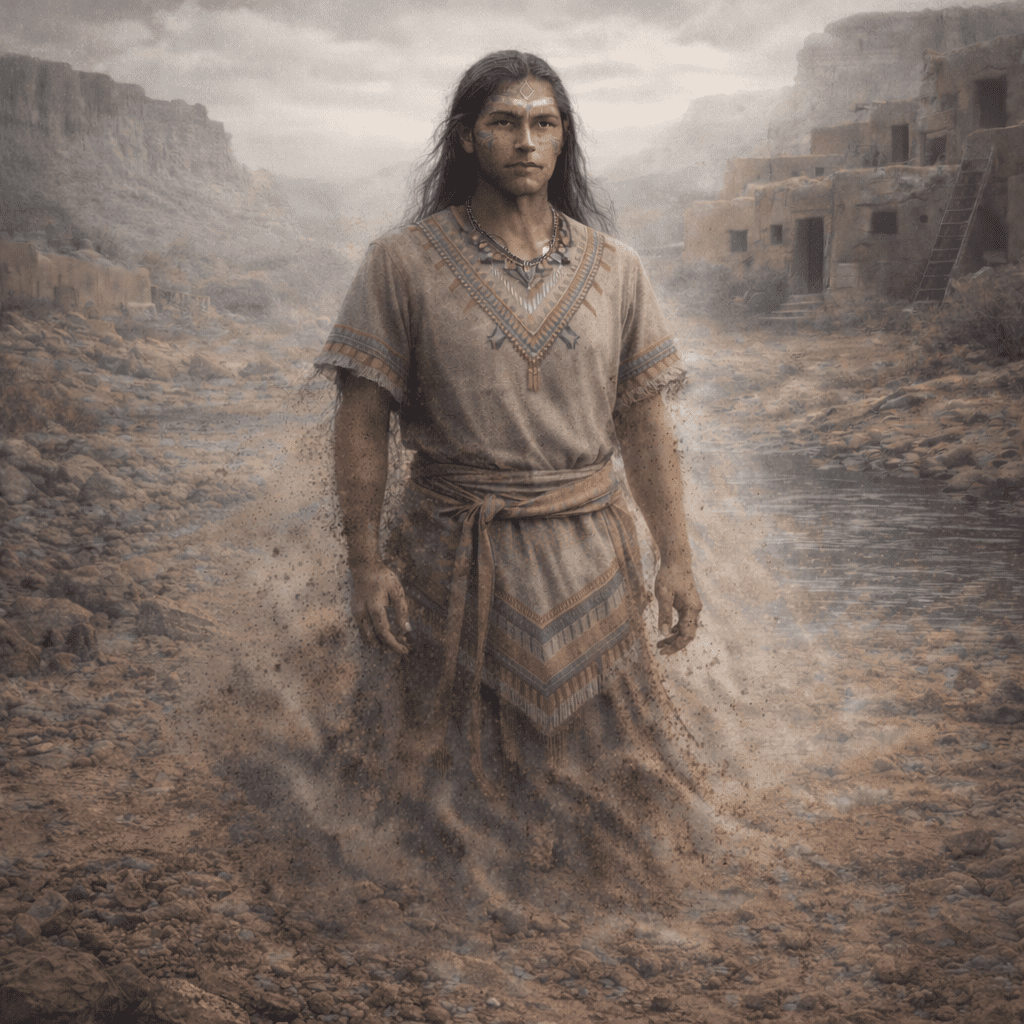
Unlike many kachina figures with highly codified visual forms, Kiaklo’s physical description is intentionally understated in Zuni tradition. Ethnographic records describe him as arriving at the Sacred Lake exhausted, partially blinded, and weakened by the harsh northern journey. This worn state is not incidental but symbolic, emphasizing human limitation when approaching divine knowledge. Kiaklo is not defined by elaborate masks or distinctive regalia; instead, his appearance aligns with humility and perseverance. His entry into the underwater council of beings, carried by the Koyemshi attendants and descending by a reed ladder, mirrors ceremonial movement into kivas rather than showcasing visual splendor. In Zuni thought, Kiaklo’s body reflects the cost of wisdom, reinforcing that sacred knowledge is earned through endurance rather than bestowed through power.
Family
Kiaklo belongs to a complex mythic family structure that reinforces Zuni ideas of balance, consequence, and social order. He is remembered as the eldest son of Ka’wimosa, the Kachina Maker priest, who sends his children in different directions during the time of migration. While Kiaklo journeys north, his siblings travel south and east, each path carrying distinct outcomes. The eastern siblings’ transgression results in the birth of the Koyemshi, who later become ritual interpreters, while Kiaklo’s success grants him access to divine instruction. These family narratives are not genealogical curiosities but moral frameworks that encode Zuni rules of kinship, exogamy, and communal responsibility. Kiaklo’s role as the successful emissary restores balance among his siblings by transforming disorder into ritual structure.
Other names
Kiaklo is primarily known by this name, though spelling variations such as K’yäk’lu or Kaiklo appear in early ethnographic transcriptions. These differences reflect phonetic interpretation rather than distinct identities. Unlike many mythic figures who accumulate titles over time, Kiaklo remains closely tied to his narrative role rather than epithets. In some oral contexts, he is referred to descriptively as the Elder Son or the Seeker of the Middle Place, but these are interpretive labels rather than formal names. This restraint aligns with Zuni cultural practice, where names are preserved carefully and not multiplied for poetic effect. Kiaklo’s identity remains stable, reinforcing continuity rather than mythic embellishment.
Powers and Abilities
Kiaklo’s abilities are intellectual, spiritual, and ceremonial rather than physical or destructive. His greatest power lies in endurance and comprehension. After reaching the Sacred Lake with the aid of guiding beings such as Duck, he gains access to the council of gods and ancestral spirits. There he learns the structure of the cosmos, the origins of the kachinas, the proper conduct of ceremonies, and the path souls must follow after death. Upon returning, Kiaklo transmits this knowledge to the Zuni people, establishing ritual systems that govern seasonal cycles, mourning practices, and communal dances. His authority does not stem from command but from accuracy. In Zuni tradition, correct knowledge is power, and Kiaklo embodies this principle completely.
Modern Day Influence
Kiaklo continues to influence Zuni life through ceremony, story, and cultural memory. While many rituals associated with kachinas are now closed to outsiders to protect sacred integrity, Kiaklo’s narrative remains foundational in understanding why these traditions exist. Academic scholarship has preserved his story through careful documentation, though contemporary Zuni communities emphasize lived practice over textual interpretation. Beyond the pueblo, Kiaklo appears in comparative mythology and Indigenous studies as an example of non-hierarchical heroism, where success is measured by preservation rather than domination. His continued relevance demonstrates how myth functions as a living framework, guiding cultural continuity in the face of historical disruption.
Related Images



Source
Benedict, R. (1935). Zuni mythology (Columbia University Contributions to Anthropology, Vol. 21). Columbia University Press.
Cushing, F. H. (1988). The mythic world of the Zuni. University of New Mexico Press. https://books.google.com/books/about/The_Mythic_World_of_the_Zuni.html?id=CbB1AAAAMAAJ
Bunzel, R. L. (1932). Introduction to Zuni ceremonialism (47th Annual Report, Bureau of American Ethnology). Smithsonian Institution.
Wright, B. (1988). Notes on Cushing’s Zuni origin myth. Harvey Mudd College. https://pages.hmc.edu/beckman/western/zuni.htm
Wikipedia contributors. (2024). Zuni mythology. Wikipedia. https://en.wikipedia.org/wiki/Zuni_mythology
Stevenson, M. C. (1904). The Zuñi Indians. Bureau of American Ethnology.
Tedlock, D. (1972). Zuni sacred theater. Cornell University. https://courses.cit.cornell.edu/thetr240/secure/tedlock.pdf
Fergusson, E. (1933). Dancing gods: Indian ceremonials of New Mexico and Arizona. Knopf.
Frequently Asked Questions
Who is Kiaklo in Zuni tradition?
Kiaklo is a cultural and spiritual figure known for journeying north to obtain sacred knowledge that structured Zuni ceremonial life.
Is Kiaklo a god or a spirit?
Kiaklo is best understood as a spirit-mediator rather than a ruling god, defined by knowledge transmission rather than divine authority.
What did Kiaklo bring back to the Zuni people?
He returned with teachings on kachina rituals, cosmology, and the correct path of the dead.
Why is Kiaklo important in Zuni culture today?
His story explains the origin of core ceremonies and reinforces values of endurance, balance, and communal responsibility.
Is Kiaklo represented in kachina dolls?
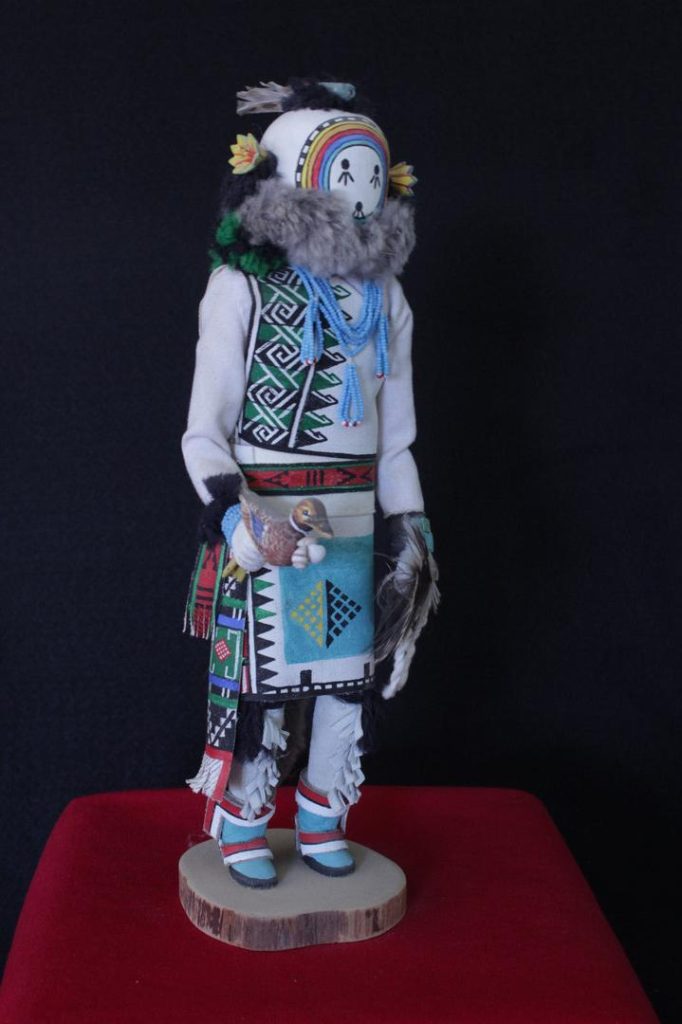
Kiaklo himself is not commonly depicted, reflecting Zuni restraint around sacred representation, though related figures evoke his era and teachings.
