
Kaveh : The Iranian Blacksmith Who Sparked a Revolution
At a glance
| Description | |
|---|---|
| Origin | Iranian Mythology |
| Classification | Mortals |
| Family Members | N/A |
| Region | Iran |
| Associated With | Resistance, Justice, Rebellion, Leadership, Blacksmithing |
The Mythlok Perspective
In Mythlok’s Perspective, Kaveh represents the archetype of the rebel craftsman, a figure who transforms labor into resistance. Unlike divine warriors, his strength comes from lived experience and moral clarity. This makes him closer to figures like Hephaestus from Greek tradition, who also embodies the forge, yet differs in purpose. Kaveh stands alongside Prometheus as a challenger of unjust authority, but remains uniquely grounded in collective uprising rather than individual defiance.
Kaveh
Introduction
Kaveh stands as one of the most powerful symbols of resistance in Iranian tradition. Known as Kāveh Āhangar, or Kaveh the Blacksmith, he emerges from the pages of the Shahnameh, the great Persian epic composed by Ferdowsi. His story unfolds during the oppressive reign of Zahhak, a ruler whose shoulders bore serpents that demanded human brains as sustenance.
Kaveh is not introduced as a noble or warrior, but as a common man driven by grief and injustice. When Zahhak’s agents threaten his last surviving child, Kaveh refuses to submit. In a defining act of rebellion, he tears apart a royal decree meant to legitimize Zahhak’s rule and storms out of the court. This moment marks the beginning of a people’s uprising. Using his leather apron as a banner, he creates what becomes known as the Derafsh Kaviani, transforming a symbol of labor into a flag of revolution.
Kaveh’s journey from blacksmith to revolutionary leader reflects a deeper cultural idea: that true power lies not in kingship, but in moral courage.
Physical Traits
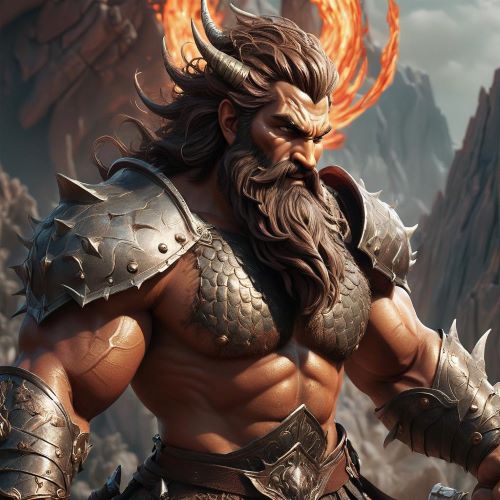
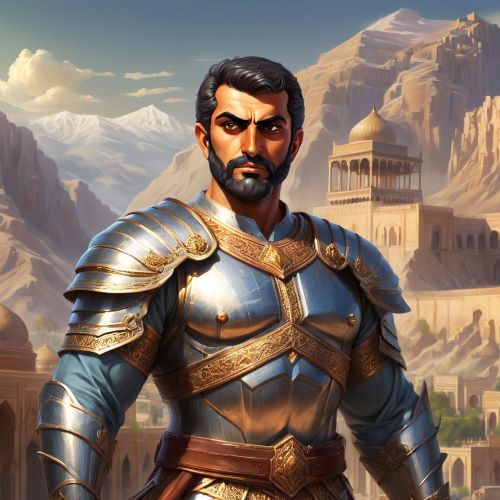
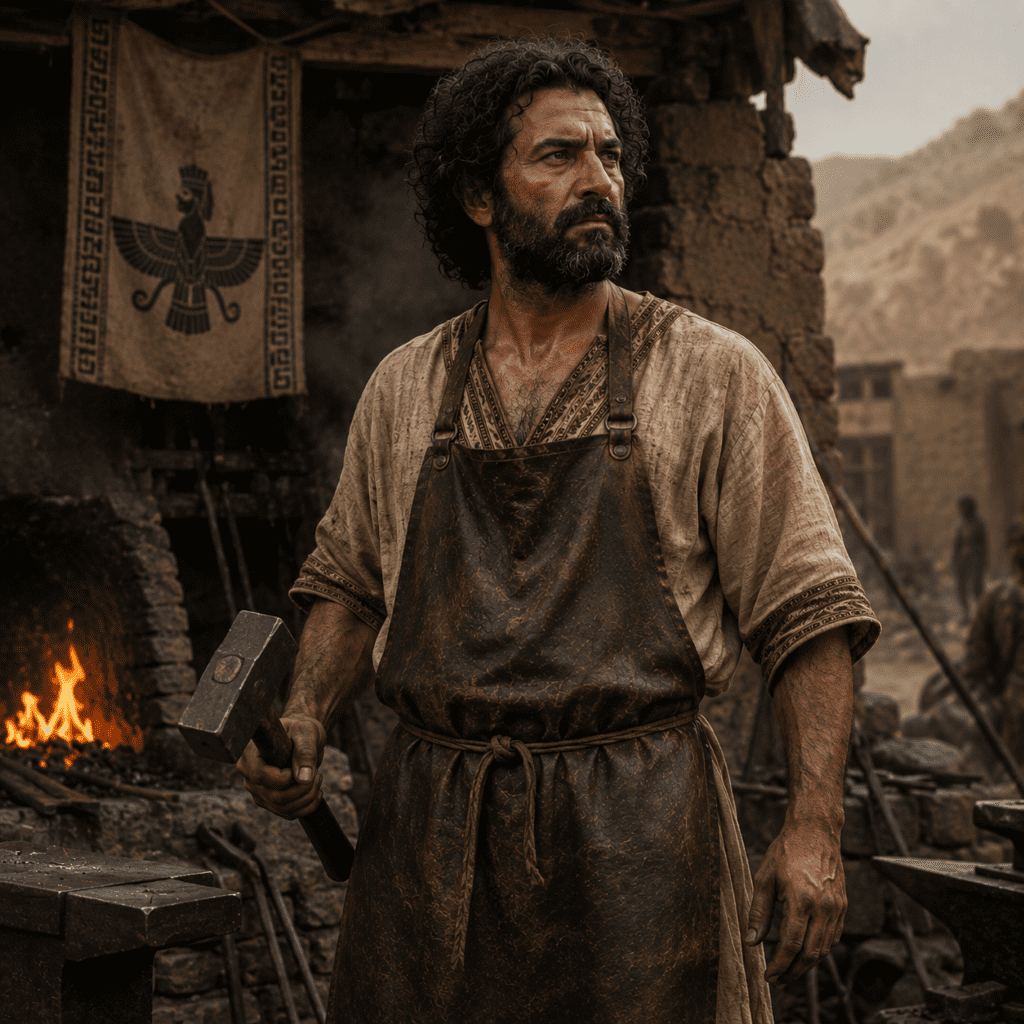
The original sources provide very little detail about Kaveh’s physical appearance. Unlike many mythic heroes, he is not defined by extraordinary beauty or divine features. Instead, his identity is rooted in his profession and presence.
As a blacksmith, Kaveh is associated with strength, endurance, and mastery over fire and metal. Later artistic interpretations often depict him as broad-shouldered and physically imposing, shaped by years of labor at the forge. However, these are interpretive additions rather than textual facts.
What the tradition emphasizes is his aura. When Kaveh confronts Zahhak, the tyrant is momentarily overwhelmed. This reaction is not due to supernatural power, but to the symbolic authority Kaveh carries. His leather apron becomes his defining visual marker, representing both his craft and his defiance. In essence, Kaveh’s “appearance” is less about physical description and more about presence. He embodies the כוח of the working class, grounded, resilient, and unyielding.
Family
Kaveh’s story is deeply shaped by personal loss. The Shahnameh confirms that he had children, but the exact number varies across traditions. In the core narrative, at least one of his sons is taken by Zahhak’s agents, while later retellings expand this into a larger tragedy, with multiple sons sacrificed to feed the serpents.
Some traditions claim that Kaveh had up to eighteen sons, with only one surviving at the time of his rebellion. While this number is not universally accepted, it reinforces the emotional weight behind his actions. His uprising is not abstract or political at first. It is personal.
Later Iranian traditions also connect Kaveh to noble lineages. Figures such as Qāran and Qobād are sometimes described as his descendants, linking him to the House of Karen, one of the prominent aristocratic families in later Iranian history.
These variations highlight how Kaveh’s story evolved over time, shifting from a tale of individual defiance to one embedded in broader cultural identity.
Other names
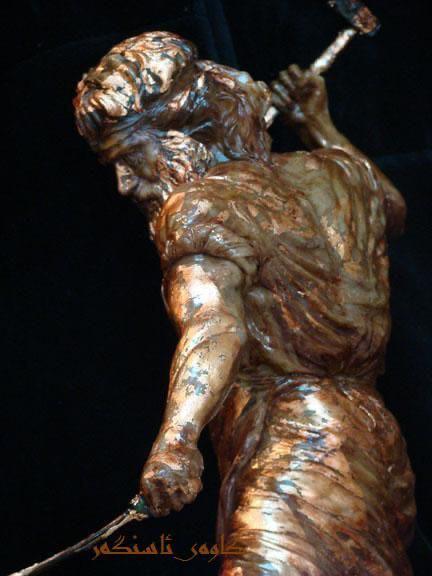
Kaveh is known by several names across regions and traditions, each reflecting linguistic and cultural variations. The most common form is Kāveh Āhangar, meaning “Kaveh the Blacksmith.” In Kurdish traditions, he appears as Kawa, where he is celebrated as a liberator figure. This version of the story plays a role in cultural narratives of resistance and is often associated with seasonal festivals symbolizing renewal and freedom.
Scholars have also explored connections between Kaveh and the ancient term “Kavi,” a title used in early Iranian texts for kings and spiritual leaders. While this link is debated, it suggests that Kaveh may represent a bridge between royal authority and popular power. Despite these variations, the core identity remains unchanged. Whether called Kaveh, Kāva, or Kawa, he is remembered as the blacksmith who stood against tyranny.
Powers and Abilities
Kaveh is not portrayed as a god or a wielder of supernatural forces. His strength lies in qualities that are distinctly human. Courage, leadership, and moral conviction define his role in the narrative.
One of his most significant acts is the creation of the Derafsh Kaviani. By raising his leather apron on a spear, Kaveh transforms an ordinary object into a symbol of unity. This act demonstrates his ability to inspire collective action, turning individual resistance into a national movement.
Some interpretations suggest that blacksmiths in ancient cultures were seen as possessing a kind of symbolic power due to their mastery over fire and metal. In Kaveh’s case, this translates into authority rather than magic. His presence alone is enough to disrupt Zahhak’s dominance, hinting at the cultural belief in the protective or apotropaic qualities of iron.
Kaveh also plays a crucial role in supporting Fereydun, the hero who ultimately defeats Zahhak. Rather than being the final conqueror, Kaveh acts as the catalyst who makes that victory possible. His abilities remind us that mythic power does not always come from the supernatural. Sometimes, it emerges from the ability to stand firm when others cannot.
Modern Day Influence
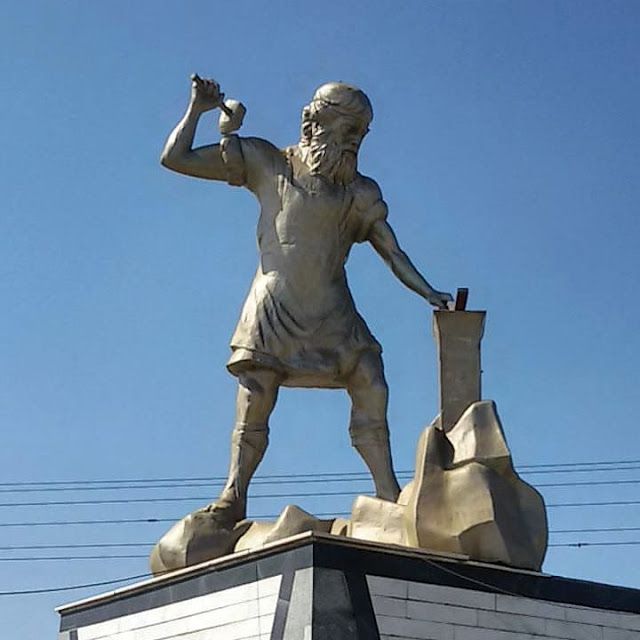
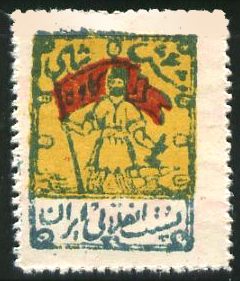
Kaveh continues to hold a powerful place in modern Iranian and Kurdish cultural identity. His story has transcended its mythological origins to become a symbol of resistance against oppression. The Derafsh Kaviani, originally fashioned from a blacksmith’s apron, later evolved into a royal standard associated with Iranian sovereignty. Even today, it is remembered as a representation of unity and independence.
Kaveh’s legacy also appears in literature, political discourse, and cultural movements. In the early twentieth century, a journal named Kaveh was published in Berlin, promoting ideas of reform and national revival. His story is frequently referenced in discussions about justice, leadership, and the role of ordinary people in shaping history.
In Kurdish traditions, Kaveh’s rebellion is symbolically linked to themes of liberation and renewal, further extending his influence beyond a single cultural framework. Across centuries, Kaveh has remained relevant because his story addresses a universal truth. The fight against injustice often begins with a single voice.
Related Images
Source
Encyclopaedia Iranica. (n.d.). KĀVA. https://www.iranicaonline.org/articles/kava-hero/
Wikipedia contributors. (n.d.). Kaveh the Blacksmith. Wikipedia. https://en.wikipedia.org/wiki/Kaveh_the_Blacksmith
Wikipedia contributors. (n.d.). Derafsh Kaviani. Wikipedia. https://en.wikipedia.org/wiki/Derafsh_Kaviani
Amordadnews. (2025, December 4). The Majestic Tale of the Derafsh Kaviani. https://en.amordadnews.com/?p=160363
Afshari, M., & Madayeni, M. (Eds.). (1998). Haft laškar: ṭumār-e jāmeʿ-e naqqālān az Kiumarṯ tā Bahman. Tehran, Iran.
Asadi Tusi, A. b. A. (1975). Garšāsp-nāma (H. Yaghma’i, Ed.). Tehran, Iran.
Balʿami, A. b. A. M. (1995). Tāriḵ-nāma-ye Ṭabari (M. Rowšan, Ed.). Tehran, Iran.
Frequently Asked Questions
Who is Kaveh in Iranian tradition?
Kaveh is a legendary blacksmith who led a rebellion against Zahhak, becoming a symbol of justice and resistance in Persian epic tradition.
What is the Derafsh Kaviani?
It is the banner created by Kaveh from his apron, later becoming a powerful symbol of Iranian unity and sovereignty.
Did Kaveh have supernatural powers?
No, Kaveh is portrayed as a mortal whose strength lies in courage, leadership, and the ability to inspire people.
Why is Kaveh important today?
He remains a cultural symbol of resistance, often referenced in discussions about justice, identity, and political freedom.
How is Kaveh connected to Fereydun?
Kaveh supports Fereydun’s rise, helping him overthrow Zahhak and restore balance and rightful rule.