


Gveleshapi : The Serpent Dragon of Georgian Waters
Listen
At a glance
| Description | |
|---|---|
| Origin | Georgian Mythology |
| Classification | Spirits |
| Family Members | N/A |
| Region | Georgia |
| Associated With | Water control, Floods, Droughts, |
The Mythlok Perspective
In Mythlok’s Perspective, Gveleshapi reflects a universal idea: water is never neutral. It nurtures civilizations yet holds the power to erase them. The transformation of Gveleshapi from guardian to destroyer mirrors how human perception shifts when nature turns hostile. This duality finds parallels in Indian Nāgas, who guard rivers yet can unleash destruction, and in Mesopotamian Tiamat, a primordial water force of chaos. Across cultures, serpent beings tied to water embody the same truth—creation and destruction are never separate, only balanced.
Gveleshapi
Introduction
Gveleshapi stands as one of the most fascinating and layered creatures in the folklore of Georgia, embodying both fear and reverence. Often described as a massive serpent or dragon tied to rivers, lakes, and hidden springs, Gveleshapi reflects the deep relationship between people and water in the mountainous Caucasus region. Its very name, meaning “snake-whale,” captures its hybrid identity as a creature of immense scale and mystery.
In early traditions, Gveleshapi was not always a villain. It was sometimes seen as a guardian of water sources, a being of wisdom and hidden knowledge. Over time, especially after cultural shifts brought by Christianity, its image transformed into that of a destructive force. Floods, droughts, and water scarcity became associated with its presence, turning it into a mythic adversary that heroes were destined to confront. This dual nature makes Gveleshapi more than just a monster. It represents the unpredictable power of nature itself—life-giving when respected, but devastating when provoked.
Physical Traits
Gveleshapi is typically envisioned as a colossal serpent with characteristics that blend aquatic and draconic features. The term “snake-whale” suggests a long, coiling body capable of navigating deep waters while possessing the overwhelming mass of a sea creature. Unlike many Western dragons, it is not consistently depicted with wings, especially in Georgian folk narratives.
Its body is imagined as powerful and fluid, designed for movement through rivers, lakes, and underground water channels. Some interpretations describe it as capable of existing across different realms, including mountains, earthly waters, and even passages leading to the underworld. This gives Gveleshapi a cosmic dimension beyond that of a simple beast.
In neighboring traditions across the Caucasus, similar dragons are described with features like forked tongues, unblinking eyes, or even elemental abilities. While these traits are not always directly attributed to Gveleshapi, they help reinforce its identity as a primordial force rather than a fixed, detailed creature. Its appearance remains intentionally ambiguous, allowing it to feel vast, ancient, and unknowable.
Family
Gveleshapi does not belong to a traditional divine lineage. It exists outside structured mythological families, making it a solitary force rather than a member of a pantheon. This isolation enhances its role as a chaotic and independent entity.
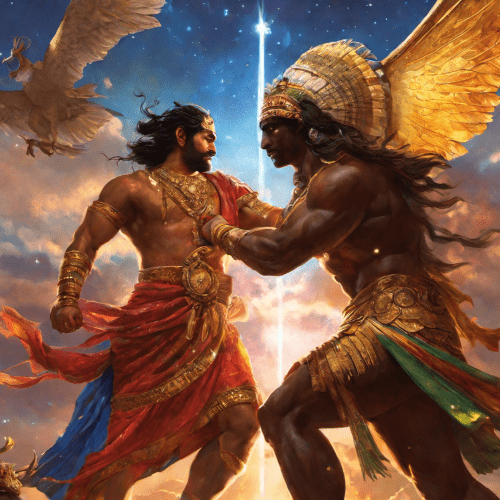
However, it is strongly connected to other mythological beings through conflict. One of the most important relationships is with Paskunji, a powerful bird that inhabits the underworld and aids heroes. The dynamic between them is one of constant tension. Gveleshapi devours the bird’s offspring, while Paskunji becomes an ally to those who challenge the serpent.
In several stories, heroes such as Mzechabuki intervene in this conflict. By defeating Gveleshapi, they not only restore balance but also earn the gratitude and assistance of Paskunji. This relationship creates a symbolic triangle of predator, protector, and hero, emphasizing themes of sacrifice, courage, and restoration. Some traditions also mention offspring known as Amaars, suggesting that Gveleshapi is not entirely alone in its existence, but these connections are rarely explored in depth.
Other names
The primary name Gveleshapi comes directly from the Georgian language, combining words for “snake” and “whale.” Earlier forms of the word appear as “gvel-veshapi,” highlighting its composite meaning more explicitly.
While the term can loosely translate to “dragon,” it is not interchangeable with European dragon concepts. Its identity is rooted in local geography and cultural symbolism rather than borrowed mythic frameworks. Variations like “Veshapi” appear in historical texts and literature, but they all refer back to the same essential being. Unlike many mythological creatures, Gveleshapi does not have a wide range of alternate names. Its singular identity reinforces its presence as a unique and culturally specific figure.
Powers and Abilities
Gveleshapi’s powers are deeply tied to water and the environment. It is believed to inhabit and control rivers, lakes, and underground springs, making it both a source of life and a cause of destruction. Its presence is often linked to floods, droughts, and disruptions in natural balance.
In some myths, Gveleshapi shapes the land itself. Its movements carve riverbeds, alter landscapes, and influence the flow of water. This ability positions it as a creator as much as a destroyer, blurring the line between natural formation and mythic intervention.
Another striking ability is its connection to transformation and cosmic symbolism. Certain stories suggest it can turn into a celestial body or is associated with the sun, hinting at a deeper, almost universal significance. It is not just a creature of water but a force that bridges earth and sky.
Gveleshapi is also portrayed as nearly invincible in direct combat. Heroes must rely on strategy rather than strength, often entering its body or exploiting its vulnerabilities from within. This recurring motif reflects the idea that chaos cannot be defeated from the outside alone; it must be understood and confronted at its core.
Modern Day Influence
Even today, Gveleshapi remains a powerful symbol in Georgian culture. Its stories continue to be told in folklore, literature, and modern reinterpretations, keeping its legacy alive across generations.
In contemporary contexts, Gveleshapi is often used as a metaphor. It can represent threats to natural resources, particularly water, or the consequences of human interference with the environment. In some modern narratives, corporations or systems that exploit natural landscapes are likened to the ancient water dragon, reflecting ongoing concerns about ecological balance.
The creature has also found a place in artistic expression, from visual art to digital recreations. Its adaptability allows it to remain relevant, evolving from a mythic monster into a symbol of environmental awareness and cultural identity.
Related Images



Source
Gogiashvili, E. (2013). Overview of Georgian fairytales. BABELAO, 2. https://ojs.uclouvain.be/index.php/babelao/article/download/19913/18533/37833
Wikipedia contributors. (2024). Georgian mythology. Wikipedia. https://en.wikipedia.org/wiki/Georgian_mythology
Gambashidze, N. (2025). Kopala, veshapi, and the gigantomachia: The ethics of divine power in Georgian mythology. Humanities and Applied Ethics, 1. http://www.sciencejournals.ge/index.php/HAE/article/view/777
Chertoprud, E. M. (2026). Tiny guardian of the spring: Description of the first Islamiinae (Collembola, Entomobryidae) from Georgia. PMC. https://pmc.ncbi.nlm.nih.gov/articles/PMC12997038/
Scribd. (2021). About Georgian fairytales. https://www.scribd.com/document/495281620/About-Georgian-Fairytales
Promote Georgia. (n.d.). Legends & myths. http://promotegeorgia.com/en/data/unique-georgia/legends
Nova Science Publishers. (2023). Georgian mythology. https://novapublishers.com/shop/georgian-mythology/
Beasts of Legend. (2025). West Asia – Gveleshapi (Georgian Water Serpent). https://beastsoflegend.com/bestiary/asia-2/west-asia/
Frequently Asked Questions
Who is Gveleshapi?
Gveleshapi is a serpent-dragon in Georgian folklore linked to water sources, floods, and natural forces.
Is Gveleshapi good or evil?
Originally a guardian, it later became a destructive force associated with chaos and disasters.
Where does Gveleshapi live?
It inhabits lakes, rivers, springs, and sometimes underground water systems.
Who defeats Gveleshapi in myths?
Heroes like Mzechabuki defeat it, often with help from the bird Paskunji.
What does Gveleshapi symbolize?
It represents nature’s dual power—life-giving water and destructive chaos.
