
Gaa : The Founding Ancestor of the Nuer People
At a glance
| Description | |
|---|---|
| Origin | Nuer Mythology |
| Classification | Mortals |
| Family Members | N/A |
| Region | South Sudan, Ethiopia |
| Associated With | Ancestral leadership, Clan formation, |
The Mythlok Perspective
In Mythlok’s Perspective, Gaa demonstrates that not every legendary figure becomes immortal through supernatural powers. Some achieve lasting significance by creating institutions that outlive them. Much like Romulus in Roman tradition or Manu in Indian tradition, Gaa represents the idea that civilizations remember their founders not only for who they were but for the values they embedded into society. His story reminds us that leadership rooted in justice and reconciliation can become as legendary as any divine miracle.
Gaa
Introduction
Gaa is one of the most influential ancestral figures in Nuer tradition, particularly among the Jikany Nuer of South Sudan and western Ethiopia. Rather than being worshipped as a god, Gaa is remembered as a founding ancestor whose descendants shaped some of the largest Nuer lineages. His legacy extends beyond genealogy into law, leadership, and the social customs that continue to influence Nuer identity today.
The Nuer, one of the largest Nilotic communities in East Africa, preserve much of their history through oral traditions. These traditions describe how early ancestors established clans, resolved disputes, and organized society around kinship and cattle. Within these accounts, Gaa occupies a central position because he is traditionally regarded as the eldest son of an important founding ancestor of the Jikany Nuer. His descendants formed several influential clans whose identities remain significant centuries later.
Although Nuer religion revolves around Kwoth, the supreme spiritual power, Gaa belongs to a different category. He is not considered a divine creator but an ancestral leader whose authority was rooted in ritual, justice, and community leadership. This distinction makes Gaa an important historical and cultural figure whose influence bridges mythology, oral history, and social organization.
Physical Traits
Unlike legendary heroes from many mythological traditions, Gaa is not remembered through elaborate descriptions of his appearance. Nuer oral history focuses far more on his role as a leader than on his physical characteristics. As a result, there are no authoritative accounts describing his face, clothing, or bodily features in detail.
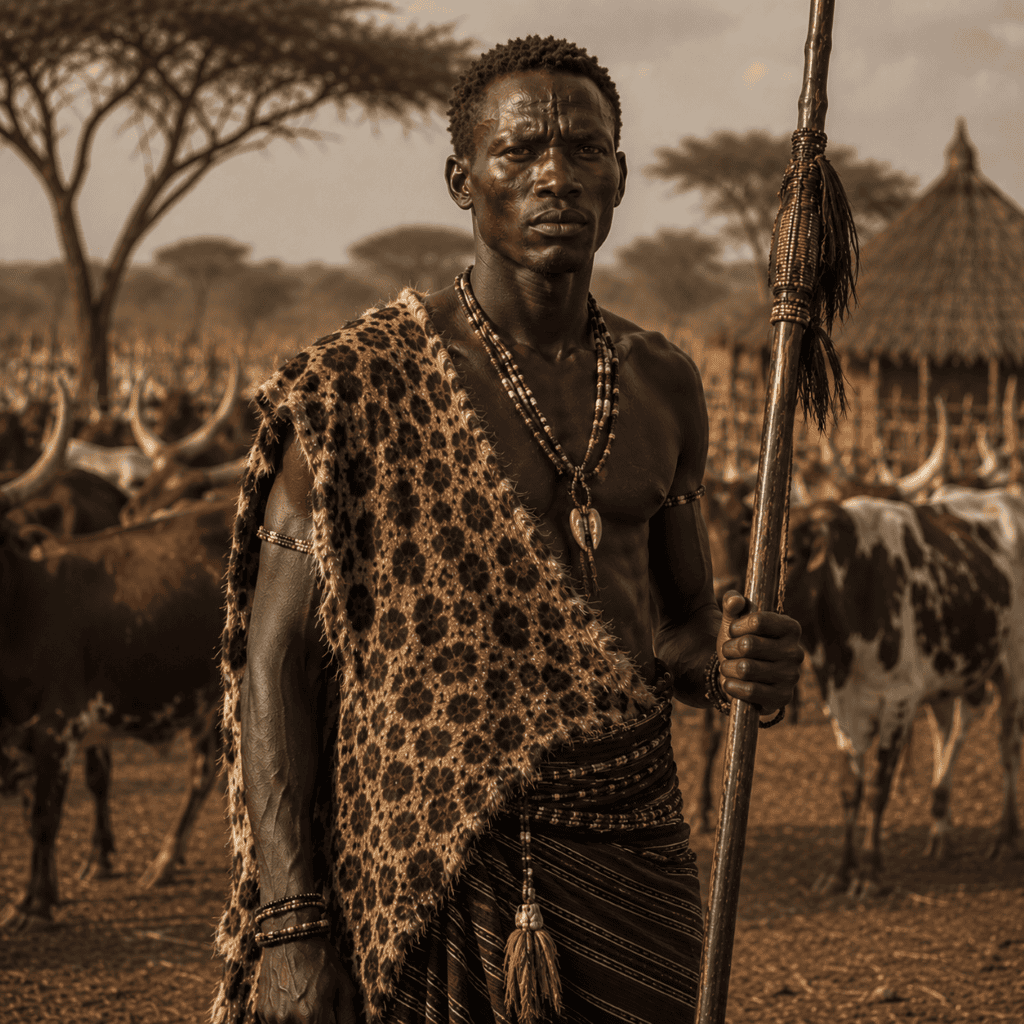
However, tradition closely associates Gaa with the symbols of Nuer leadership. The most recognizable of these is the leopard skin, which represents the office of the Leopard Skin Chief. The leopard skin served as a sacred emblem of mediation rather than political power, distinguishing its wearer as someone entrusted with maintaining harmony between families and clans.
As a respected elder of the Naath—the name the Nuer use for themselves—Gaa would have embodied the cultural practices of his people. Traditional scarification, cattle-based wealth, and ceremonial attire would have reflected his position within society. His importance therefore lies not in a mythical physical form but in the authority and respect attached to his office.
Family
Genealogy forms the foundation of Nuer society, making Gaa’s family one of the most important lineages in their oral traditions. He is widely regarded as the eldest son of a founding ancestor whose descendants spread across the Upper Nile region. Through this lineage, Gaa became the ancestor of several prominent Jikany Nuer clans.
Among the best-known branches descending from him are the Gaajak, Gaajiok, and Gaaguang lineages. Over generations, these groups developed into distinct clan segments while maintaining their shared ancestral connection to Gaa. Their migrations played an important role in shaping the settlement patterns of the Nuer across present-day South Sudan and Ethiopia.
Some traditions also connect Gaa’s lineage with that of other respected ancestors such as Kiir, reflecting the way Nuer oral history intertwines genealogy with political alliances and community identity. Rather than emphasizing individual family relationships, these traditions highlight how ancestry creates bonds between entire communities.
Other names
Gaa is primarily known simply by his personal name, but his influence is reflected in the names of the clans that trace their ancestry to him. Terms such as Gaajak, Gaajiok, and Gaaguang literally identify groups that descend from Gaa, preserving his memory within the social structure of the Nuer people.
He is also associated with the title of the Leopard Skin Chief, although this designation refers to his sacred role rather than serving as an alternative name. The title symbolizes ritual authority, mediation, and responsibility for maintaining peace among clans.
Because Nuer traditions are transmitted orally, variations in spelling occasionally appear in English-language sources. Regardless of these differences, the historical and cultural significance attached to Gaa remains consistent across anthropological studies.
Powers and Abilities
The abilities attributed to Gaa are not supernatural in the same way as those of gods found in many mythologies. Instead, his power came from ritual authority, wisdom, and his ability to preserve social order.
According to Nuer tradition, Gaa established the office of the Leopard Skin Chief, a respected mediator who intervened in disputes between families and clans. In cases of homicide or serious conflict, the Leopard Skin Chief performed rituals that helped prevent cycles of revenge and encouraged reconciliation. This role was central to maintaining peace in a society where kinship ties were deeply important.
Gaa was also regarded as a Land Chief, responsible for overseeing rituals connected to the welfare of the community and its territory. His authority linked people, cattle, and the land they depended upon for survival. Rather than ruling through force, he exercised influence through custom, ritual knowledge, and moral leadership.
His enduring power therefore lies in the institutions he established rather than miraculous feats. The social systems attributed to Gaa helped shape Nuer identity for generations and continue to influence traditional leadership today.
Modern Day Influence
The legacy of Gaa remains visible throughout Nuer society. Many communities still identify themselves through clan divisions that trace their ancestry back to him, reinforcing the importance of genealogy in everyday life.
Traditional conflict resolution practices inspired by the Leopard Skin Chief continue to hold cultural significance, even where formal legal systems now exist. Elders who mediate disputes often draw upon customs that have been passed down for generations, reflecting principles associated with Gaa’s leadership.
Christianity has become the dominant religion among many Nuer communities, yet ancestral traditions remain an important part of cultural identity. Rather than replacing these traditions entirely, many families preserve stories about Gaa alongside their Christian beliefs, viewing him as an honored ancestor rather than an object of worship.
Today, the story of Gaa continues to strengthen the identity of Nuer communities across South Sudan, Ethiopia, and the global diaspora. His memory represents continuity, unity, and the enduring importance of kinship in one of Africa’s most distinctive pastoral cultures.
Related Images

Source
Britannica, T. Editors of Encyclopaedia. (2026, June 30). Kwoth. Encyclopedia Britannica. https://www.britannica.com/topic/Kwoth
Durham University. (2020). The Nuer Messianic Jewish movement: Authority and authenticity in Ethiopia’s western frontierlands. Durham e-Theses. .ac.uk/id/eprint/13851/
Evans-Pritchard, E. E. (1940). The Nuer: A description of the modes of livelihood and political institutions of a Nilotic people. Clarendon Press.
Evans-Pritchard, E. E. (1956). Nuer religion. Oxford University Press.
Hutchinson, S. E. (1996). Nuer dilemmas: Coping with money, war, and the state. University of California Press. uer_Dilemmas.html?id=WMFtmRKB6iYC
Johnson, D. H. (1982). Evans-Pritchard, the Nuer, and the Sudan political service. African Affairs, 81(323), 231-246. https://www.africabib.org/rec.php?RID=188856250
Pocock, D. (1974). Nuer religion: A supplementary view. Journal of the Anthropological Society of Oxford, 5(2). https://m.africabib.org/rec.php?RID=P00046637&DB=a
Yale University. (n.d.). Nuer – Summary. eHRAF World Cultures. https://ehrafworldcultures.yale.edu/cultures/fj22/summary
Frequently Asked Questions
Who is Gaa in Nuer mythology?
Gaa is a revered ancestral figure of the Jikany Nuer, remembered as a founding lineage ancestor and the traditional originator of the Leopard Skin Chief institution.
Is Gaa a god or a human ancestor?
Gaa is traditionally regarded as a human ancestral leader rather than a god. The supreme spiritual power in Nuer religion is Kwoth.
What is Gaa famous for?
Gaa is best known for founding major Nuer lineages and establishing traditions of ritual leadership, mediation, and conflict resolution.
What is the Leopard Skin Chief?
The Leopard Skin Chief is a traditional Nuer ritual mediator who helps resolve serious disputes and maintain peace between clans through customary practices.
Why is Gaa important to the Nuer people today?
Gaa remains important because many Nuer clans trace their ancestry to him, and his legacy continues to influence cultural identity, traditional leadership, and community values.
