

Japanese Creation Story : Birth of the Islands and the Rise of the Kami
| Description | |
|---|---|
| Origin | Japanese Mythology |
| Country | Japan |
| Deities Involved | Izanagi, Izanami |
| Symbolism | Spear (creation), marriage ritual (harmony), death (mortality), purification (renewal) |
| Process | Stirring sea, land formed, union birthed, death purified |
Mythlok Perspective
In Mythlok’s Perspective, the Japanese Creation Story stands apart because it treats creation as a ritual act rather than a conquest. Order arises from harmony and correct conduct, not domination. When compared to the Greek succession myths or the Mesopotamian battles against chaos, the Japanese narrative feels more relational and cyclical. Its closest parallel may lie in certain Polynesian sky-earth unions, yet even there the strong emphasis on purification remains uniquely Japanese.
Japanese Creation Story
Introduction
The Japanese Creation Story is one of the most important origin narratives in East Asian tradition. At its heart stands the divine couple Izanagi and Izanami, whose actions explain how the Japanese islands were formed and how the first kami, or sacred beings, entered the world. This story is preserved in two early eighth-century chronicles: the Kojiki and the Nihon Shoki.
More than a tale about geography, the Japanese Creation Story explores themes of cosmic order, ritual correctness, life, death, and purification. It forms the foundation of Shinto belief and establishes the divine ancestry of the Japanese imperial line through the sun goddess Amaterasu. Even today, the narrative continues to shape cultural identity, spiritual practice, and artistic imagination across Japan.
Cosmic Origins
Before land, sky, or sea took recognizable form, existence was described as a shapeless mass drifting like oil upon water. From this undifferentiated chaos, the first heavenly kami emerged spontaneously in the High Plain of Heaven, known as Takamagahara. These early deities were abstract and largely passive, representing the awakening of cosmic order.
As more kami appeared, the universe gradually separated into lighter and heavier elements. The lighter rose to form the heavens, while the heavier settled below as a watery expanse. At this stage, the divine pair Izanagi (“He Who Invites”) and Izanami (“She Who Invites”) were appointed to bring stability to the drifting earth.
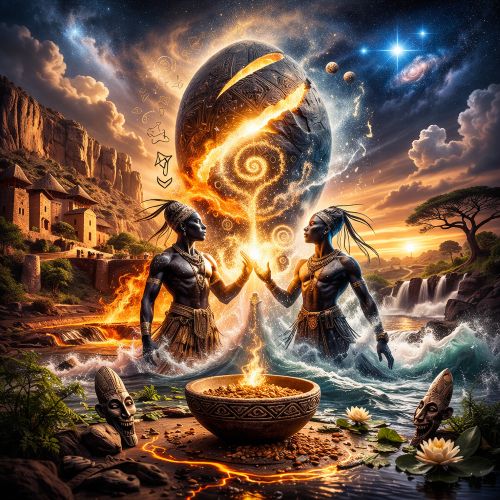
Standing upon the Floating Bridge of Heaven, they were given a sacred weapon, the jeweled spear called Ame-no-nuboko. When they stirred the chaotic ocean below, droplets fell from its tip and solidified into the first island, Onogoro. This moment marks the true beginning of the Japanese Creation Story, where form crystallizes out of fluid uncertainty.
Deities and Forces Involved
At the center of the Japanese Creation Story are Izanagi and Izanami, divine siblings who become husband and wife. They are not omnipotent creators but active participants in shaping reality. Their partnership reflects balance between complementary forces rather than domination by a single deity.
The heavenly kami who commissioned them represent cosmic authority, entrusting the pair with the responsibility of ordering the world. The spear itself symbolizes divine mandate and creative power.
From the union of Izanagi and Izanami came numerous kami embodying natural elements. Among their most important descendants are Amaterasu, the sun goddess; Tsukuyomi, the moon deity; and Susanoo, the storm god. These deities would shape not only the physical cosmos but also the moral and political imagination of Japan.
Process
The creation unfolds in carefully ordered stages. After forming Onogoro Island, Izanagi and Izanami built a pillar and performed a marriage ritual by circling it in opposite directions. During their first attempt, Izanami spoke first when they met. This breach of ritual protocol resulted in the birth of Hiruko, a malformed child who was set adrift.
Realizing their mistake, they repeated the ceremony correctly, with Izanagi speaking first. This time their union succeeded. They gave birth to the eight great islands of Japan, including Awaji, Shikoku, Kyushu, and Honshu. The land itself was thus understood as divine offspring.
Following the birth of the islands, Izanami produced many kami representing mountains, rivers, trees, and wind. However, tragedy struck when she gave birth to Kagutsuchi, the fire deity. The flames fatally burned her, and she descended into Yomi, the land of the dead.
Grief-stricken, Izanagi attempted to retrieve her. When he found her decayed form in the underworld, he fled in horror. After sealing the entrance to Yomi, he performed a purification ritual to cleanse himself of impurity. During this act of washing, new deities were born, including Amaterasu from his left eye, Tsukuyomi from his right eye, and Susanoo from his nose. Thus, the Japanese Creation Story does not end with formation alone. It explains the origin of death and introduces purification as a sacred act that restores balance.
Symbolism
Every element of the Japanese Creation Story carries symbolic weight. The spear represents the act of shaping chaos into structure. The circling of the pillar highlights the importance of harmony and correct ritual conduct. Order is not accidental but maintained through proper action.
Izanami’s death introduces mortality into the world, suggesting that life and destruction are intertwined. Creation is not free from suffering. Instead, renewal emerges from purification, as shown by Izanagi’s cleansing ritual. Water plays a central role throughout the narrative, from the primordial sea to the final act of washing. In Shinto belief, water symbolizes spiritual renewal and the removal of pollution. The myth therefore establishes the religious emphasis on cleanliness and ritual purity that continues in shrine practices today.
Comparative Analysis
The Japanese Creation Story shares themes with other world traditions while remaining culturally distinct. In Greek tradition, Gaia and Uranus produce the world through divine union, echoing the partnership of Izanagi and Izanami. In Mesopotamian myth, Marduk shapes order from chaotic waters, reflecting a similar transition from disorder to structure. Norse cosmology describes land emerging from primordial forces, much like islands forming from stirred seas.
Yet the Japanese narrative differs in tone. There is no violent cosmic battle establishing dominance. Instead, creation unfolds through cooperation, ritual precision, and gradual refinement. The emphasis on purification after contact with death is also uniquely central, reflecting the spiritual framework of Shinto practice.
Legacy
The Japanese Creation Story provided theological grounding for imperial authority by tracing lineage to Amaterasu. It also sacralized the landscape, framing the islands as divine progeny rather than mere territory. Shrines across Japan honor Izanagi, Izanami, and their descendants. Ritual purification, seasonal festivals, and reverence for natural features all echo themes first introduced in this ancient narrative. The myth continues to function as a cultural anchor linking geography, spirituality, and identity.
Modern Influence
Today, the Japanese Creation Story remains embedded in education, literature, and popular media. Anime, manga, and video games frequently reimagine Izanagi and Izanami or reference Yomi and the heavenly spear. The themes of love, loss, and renewal resonate across generations. Environmental awareness movements sometimes draw upon Shinto ideas rooted in this story, emphasizing respect for land and natural forces. The myth is not frozen in the past. It continues to evolve while preserving its essential vision of balance between order and chaos.

Sources
Britannica. (n.d.). Izanagi and Izanami Japanese mythology, creation myth, Kami. In Encyclopaedia Britannica. Retrieved February 26, 2026, from https://www.britannica.com/topic/Izanagi-and-Izanami
Mythopedia. (2025, December 23). Izanagi and Izanami: Creation, Death, and the Birth of the Japanese Gods. Retrieved February 26, 2026, from https://mythopedia.com/topics/izanagi-and-izanami
Itou, M. (2024, November 4). The Story of Creation: Izanagi and Izanami’s Influence. Japanese Mythology Journal. Retrieved February 26, 2026, from https://japanesemythologyjournal.com/izanagi-izanami
Aston, W. G. (Trans.). (1972). Nihongi: Chronicles of Japan from the earliest times to A.D. 697. Tuttle Publishing.
Ono, S., & Woodard, W. P. (Trans.). (1962). Shinto: The kami way. Tuttle Publishing.
Herbert, J. (2010). Shinto: At the fountain-head of Japan (2nd ed.). Routledge.
Ellwood, R. S. (1993). Japan’s first monotheist: A new chapter in the study of Izanagi and Izanami. Japanese Journal of Religious Studies, 20(2-3), 235-249. https://doi.org/10.18874/jjrs.20.2-3.1993.235-249
Frequently Asked Questions
What is the Japanese Creation Story about?
The Japanese Creation Story explains how the gods Izanagi and Izanami formed the Japanese islands and gave birth to many kami, including the sun goddess Amaterasu.
Where is the Japanese Creation Story recorded?
It is preserved in two early chronicles, the Kojiki (712 CE) and the Nihon Shoki (720 CE).
Who are Izanagi and Izanami?
They are the divine couple tasked with creating Japan and populating it with deities representing natural forces.
Why did Izanami go to Yomi?
She died after giving birth to the fire deity Kagutsuchi and descended to Yomi, the land of the dead.
Why is purification important in the Japanese Creation Story?
Izanagi’s purification after escaping Yomi led to the birth of major deities and established ritual cleansing as a core principle in Shinto belief.