


Boon of Ifá Divination : How Orunmila Bestowed Wisdom
At a glance
| Description | |
|---|---|
| Mythology | Yoruba Mythology |
| Bestowed Upon | Babalawos & Iyanifas |
| Granted By | Orunmila |
| Primary Effect | Ability to interpret destiny through Ifá |
| Conditions Attached | Requires initiation, ritual purity, and devotion |
Mythlok Perspective
In Mythlok’s View, Ifá Divination represents wisdom as a living system rather than a fixed doctrine. It frames destiny as something negotiated through knowledge and character, not blindly followed. This makes it less about prophecy and more about alignment. Comparable ideas appear in other cultures. The Greek concept of the Moirai defines fate, yet lacks the corrective agency seen in Ifá. Similarly, Chinese I Ching divination uses patterns to interpret change, echoing Ifá’s structured logic. What sets Ifá apart is its fusion of ethics, memory, and mathematics into a single spiritual framework.
Boon of Ifá Divination
Introduction
In the spiritual tradition of the Yoruba people, Ifá Divination stands as one of the most sophisticated systems of sacred knowledge in the world. It is not simply a method of predicting the future, but a deeply philosophical framework that connects human life with cosmic order. At the center of this system is Orunmila, the divine custodian of wisdom and the witness of destiny. Through Ifá, humanity gained access to guidance that helps interpret fate, resolve conflict, and live in alignment with spiritual laws.
This system has endured for centuries because it blends ritual, memory, mathematics, and poetry into a living tradition. Even today, Ifá remains central to Yoruba spirituality and continues to influence cultures far beyond West Africa.
Mythological Background
In Yoruba cosmology, the universe is governed by Olódùmarè, the source of all existence. Beneath this supreme force operate the orishas, divine beings who guide different aspects of reality. Among them, Orunmila occupies a unique position as the embodiment of wisdom and the “Ẹlẹ́rìí ìpín,” meaning the witness to destiny.
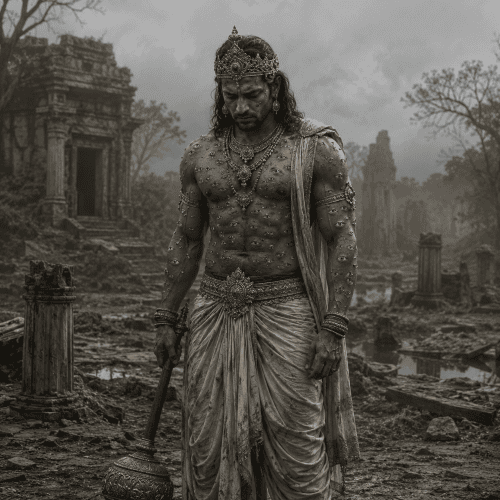
Mythic traditions describe Orunmila as present at the moment of creation, advising Obatala during the formation of the earth. Unlike other orishas, he possessed complete knowledge of past, present, and future, making him the ultimate interpreter of existence. He was believed to move freely between the spiritual realm (Ọ̀run) and the human world (Ayé), acting as a bridge between divine intention and human experience.
From this role emerged Ifá Divination, a system built on a vast corpus of knowledge known as the Odù Ifá. These 256 patterns encode thousands of verses that preserve Yoruba philosophy, ethics, history, and spiritual law. Rather than relying on intuition alone, Ifá is structured, systematic, and rooted in symbolic logic, making it one of the most intellectually rich traditions of divination in human history.
Granting of the Boon/Blessing
The origin of Ifá Divination is often explained through symbolic myths that emphasize wisdom as a divine gift. One widely known narrative describes how Olódùmarè granted Orunmila sacred knowledge in the form of sixteen vessels of wisdom. Through a transformative process, Orunmila absorbed this knowledge completely, gaining the ability to understand the hidden structure of reality.
Recognizing that humanity would struggle without guidance, Orunmila chose to share this wisdom before withdrawing from constant presence on earth. He entrusted the system of Ifá to trained practitioners, ensuring that divine knowledge would remain accessible.
Another important tradition recounts the creation of divination tools such as the ikin (sacred palm nuts) and the opele chain. These tools allow priests to generate patterns that correspond to specific Odù, making it possible to interpret messages from the spiritual realm. Together, these stories emphasize that Ifá was not an accidental discovery, but a deliberate and compassionate gift designed to guide humanity across generations.
Nature of the Boon/Blessing
At its core, Ifá Divination is a complete knowledge system rather than a simple oracle. It combines ritual practice with an extensive oral archive of verses that address nearly every aspect of life. Each consultation involves generating a specific Odù pattern, followed by the recitation and interpretation of relevant verses.
These verses contain layered meanings. They include moral teachings, historical references, spiritual prescriptions, and practical advice. In many cases, they also recommend ebo, or ritual offerings, to restore balance and align an individual with their destiny, known as ori.
What makes Ifá unique is its structured nature. The 256 Odù function almost like a coded system, where each pattern opens access to a vast body of knowledge. This blend of symbolic mathematics and oral literature reflects a sophisticated intellectual tradition that has been preserved entirely through memory and transmission.
Recipients and Key Figures
Although Ifá Divination is considered a gift to all humanity, its practice is entrusted to trained specialists. These include the babaláwo, meaning “father of secrets,” and the iyanifá, female priests who also serve as custodians of the tradition. Their role is not only to interpret the oracle but also to preserve the vast corpus of knowledge through rigorous training.
Orunmila remains the central divine figure in every consultation, invoked as the source of wisdom. Alongside him, Èṣù plays a crucial role as the divine messenger who ensures that communication between humans and the spiritual realm flows correctly. Without Èṣù, the messages of Ifá cannot reach their intended destination.
Communities themselves are also recipients of this boon. From personal decisions to collective concerns, Ifá serves as a guiding force that shapes social and spiritual life.
Effects and Consequences
The influence of Ifá Divination extends far beyond spiritual consultation. On an individual level, it provides clarity in moments of uncertainty, helping people make decisions about health, relationships, and livelihood. By identifying potential challenges and prescribing solutions, Ifá is believed to help prevent misfortune and encourage prosperity.
On a societal level, Ifá has historically shaped ethics, governance, and conflict resolution within Yoruba communities. Its teachings emphasize character, responsibility, and harmony, reinforcing a moral framework that supports collective well-being.
However, the system also carries responsibility. Misinterpretation or misuse of Ifá can lead to imbalance, as the tradition requires discipline, training, and respect for its sacred nature. Despite challenges such as colonial suppression and modernization, Ifá continues to survive, particularly in diaspora communities where it became a symbol of cultural resilience.
Symbolism and Spiritual Meaning
The symbols of Ifá Divination reflect its deeper philosophical meaning. The divination tray, known as the opon Ifá, represents the universe itself, with its surface serving as a map of cosmic interaction. The sacred palm nuts symbolize seeds of knowledge, emphasizing growth, fertility, and continuity.
At a spiritual level, Ifá teaches that destiny is not fixed but guided. It highlights the relationship between ori (inner destiny) and iwa (character), suggesting that a person’s choices shape how destiny unfolds. This idea places responsibility on the individual while still acknowledging divine influence.
The presence of Èṣù within the system also reinforces the idea of balance. As a mediator between order and chaos, he ensures that transformation remains possible, reminding practitioners that life is dynamic rather than predetermined.
Cultural Impact and Legacy
The legacy of Ifá Divination extends across continents. Originating in the Yoruba regions of present-day Nigeria, Benin, and Togo, it spread through the African diaspora into the Americas and the Caribbean. Today, it continues to influence traditions such as Santería and Candomblé, where its principles remain central.
In 2008, Ifá was recognized by UNESCO as an Intangible Cultural Heritage of Humanity. This acknowledgment highlights its importance not just as a religious system, but as a global intellectual and cultural treasure. Despite modern pressures, Ifá continues to adapt. It remains a source of identity, philosophy, and spiritual grounding, proving that ancient systems of knowledge can remain relevant in contemporary life.


Source
Abimbola, W. (1977). Ifá divination poetry. Nok Publishers.
Bascom, W. (1969). Ifa divination: Communication between gods and men in West Africa. Indiana University Press.
Idowu, E. B. (1962). Olódùmarè: God in Yoruba belief. Longmans.
Irving, J. (2023). Ifá: A complete divination. Ile IFA.
Olupona, J. K., & Nyang, S. S. (Eds.). (1991). Religious plurality in Africa: Essays in honour of John S. Mbiti. Mouton de Gruyter.
UNESCO. (2008). Ifa divination system. https://ich.unesco.org/en/RL/ifa-divination-system-00146
Wikipedia. (2024). Ifá. https://en.wikipedia.org/wiki/If%C3%A1
Wikipedia. (2024). Ọrunmila. https://en.wikipedia.org/wiki/%E1%BB%8Crunmila
Abimbola, W. (1976). Ifá: An Exposition of Ifá Literary Corpus. Oxford University Press.
Frequently Asked Questions
What is Ifá Divination?
Ifá Divination is a Yoruba spiritual system using sacred patterns and verses to reveal destiny, guide decisions, and restore balance in life.
Who is Orunmila in Ifá Divination?
Orunmila is the orisha of wisdom and destiny, believed to be the divine source and custodian of the Ifá system.
How does Ifá Divination work?
Priests cast palm nuts or chains to produce Odù patterns, then interpret verses that provide guidance and spiritual solutions.
What are the 256 Odù in Ifá?
The 256 Odù are symbolic patterns forming the core of Ifá, each containing verses on morality, fate, and human experience.
Is Ifá Divination still practiced today?
Yes, Ifá is widely practiced in West Africa and the diaspora, influencing traditions like Santería and Candomblé.


