

Baubas : The Lithuanian Spirit of Fear and Discipline
At a glance
| Description | |
|---|---|
| Origin | Baltic Mythology |
| Classification | Spitits |
| Family Members | N/A |
| Region | Lithuania |
| Associated With | Fear, Discipline, Darkness |
The Mythlok Perspective
From the Mythlok perspective, Baubas represents fear as a tool of social order rather than chaos. Unlike grand demons that threaten worlds, Baubas polices behavior within the smallest human unit, the household. This places it closer to psychological archetypes than theological figures. Comparable beings appear across cultures, from the Slavic Baba Yaga in her disciplinary role to the Western boogeyman and Japan’s Namahage, all enforcing norms through fear rather than moral instruction. Baubas stands out for its intimacy, showing how Baltic tradition framed fear not as an external invasion, but as something already living in the shadows of everyday life.
Baubas
Introduction
In Lithuanian folklore, Baubas occupies a familiar yet unsettling space within the home. Neither a god nor a grand demon of cosmic consequence, it belongs to the intimate world of household fears. It represents the Baltic answer to the boogeyman archetype, a shadowy presence believed to linger in dark corners, under beds, and in places children are warned not to explore. Lithuanian storytelling has long used Baubas as a moral enforcer, a supernatural reminder that misbehavior invites consequences.
Unlike deities such as Perkūnas, who rule storms and skies, Baubas operates on a smaller but psychologically potent scale. Its influence is domestic, personal, and immediate. This reflects a broader pattern in Baltic folklore where fear is not always cosmic but close at hand. Baubas does not explain the universe; it explains why children should listen to their elders, stay close to the hearth, and respect the unseen forces believed to inhabit everyday life.
The late Christianization of Lithuania ensured that many pre-Christian beliefs survived as folk spirits rather than structured theology. As a result, Baubas endured not as a demonized god but as a cautionary figure, reshaped by oral tradition and domestic storytelling. Its power lies not in worship, but in memory and imagination.
Physical Traits
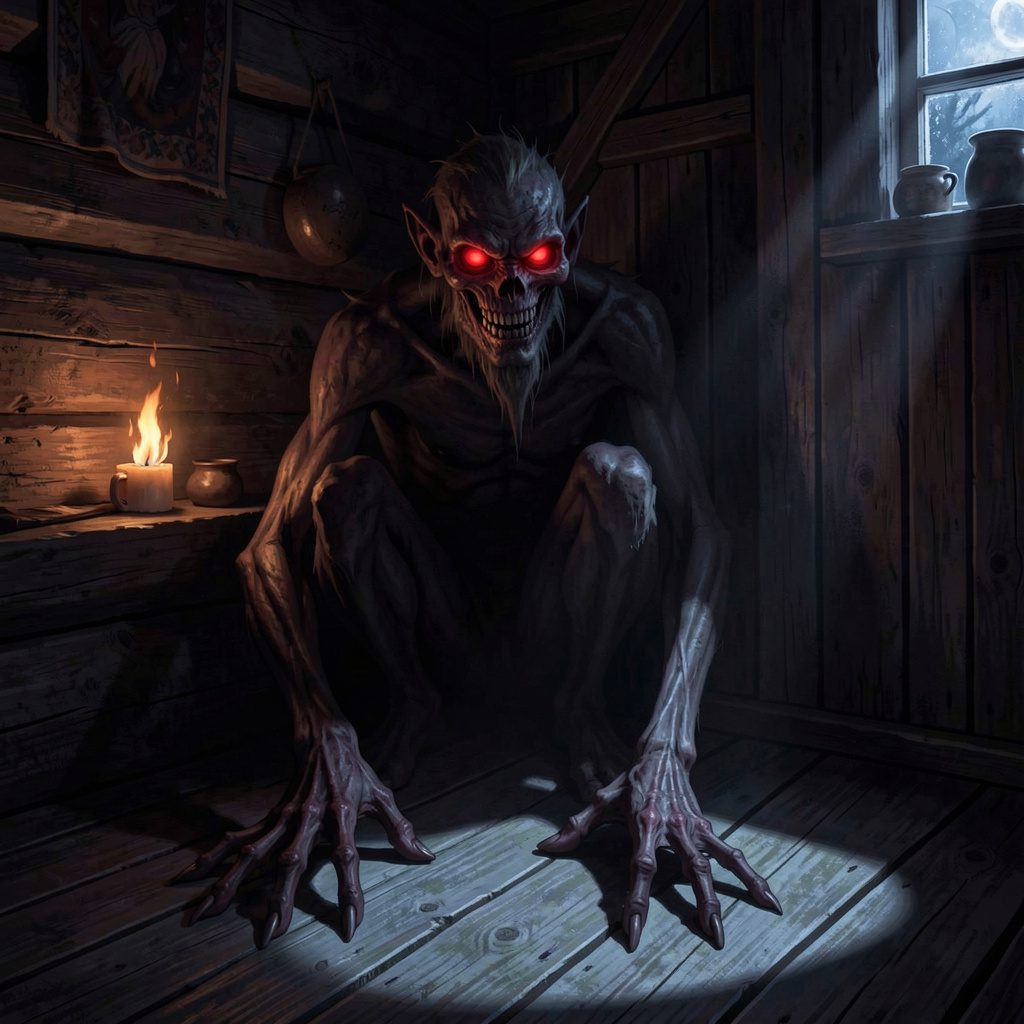
Descriptions of Baubas are consistent in mood rather than detail. Folklore commonly presents it as a humanoid figure with an unnerving face and glowing red eyes, features designed to be glimpsed rather than clearly seen. Its body is usually described as dark or black, allowing it to blend seamlessly into shadows. Long, thin arms ending in bony, wrinkled fingers are a recurring motif, emphasizing its ability to reach out from hiding places.
Baubas is not a creature of open spaces. It thrives in enclosed darkness, beneath carpets, behind doors, and within cupboards. This association with hidden domestic spaces reinforces its role as a nighttime terror rather than a roaming monster. The lack of a fixed or elaborate form allows Baubas to remain adaptable, changing shape in the imagination of each listener. What matters is not how it looks, but where it waits.
Family
Lithuanian folklore does not assign Baubas a family lineage in the way gods or heroic figures possess parents, siblings, or offspring. It exists independently, without genealogy or mythic ancestry. This absence is significant. It is not part of a divine order but a solitary presence shaped by fear and function.
While some scholars loosely associate Baubas with other chthonic or devil-like figures following Christian influence, such connections are symbolic rather than genealogical. it remains a standalone household spirit, defined by its behavior rather than its bloodline. In this sense, it reflects a category of beings that exist because they are needed, not because they were born.
Other names
The name “Baubas” appears consistently across Lithuanian folklore, with “baubai” used as its plural form. Unlike many mythological beings, it does not possess an extensive list of alternate identities. However, related fear figures such as Bubas, Bubė, Babaužis, and Maumas appear in parallel traditions. These names often describe similar functions rather than the same being.
Maumas, for instance, is said to dwell in wells or waterbeds, while Baubas remains tied to dark household spaces. The linguistic overlap reflects a shared cultural vocabulary of fear, but Baubas maintains a distinct identity within that spectrum.
Powers and Abilities
Baubas’ abilities are psychological rather than physical. Its defining power is fear, particularly fear directed at children. Folklore credits it with hiding silently and emerging when least expected, pulling hair, pressing on the chest, or creating a suffocating sense of presence. These actions mirror common childhood night terrors and sleep paralysis experiences, suggesting that Baubas personifies unexplained fear rather than causing literal harm.
Light and laughter are believed to weaken or repel Baubas. This vulnerability reinforces its symbolic role as a creature sustained by darkness, silence, and anxiety. In some rural traditions, Baubas was also associated with agricultural spaces, especially the last sheaf of rye, linking it faintly to field spirits and seasonal boundaries. Even so, its primary domain remains the household, where fear serves as discipline rather than destruction.
Modern Day Influence
Baubas continues to exist in modern Lithuania as a cultural reference rather than a literal belief. Parents still invoke the name jokingly or nostalgically, and folklorists discuss Baubas as an example of Baltic domestic spirits. While it has not become a mainstream horror icon, Baubas appears in folklore compilations, educational content, and occasional digital adaptations inspired by Baltic mythology.
Its endurance lies in its simplicity. Baubas does not require temples, rituals, or festivals. It survives through language, memory, and the universal childhood fear of the dark. In this way, Baubas remains quietly relevant, a reminder that mythology often begins at home.
Related Images
Source
Balsys, R. (2015). Encyclopedia of Baltic mythology in Czech. https://gs.elaba.lt/object/elaba:15154198/15154198.pdf
Bestiary.us. (2017). Baubas. https://www.bestiary.us/baubas/en
List of Lithuanian gods and mythological figures. (2006). Wikipedia. https://en.wikipedia.org/wiki/List_of_Lithuanian_gods_and_mythological_figures
Lithuanian mythology. (2004). Wikipedia. https://en.wikipedia.org/wiki/Lithuanian_mythology
Myth of the Day: Baubas. (2025). Mythology: Gods and Monsters. https://godsandmonstersinfo.substack.com/p/myth-of-the-day-baubas
Stronghold Nation. (2012). Baubas | Legends from around the world. https://www.stronghold-nation.com/history/myth/baubas
Truelithuania. (2022). Lithuanian mythology and folklore. https://www.truelithuania.com/lithuanian-mythology-and-folklore-3474
Veckenstedt, E. (1883). Die Mythen, Sagen und Legenden der Zamaiten (Litauer).
Frequently Asked Questions
Who is Baubas in Lithuanian folklore?
Baubas is a fear-inducing household spirit from Lithuanian folklore, commonly used as a boogeyman figure to discipline children. Rather than being part of a divine pantheon, Baubas belongs to everyday domestic storytelling.
Is Baubas a god or a demon?
Baubas is neither a god nor a formal demon. It is best understood as a folkloric spirit, operating outside organized theology or mythology. Unlike deities who control natural forces or demons with cosmic agendas, Baubas functions on a personal, domestic level.
Where does Baubas live?
Folklore consistently places Baubas within the home, especially in dark, enclosed spaces that naturally provoke fear. These include areas such as under beds, inside closets, behind doors, beneath carpets, or in shadowed corners of rooms.
What powers does Baubas have?
Baubas’ primary ability is psychological intimidation. It is said to frighten by suddenly appearing, pulling hair, pressing on the chest, or creating a suffocating sense of presence, especially at night. These actions mirror common childhood fears and night terrors.
Is Baubas still believed in today?
Baubas is no longer widely believed in as a literal supernatural being, but it remains culturally relevant. The name still appears in Lithuanian language, parenting humor, folklore studies, and educational contexts as a symbol of childhood fear.
