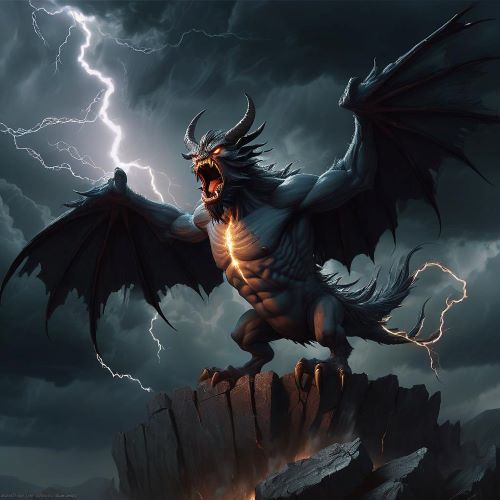


Alkonost : The Mythical Bird Woman of Joy and Song
At a glance
| Description | |
|---|---|
| Origin | Slavic Mythology |
| Classification | Hybrids |
| Family Members | N/A |
| Region | Russia |
| Associated With | Joy, Paradise, Music |
The Mythlok Perspective
In Mythlok’s Perspective, the Alkonost represents the human longing for emotional transcendence rather than divine power. It is not a conqueror or creator but a presence that dissolves suffering through beauty and sound. This makes it closer in spirit to figures like the Greek Sirens, though less destructive, and the Japanese Tennin, who embody celestial grace. Across cultures, such beings reveal a shared idea that true power can lie in harmony, not dominance.
Alkonost
Introduction
The Alkonost is one of the most captivating beings in Slavic folklore, often described as a bird of paradise whose presence bridges the human world and a higher, celestial realm. Rooted in medieval East Slavic traditions, this mythic creature is closely associated with the legendary island of Buyan, a shifting paradise that appears and disappears with the tides. Early depictions of the Alkonost can be traced to 13th-century cathedral carvings and decorative objects from Kievan Rus, where it symbolized divine harmony and the mystery of the heavens.
The name “Alkonost” is widely believed to derive from the Greek figure Alcyone, hinting at cultural exchange between Byzantine and Slavic worlds. Over time, the Alkonost evolved into a distinctly Slavic symbol of joy, serenity, and spiritual escape. Unlike darker mythic birds that lure mortals toward danger, the Alkonost embodies bliss and emotional transcendence. Its legend reflects a longing for peace, often positioning it as a messenger of paradise and a reminder of a world untouched by suffering.
Physical Traits
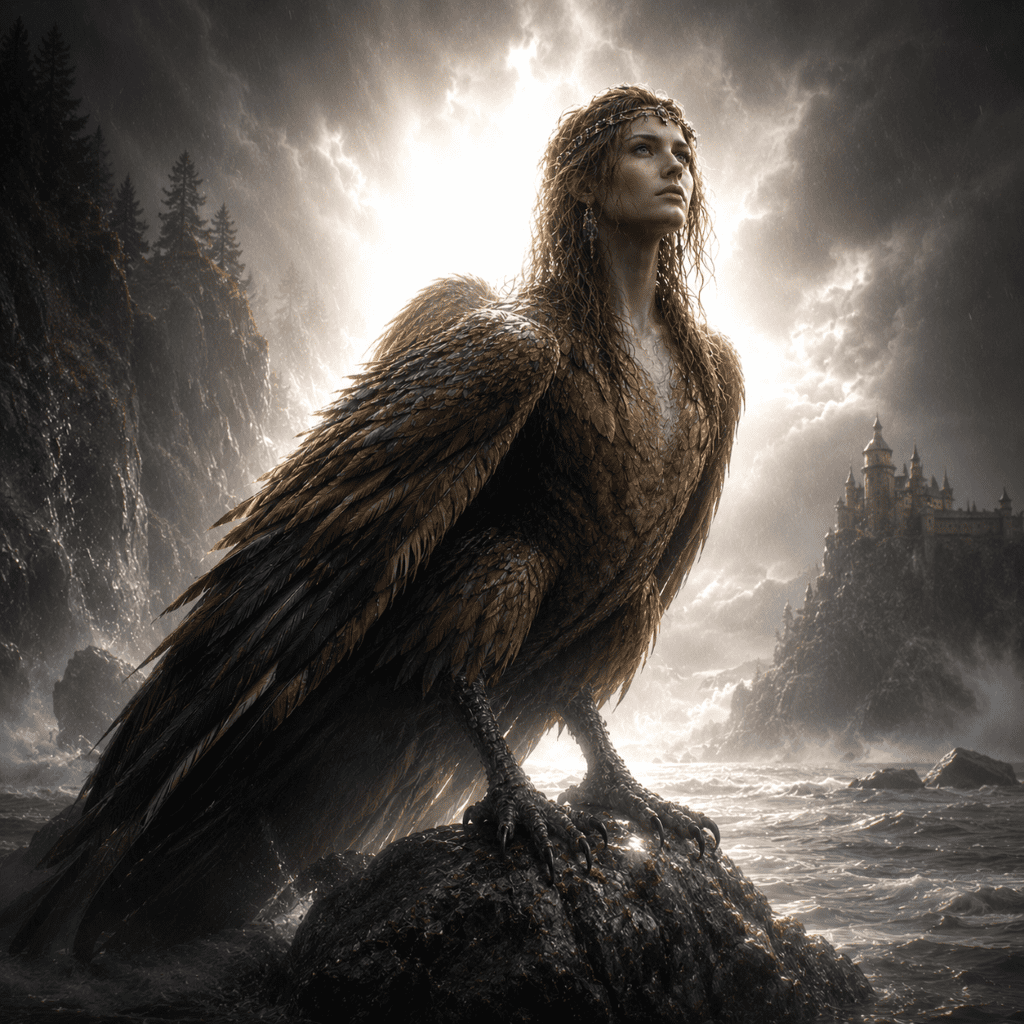
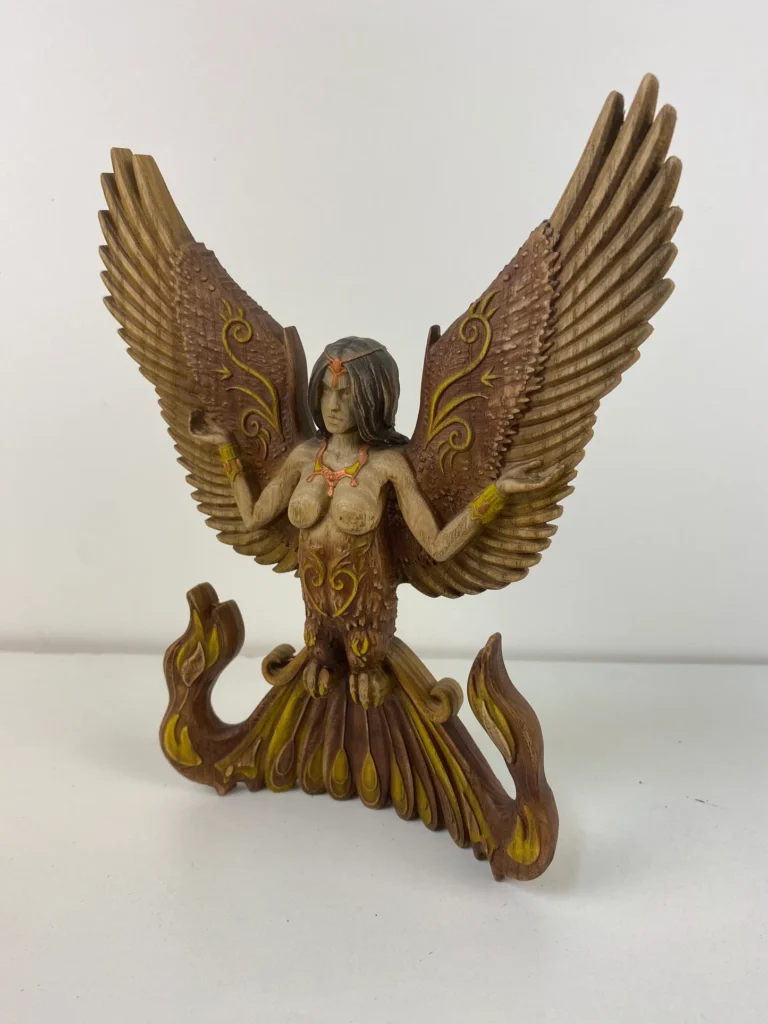
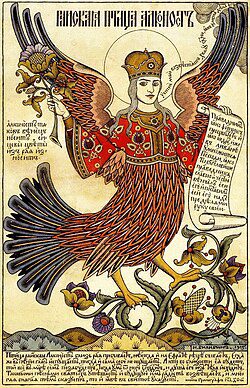
The Alkonost is traditionally depicted as a hybrid creature, combining the body of a bird with the head and upper form of a woman. Its avian body is often imagined with vibrant, radiant feathers that suggest a connection to paradise, while its human features are delicate and serene. Long flowing hair, luminous skin, and expressive eyes give the Alkonost an almost hypnotic beauty that matches its enchanting voice.
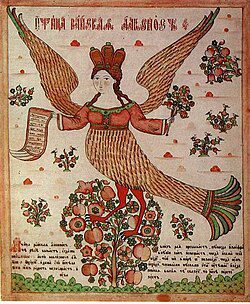
In many artistic representations, especially Russian lubok prints from the 18th and 19th centuries, the Alkonost appears calm and composed, often surrounded by natural or heavenly imagery. Its wings are broad and powerful, allowing it to move effortlessly between earthly and divine spaces. The fusion of human and bird elements is not grotesque but harmonious, reinforcing its role as a being that exists between worlds rather than belonging entirely to one.
Family
Within Slavic mythic tradition, the Alkonost is often grouped with other legendary bird-women, most notably the Sirin and the Gamayun. These three figures form a symbolic triad, each representing different emotional and spiritual states. While the Alkonost embodies joy and peace, the Sirin is associated with sorrow and temptation, and the Gamayun serves as a prophetic voice, revealing truths about fate and the future.
Unlike many mythological beings, the Alkonost does not have a clearly defined lineage or genealogy. It is not described as the child of specific gods or spirits. Instead, it exists as part of a broader category of paradise birds, often linked to the mythical island of Buyan and, in later Christianized interpretations, to Eden. This lack of fixed ancestry adds to its mystique, allowing it to function more as a symbol than as a character bound by narrative constraints.
Other names
The name Alkonost remains consistent across most Slavic sources, with very few variations. Its strongest linguistic connection is to the Greek word “alkyon,” referring to the kingfisher bird and tied to the myth of Alcyone. This connection also explains the association with calm seas and tranquil weather, themes that appear in both Greek and Slavic traditions.
In broader cultural contexts, the Alkonost is sometimes described as a “bird of paradise” or a “bird of joy,” emphasizing its symbolic role rather than offering alternative names. Unlike many mythological figures that evolve through multiple regional identities, the Alkonost retains a stable identity, making it easier to trace across historical texts and artistic traditions.
Powers and Abilities
The defining feature of the Alkonost is its voice. Its song is said to be so beautiful that anyone who hears it becomes completely entranced. Unlike the fatal allure of Greek sirens, the Alkonost’s melody does not lead to death but to a state of blissful forgetfulness. Listeners lose awareness of pain, worry, and even time itself, drawn into a moment of pure emotional peace.
Another unique ability attributed to the Alkonost involves its connection to nature, particularly the sea. According to folklore, it lays its eggs on the shore. When these eggs are placed in the water, they bring about seven days of perfect calm, after which storms follow once they hatch. This cyclical control over weather reflects a deeper symbolic link between the Alkonost and the balance of natural forces.
In some interpretations, the Alkonost also acts as a messenger between worlds, carrying divine truths through its song. Its presence can signify moments of revelation, emotional clarity, or spiritual awakening. Rather than wielding power through force, it influences through beauty, sound, and atmosphere.
Modern Day Influence
The Alkonost continues to inspire modern art, literature, and music, maintaining its place as one of the most recognizable figures in Slavic folklore. The famous painting Sirin and Alkonost by Viktor Vasnetsov played a major role in shaping contemporary visual interpretations, contrasting the joy of the Alkonost with the melancholy of the Sirin.
In music, the creature has inspired the Alkonost, which blends traditional Slavic themes with modern metal sounds. The figure also appears in fantasy games, digital illustrations, and novels, often reimagined as a mystical guide or enchanting being.
Museums such as the Philadelphia Museum of Art preserve artworks featuring the Alkonost, ensuring that its legacy continues to be studied and appreciated. In modern storytelling, it often represents escapism, emotional healing, and the timeless human desire to connect with something beyond the ordinary world.
Related Images




Source
Afanas’ev, A. N. (1973). Russian fairy tales. Pantheon Books.
Ancient Pages. (2020). Alkonost – mythical bird of paradise in Slavic and Russian folklore. https://www.ancientpages.com/2020/07/06/alkonost-mythical-bird-of-paradise-in-slavic-and-russian-folklore/
Ivanits, L. J. (1989). Russian folk belief. M.E. Sharpe.
Mythical Encyclopedia. (2023). Alkonost. https://mythicalencyclopedia.com/alkonost/
Propp, V. Ya. (2009). Morphology of the folktale (2nd ed.). University of Texas Press.
Sutherland, A. (2020). Alkonost and Sirin. Ark Horton. https://arkhorton.com/2020/07/07/alkonost-and-sirin/
Warner, E. (2002). Russian myths. University of Texas Press.
Frequently Asked Questions
What is the Alkonost in Slavic folklore?
The Alkonost is a mythical bird-woman symbolizing joy and paradise, known for its enchanting song that brings peace and forgetfulness.
Is the Alkonost dangerous to humans?
No, unlike darker mythic birds, it brings bliss and calm rather than harm, though its song can make listeners lose awareness.
Where does the Alkonost live?
It is believed to dwell on the mythical island of Buyan, a shifting paradise in Slavic tradition.
What powers does the Alkonost have?
It can enchant with its voice and influence weather by laying eggs that calm seas before storms.
How is the Alkonost different from the Sirin?
The Alkonost represents joy and peace, while the Sirin is linked to sorrow and temptation.