Dharmakshetra : The Mahabharata as a Courtroom Drama
| Description | |
|---|---|
| Origin | Indian Mythology |
| Language | Hindi |
| Type | Reimagination |
| Seasons | 1 (2014–2015) |
| Cast | Gaurav Ghatnekar, Aarya Dharmchand Kumar, Ankit Arora, Chandan K Anand, Dinesh Mehta |
| OTT Platform / TV Channel | Epic TV |
Dharmakshetra
Introduction
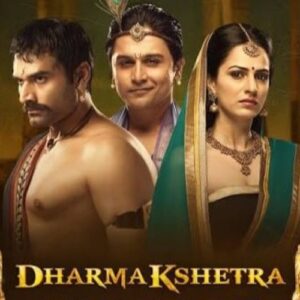
Dharmakshetra is an Indian mythological television series that reimagines one of the most famous stories in Indian tradition from an entirely new perspective. Rather than retelling the events of the Kurukshetra War, the series explores what happens after the battle has ended. Every major figure from the Mahabharata is summoned before Chitragupta, the divine recorder of human deeds, to answer for their actions in a celestial court.
Originally produced for EPIC Channel, the series transforms the epic into a courtroom drama where morality, justice, and personal responsibility take center stage. Instead of presenting the Pandavas as flawless heroes and the Kauravas as irredeemable villains, Dharmakshetra encourages viewers to question every decision that shaped the war. Characters defend their motives, challenge accusations, and revisit pivotal moments that changed the course of history.
This distinctive storytelling approach reflects one of the Mahabharata’s central themes—that dharma is rarely absolute. Right and wrong often depend on circumstance, intention, and duty. By shifting the focus from warfare to ethical judgment, Dharmakshetra offers a thought-provoking interpretation of the epic while remaining rooted in its philosophical foundations.
Plot
The story of Dharmakshetra begins after the eighteen-day Kurukshetra War has concluded. The great conflict is over, but its moral questions remain unresolved. Before the souls of the fallen can proceed to their final destination, they are brought before Chitragupta, who presides over a celestial court to determine whether their actions were truly righteous.
Each episode typically focuses on a single character whose life and choices become the subject of examination. Warriors, kings, queens, teachers, and advisors recount their own versions of familiar events while responding to difficult questions about loyalty, revenge, deception, sacrifice, and duty. Testimonies often challenge accepted versions of the Mahabharata, allowing multiple perspectives to emerge.
The courtroom format gives equal importance to both accusation and defense. Yudhishthira must explain why he gambled away his kingdom and Draupadi. Karna defends his unwavering loyalty to Duryodhana despite knowing the moral cost. Duryodhana argues that history has unfairly branded him as a villain, while Draupadi recounts the humiliation that became one of the war’s defining moments.
Rather than functioning as a conventional legal drama, the courtroom serves as a philosophical space where every verdict invites reflection instead of delivering simple answers. The series ultimately asks whether anyone who participated in such a devastating conflict can be judged solely as righteous or wicked.
Mythological Basis
The foundation of Dharmakshetra is the Mahabharata, one of India’s two great Sanskrit epics and an enduring exploration of morality, leadership, family, and duty. Throughout the epic, characters repeatedly face situations where every available choice carries ethical consequences. The television series expands on this central idea by imagining how these decisions might be evaluated after death.
The title itself has deep scriptural significance. The word Dharmakshetra, meaning “Field of Dharma” or “Field of Righteousness,” appears in the opening verse of the Bhagavad Gita, where Kurukshetra is described as a sacred land. While the battlefield witnessed one of mythology’s greatest wars, it also became the setting for Krishna’s timeless teachings on duty, selflessness, and righteousness.
The series builds its premise around Chitragupta, a respected figure in Hindu tradition. According to later Puranic literature and popular belief, Chitragupta records every human action and assists Yama, the god of death, in determining the consequences of one’s karma. Although traditional scriptures do not describe the Mahabharata heroes undergoing formal courtroom trials before him, the concept naturally extends the Hindu belief that every action is ultimately accountable.
References to karma, dharma, free will, and moral responsibility throughout the series remain consistent with the broader philosophical themes found in the Mahabharata and the Bhagavad Gita. Rather than inventing new mythology, Dharmakshetra uses an original narrative framework to examine ideas that have always existed within the epic.
Characters & Archetypes
One of Dharmakshetra’s greatest strengths is its refusal to reduce its characters to simple heroes and villains. Instead, each represents a timeless human struggle, making the series as relevant today as the ancient epic itself.
Chitragupta serves as the embodiment of impartial justice. As the divine keeper of human deeds, he neither condemns nor praises without hearing every side. His role reflects the idea that true judgment requires complete understanding rather than emotional bias.
Yudhishthira, long regarded as the personification of dharma, faces uncomfortable scrutiny for choices that contributed to immense suffering. His participation in the game of dice demonstrates how even the most virtuous individuals can make disastrous decisions.
Draupadi emerges as one of the series’ most compelling voices. Her testimony highlights questions of dignity, gender, and justice while reminding viewers that the Mahabharata’s greatest conflict began long before armies assembled on the battlefield. She represents resilience in the face of systemic injustice rather than simply serving as a victim.
Arjuna embodies the conflicted warrior. His hesitation before battle, famously explored in the Bhagavad Gita, reflects the universal tension between personal emotion and social duty. The series continues examining these inner conflicts even after the war has ended.
Karna is portrayed as the tragic hero whose unwavering loyalty repeatedly clashes with his moral conscience. His life illustrates themes of identity, exclusion, gratitude, and destiny, making him one of the Mahabharata’s most emotionally complex figures.
Duryodhana receives perhaps the most unconventional treatment. Rather than depicting him as evil without nuance, the series allows him to explain his motivations and grievances. While his actions remain deeply flawed, viewers are encouraged to understand how pride, entitlement, and perceived injustice shaped his worldview.
Supporting figures such as Bhishma, Dronacharya, Krishna, Gandhari, Vidura, and Shakuni further enrich the moral debates. Together, they demonstrate that the Mahabharata is less a story of perfect heroes defeating villains than a study of deeply human individuals struggling to fulfill competing responsibilities.
Creative Liberties
Although Dharmakshetra draws extensively from Indian mythology, it is not a literal adaptation of the Mahabharata. Its most significant creative innovation is the celestial courtroom itself. While Chitragupta is an authentic mythological figure associated with karmic judgment, the formal courtroom proceedings depicted in the series are an original storytelling device rather than an event described in the epic.
This narrative framework allows familiar episodes to be revisited through debate instead of straightforward narration. Characters who rarely confront one another directly in the original text are given opportunities to challenge, question, and defend their actions. The result is a dialogue-driven interpretation that feels contemporary without abandoning its mythological roots.
The series also adopts modern courtroom conventions, including structured arguments, cross-examinations, witness testimonies, and reasoned deliberation. These elements make complex philosophical discussions accessible to modern audiences while preserving the underlying ethical questions of the Mahabharata.
Another notable creative choice is the emphasis on moral ambiguity. Traditional adaptations often celebrate the Pandavas while condemning the Kauravas. Dharmakshetra deliberately avoids such clear divisions, presenting every major figure as capable of both virtue and failure. This balanced approach reflects the Mahabharata itself, where even revered heroes occasionally employ deception and even antagonists possess understandable motivations.
Finally, the series uses contemporary dialogue and pacing to make ancient philosophical ideas easier to engage with. Rather than merely recreating historical events, Dharmakshetra encourages audiences to examine leadership, justice, loyalty, revenge, and personal responsibility through the timeless lens of Indian mythology. Its courtroom setting may be fictional, but the ethical questions it raises remain faithful to the enduring spirit of the Mahabharata.