
Hebat : The Forgotten Hurrian Queen of Heaven
At a glance
| Description | |
|---|---|
| Origin | Hurrian Mythology |
| Classification | Gods |
| Family Members | Teshub (Husband), Sharruma (Son), Allanzu, Kunzišalli (Daughter) |
| Region | Syria |
| Associated With | Queenship, Divine authority, Protection, Prosperity, Motherhood |
The Mythlok Perspective
In Mythlok’s Perspective, Hebat demonstrates that true leadership is not always expressed through conquest or displays of overwhelming power. Unlike storm gods who command attention through force, Hebat’s authority stems from wisdom, stability, and legitimacy. Her role reminds us that civilizations often relied as much on nurturing order and balance as they did on military strength. Among the great mother goddesses of the ancient world, Hebat stands apart because she embodies sovereign rule without losing her compassionate nature, making her one of the most compelling examples of divine queenship in mythology.
Hebat
Introduction
Hebat, also spelled Hepat, Hepatu, or Ḫepat, was the supreme goddess of the Hurrian pantheon and one of the most influential female deities of the ancient Near East. Revered as the Queen of Heaven, she represented divine sovereignty, motherhood, protection, and royal authority. Her worship began in the ancient city of Halab, known today as Aleppo in Syria, before spreading across northern Mesopotamia and Anatolia during the Bronze Age.
As Hurrian culture expanded, Hebat became closely associated with the storm god Teshub, forming the ruling divine couple of Hurrian religion. Together, they symbolized the harmony between celestial power and earthly order. Their prominence continued even after the Hittites absorbed many Hurrian religious traditions, with Hebat becoming identified with the Hittite Sun Goddess of Arinna. Rather than replacing either deity, this religious syncretism strengthened Hebat’s status as one of Anatolia’s most revered goddesses.
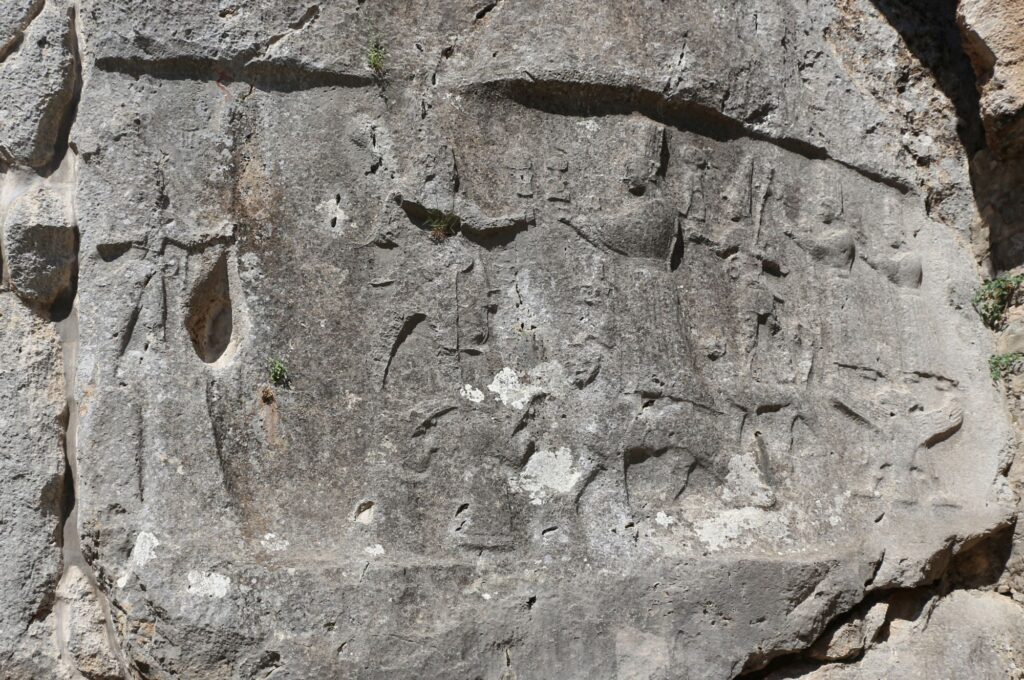
Archaeological discoveries, particularly at Yazılıkaya near the Hittite capital of Hattusa, portray Hebat leading the female deities of the pantheon, reflecting her unmatched authority. Her influence also extended into Luwian traditions and survived into the Hellenistic period under the name Hipta, demonstrating the remarkable longevity of her worship.
Physical Traits
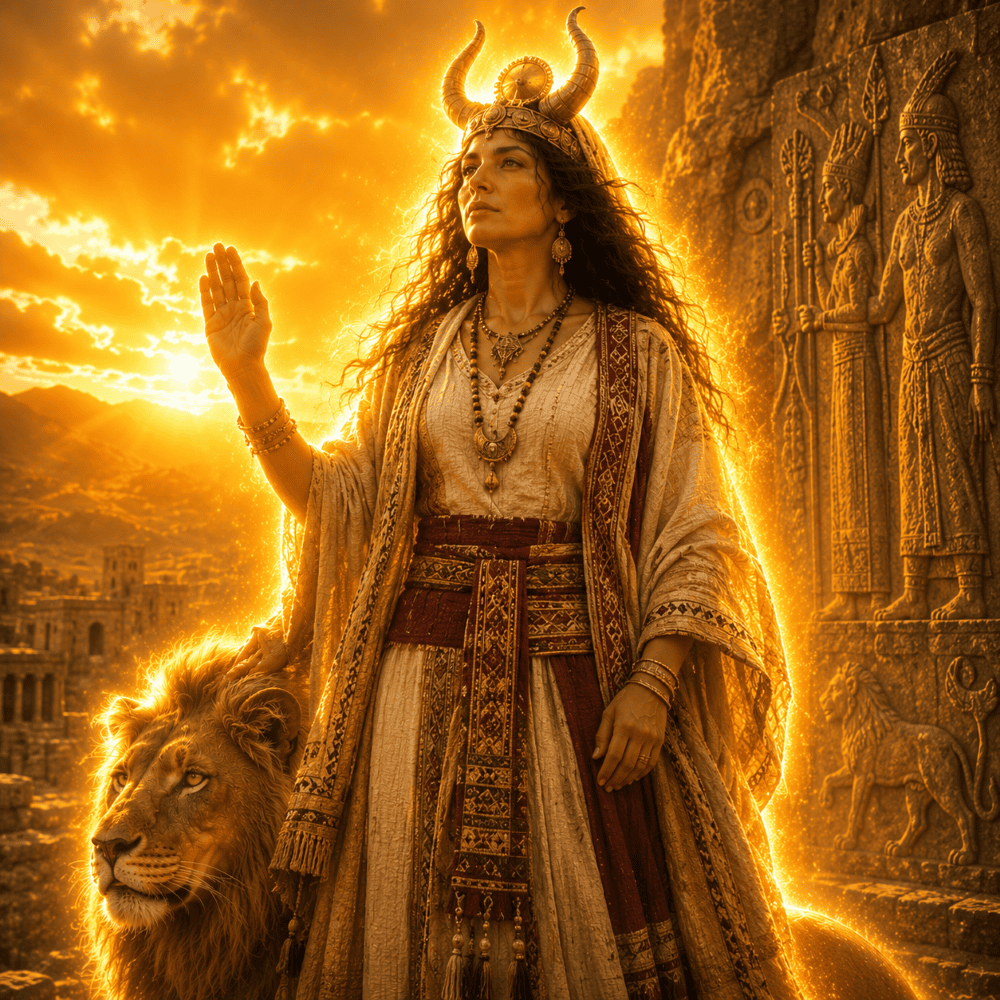
Ancient artistic representations consistently portray Hebat as a regal and mature goddess whose appearance reflects wisdom, dignity, and divine authority rather than youthful beauty. Unlike many later mythological goddesses who embody romantic ideals, Hebat’s imagery emphasizes her role as a queen and protector.
The best-known depictions come from the rock sanctuary of Yazılıkaya, where she appears wearing elaborate ankle-length robes and an ornate horned crown, a common symbol of divinity in the ancient Near East. She stands upon a powerful lion, an animal traditionally associated with royalty, strength, and divine protection. Some earlier interpretations described the animal as a panther, but most modern scholarship identifies it as a lion.
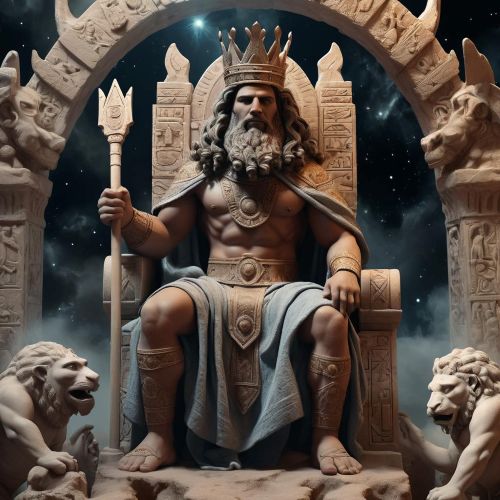
In other artistic representations, Hebat is shown seated upon a magnificent throne, reinforcing her status as the sovereign of the gods. She occasionally raises one hand in a gesture interpreted as blessing or divine acceptance. Her iconography sometimes includes a solar disc framed by horns, reflecting her later association with the Hittite Sun Goddess of Arinna rather than proving she was originally a solar deity. Her calm and composed appearance mirrors her function as a stabilizing force within the Hurrian cosmos, where she governed through wisdom, legitimacy, and sacred authority.
Family
Hebat occupied the highest position among the female deities of Hurrian mythology, and her family formed the royal household of the Hurrian pantheon. Her husband was Teshub, the mighty storm and weather god who ruled the heavens. Together, they represented one of the most important divine partnerships in ancient Near Eastern religion. While Teshub embodied the dynamic forces of storms and kingship, Hebat provided the balance of royal legitimacy, motherhood, and divine order.
Their best-known son was Sharruma, a mountain god frequently depicted as a youthful warrior and protector. In the reliefs at Yazılıkaya, Sharruma often appears standing close to his parents, highlighting his importance within the divine family.
Hebat was also regarded as the mother of Allanzu, a goddess who accompanies her parents in religious processions and ceremonial depictions. Another daughter, Kunzišalli, appears in Hurrian religious texts, though comparatively little is known about her role.
The goddess Takitu served as Hebat’s attendant rather than a family member. She frequently appears in ritual texts and ceremonial processions, acting as the trusted companion of the Queen of Heaven. Together, this divine family represented stability, kingship, fertility, and cosmic harmony, making them central figures in Hurrian and later Hittite religious practice.
Other names
Hebat’s widespread worship across different kingdoms and languages resulted in numerous spellings and titles throughout history. In Hurrian inscriptions, her name commonly appears as Ḫepat, while Ugaritic texts record it as ḪBT. Variants such as Hebat, Hepat, and Hepatu occur in Hittite, Akkadian, and other Anatolian sources.
She was frequently honored with titles including Queen of Heaven and Lady of the Palace, emphasizing her position as the supreme female authority within the divine hierarchy. These titles reflected her royal status rather than identifying a separate deity.
As her worship spread westward, Hebat became associated with the Hittite Sun Goddess of Arinna, one of Anatolia’s most important deities. This religious identification did not erase her Hurrian identity but instead elevated her importance within Hittite state religion. During the Hellenistic period, traces of her cult survived in western Anatolia under the name Hipta, demonstrating how her influence continued long after the decline of the Hurrian civilization.
Powers and Abilities
Hebat’s influence extended far beyond motherhood. She embodied the authority that maintained harmony between heaven, earth, and the divine order. Her foremost power was divine queenship. As the Queen of Heaven, she governed alongside Teshub and served as the highest-ranking goddess within the Hurrian pantheon. Kings and priests viewed her as a source of legitimacy, making her an important figure in royal ceremonies and state rituals.
Hebat was also associated with protection and prosperity. Communities sought her blessings for the wellbeing of families, successful harvests, and social stability. Although she is often described as a mother goddess, surviving texts emphasize her role as a guardian of kingdoms and divine order more than as a fertility goddess alone.
Her later identification with the Sun Goddess of Arinna introduced stronger solar symbolism, linking her with light, justice, and the life-giving power of the heavens. However, historians generally agree that Hebat was not originally a solar deity before this religious syncretism.
Some ancient sources and later interpretations suggest she possessed martial qualities, largely because of her association with powerful state deities and symbols such as lions. Nevertheless, surviving Hurrian texts provide limited evidence that warfare was one of her primary domains, making her warrior aspect secondary to her royal and protective roles.
Modern Day Influence
Although Hebat is less familiar than Greek or Egyptian goddesses, she remains an important figure in the study of ancient Near Eastern religions. Archaeologists continue to examine inscriptions, temple remains, and reliefs to better understand the development of Hurrian culture and its influence on neighboring civilizations.
The reliefs at Yazılıkaya remain among the most significant artistic representations of Bronze Age religion, with Hebat occupying a central position in the sacred procession of gods. These carvings have helped historians reconstruct Hurrian beliefs and the religious traditions later adopted by the Hittites.
Modern scholars frequently reference Hebat when exploring themes such as divine queenship, religious syncretism, and the evolution of female authority in ancient civilizations. Her identification with the Sun Goddess of Arinna also provides valuable insight into how cultures merged their religious traditions while preserving local identities.
Today, Hebat appears in documentaries, academic publications, museum exhibitions, historical novels, podcasts, and educational resources dedicated to ancient mythology. While she has not become a mainstream popular culture icon, her legacy continues to grow through ongoing archaeological discoveries and renewed interest in forgotten civilizations.
Related Images


Source
Britannica. (n.d.). Hebat | Mesopotamian, Mother Goddess, Storm Goddess. https://www.britannica.com/topic/Hebat
Encyclopaedia.com. (n.d.). Hittite and Hurrian religions. https://www.encyclopedia.com/religion/encyclopedias-almanacs-transcripts-and-maps/hittite-and-hurrian-religions
Britannica. (2025, March 24). Kummanni | ancient city, Turkey. https://www.britannica.com/place/Kummanni
Britannica. (2025, February 16). Sharruma | Anatolian deity. https://www.britannica.com/topic/Sharruma
Britannica. (2025, July 27). Alalu | Anatolian god. https://www.britannica.com/topic/Alalu
Britannica. (1998, July 19). Kizzuwadna | Hittite, Iron Age, Anatolia. https://www.britannica.com/place/Kizzuwadna
Ḫebat – Wikipedia. (n.d.). https://de.wikipedia.org/wiki/%E1%B8%AAebat
Haas, V. (1994). Geschichte der hethitischen Religion. Leiden: Brill.
Collins, B. J. (2007). The Hittites and Their World. Atlanta: Society of Biblical Literature.
Wilhelm, G. (1989). The Hurrians. Warminster: Aris & Phillips.
Taracha, P. (2009). Religions of Second Millennium Anatolia. Wiesbaden: Harrassowitz Verlag.
Beckman, G. (1999). Hittite Diplomatic Texts. Atlanta: Scholars Press.
Frequently Asked Questions
Who is Hebat in Hurrian mythology?
Hebat was the chief goddess of the Hurrian pantheon, revered as the Queen of Heaven and the consort of the storm god Teshub.
What was Hebat the goddess of?
Hebat was associated with divine queenship, protection, royal authority, prosperity, and maintaining cosmic order.
Who was Hebat's husband?
Hebat’s husband was Teshub, the Hurrian storm god and one of the most powerful deities in the ancient Near East.
Why is Hebat important in Hittite religion?
The Hittites identified Hebat with the Sun Goddess of Arinna, allowing her to become one of the highest-ranking goddesses in their state religion.
What symbols are associated with Hebat?
Hebat is commonly associated with the lion, horned crown, throne, royal robes, and the title Queen of Heaven, symbolizing sovereignty and divine protection.