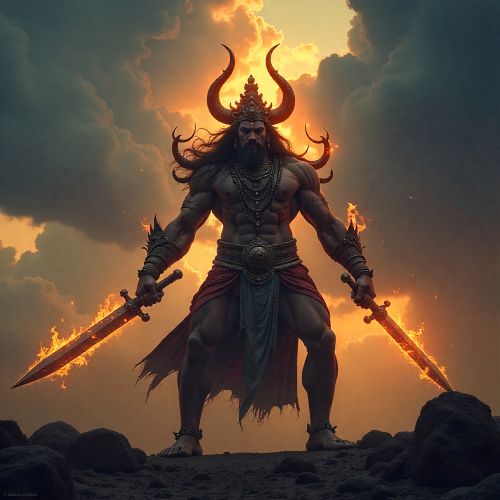


Boon of 5 Extra Days : The Egyptian Myth Behind the 365-Day Year
At a glance
| Description | |
|---|---|
| Mythology | Egyptian Mythology |
| Bestowed Upon | Osiris, Isis, Set, Nephthys, Horus |
| Granted By | Thoth |
| Primary Effect | Creation of five extra days |
| Conditions Attached | Circumventing Ra’s curse forbidding births on regular days |
Mythlok Perspective
In Mythlok’s Perspective, Thoth’s extra days represent one of the clearest examples of wisdom reshaping destiny. Rather than confronting authority directly, Thoth changes the framework in which the problem exists, transforming time itself into a solution. This theme appears in many cultures. The role of Thoth resembles that of Odin, who gains knowledge through sacrifice, and Prometheus, who uses cunning to alter humanity’s fate. Across traditions, wisdom is often portrayed as more powerful than strength. The Egyptian version stands out because the victory is achieved not through rebellion, but through the creation of new possibilities within the cosmic order itself.
Boon of Thoth’s Extra Days
Introduction
Among the many stories associated with the Egyptian god Thoth, few are as influential as the tale of Thoth’s extra days. This myth explains how the Egyptian year expanded from 360 days to 365 days and how some of the most important gods in the Egyptian pantheon came into existence.
Thoth was revered as the god of wisdom, writing, knowledge, measurement, and the moon. He served as the divine scribe who recorded the judgments of the gods and maintained cosmic order. In the story of Thoth’s extra days, he uses intelligence rather than force to overcome a seemingly impossible problem. By creating five days that existed outside the normal calendar, he enabled the sky goddess Nut to give birth to her children despite a divine prohibition.
The myth became one of the most important explanations for the structure of the Egyptian calendar and helped establish Thoth’s reputation as the master of time, calculation, and sacred knowledge.
Mythological Background
The story begins with Nut, the goddess of the sky, and Geb, the god of the earth. Their relationship was central to Egyptian cosmology, representing the union of heaven and earth. When Nut became pregnant, the situation attracted the attention of Ra, the sun god and supreme ruler of the cosmos.
According to Egyptian tradition, Ra feared the consequences of Nut’s future children. To prevent their birth, he declared that Nut would not be allowed to give birth on any day of the year. At that time, the Egyptian calendar consisted of twelve months of thirty days, creating a total of 360 days.
The curse appeared impossible to overcome because every day of the year fell under Ra’s decree. Nut was trapped by a restriction that left her with no legitimate time in which to bear her children. Faced with this dilemma, she turned to Thoth, whose wisdom often solved problems that even the greatest gods could not resolve.
Granting of the Boon/Blessing
Rather than directly challenging Ra, Thoth searched for a loophole. His solution involved the moon god Khonsu, whose light was linked to the measurement of time. In the most familiar version of the myth, Thoth challenged Khonsu to a game of chance. Through his superior intelligence and strategy, he repeatedly won portions of the moon’s light. The amount he accumulated was said to equal one-seventy-second of the moon’s brilliance.
Using the light he had won, Thoth created five entirely new days. These days did not belong to any month and were not counted among the existing 360 days of the year. Because Ra’s curse applied only to the established calendar, the newly created days fell outside its authority. By creating time that did not previously exist, Thoth provided Nut with the opportunity she needed to give birth.
Nature of the Boon/Blessing
The gift provided by Thoth was unlike any ordinary blessing. Instead of granting power, wealth, or protection, he altered the structure of time itself. The five additional days became known as the epagomenal days, a term used for supplementary days added to a calendar. They were placed at the end of the year after the twelfth month and before the beginning of the next annual cycle.
These days occupied a unique position in Egyptian religious thought. They were neither fully part of the old year nor entirely part of the new one. Existing between established cycles, they were viewed as sacred periods filled with extraordinary potential.
Because they stood outside normal time, the epagomenal days became associated with transition, renewal, and the possibility of change. They represented moments when the usual rules of the cosmos could be reshaped by divine wisdom.
Recipients and Key Figures
The immediate beneficiary of Thoth’s intervention was Nut, but the impact of his actions extended far beyond a single goddess. Each of the five extra days became associated with the birth of a major deity. On the first day, Nut gave birth to Osiris, who would become king of the gods and ruler of the afterlife. On the second day, Horus the Elder was born, an ancient sky deity distinct from the later Horus who avenged Osiris.
The third day saw the birth of Set, a powerful god associated with storms, deserts, and disorder. On the fourth day came Isis, one of the most beloved goddesses in Egyptian religion and a symbol of magic, motherhood, and healing. The fifth day marked the birth of Nephthys, a protective goddess closely linked to funerary rites and spiritual guardianship. Alongside these figures stood Thoth himself, whose clever intervention made their existence possible and permanently connected him to the unfolding story of Egyptian mythology.
Effects and Consequences
The consequences of Thoth’s extra days were immense and far-reaching. Most immediately, the births of Osiris, Isis, Set, Nephthys, and Horus the Elder transformed the Egyptian divine landscape. These gods became central participants in many of Egypt’s most famous myths, including the murder and resurrection of Osiris, the magical exploits of Isis, and the conflicts involving Set.
The myth also provided a sacred explanation for the Egyptian 365-day year. While the historical development of the calendar was more complex, the story offered a theological reason for the existence of the five additional days beyond the standard 360-day structure.
Another consequence involved the moon itself. Because Khonsu had lost part of his light to Thoth, some traditions connected the myth to the moon’s changing appearance, explaining why it waxes and wanes rather than remaining constant. The story therefore linked divine genealogy, celestial movements, and the measurement of time into a single narrative.
Symbolism and Spiritual Meaning
The symbolism of Thoth’s extra days extends well beyond the literal creation of five calendar days. At its heart, the story celebrates wisdom as a force capable of overcoming seemingly impossible obstacles. Thoth succeeds not through violence or rebellion but through intelligence, patience, and strategic thinking.
The myth also reflects the concept of “time beyond time.” The five extra days exist outside ordinary cycles, symbolizing moments of transition when new possibilities emerge. In many spiritual traditions, periods that fall between established states are viewed as opportunities for transformation, and the Egyptian epagomenal days embody this idea.
Another important theme is balance. The births enabled by Thoth include both benevolent and disruptive forces. Osiris and Isis represent order, kingship, and protection, while Set embodies conflict and chaos. Their simultaneous emergence demonstrates the Egyptian understanding that the universe depends upon the coexistence of opposing forces. Through this lens, the myth becomes a lesson about maintaining harmony rather than eliminating opposition.
Cultural Impact and Legacy
The influence of Thoth’s extra days extended far beyond mythology. In ancient Egypt, the epagomenal days were observed as significant religious occasions. Temples conducted ceremonies honoring the gods born during this period, and many people regarded the days as spiritually powerful.
The story reinforced Thoth’s role as the divine keeper of knowledge and the regulator of cosmic time. His association with calculation and astronomy made him one of the most respected deities among priests and scribes.
When Egyptian culture interacted with the Greek world, Thoth was identified with Hermes. This connection eventually contributed to the figure known as Hermes Trismegistus, a legendary sage associated with wisdom, philosophy, and esoteric knowledge.
Today, the myth of Thoth’s extra days remains one of the most fascinating examples of how ancient civilizations used storytelling to explain the structure of the cosmos. It demonstrates how Egyptians viewed time not merely as a sequence of days but as a sacred force that could be shaped by divine intelligence. Thousands of years after it was first told, the story continues to symbolize the power of knowledge, creativity, and the ability to find solutions where none appear to exist.



Source
Allen, J. P. (2005). The Ancient Egyptian Pyramid Texts. Atlanta: Society of Biblical Literature.
David, R. (2002). Religion and Magic in Ancient Egypt. New York: Penguin Books.
Pinch, G. (2002). Egyptian Myth: A Very Short Introduction. Oxford: Oxford University Press.
Redford, D. B. (Ed.). (2003). The Oxford Encyclopedia of Ancient Egypt. New York: Oxford University Press.
Tobin, V. A. (2001). Theological Principles of Egyptian Religion. New York: Peter Lang.
Wilkinson, R. H. (2003). The Complete Gods and Goddesses of Ancient Egypt. London: Thames & Hudson.
Ancient Egypt Online. (n.d.). The Birth of the Gods. Retrieved from https://www.ancientegyptonline.co.uk/nut.html
TourEgypt. (n.d.). Egyptian Mythology: The Story of Nut and the Five Days. Retrieved from https://www.touregypt.net/featurestories/fivedays.htm
Frequently Asked Questions
What are Thoth's extra days?
Thoth’s extra days are five sacred days added to the Egyptian year, allowing Nut to give birth despite Ra’s curse.
Why did Thoth create five extra days?
He created them to bypass Ra’s prohibition that prevented Nut from giving birth on any day of the year.
Which gods were born during Thoth's extra days?
Osiris, Horus the Elder, Set, Isis, and Nephthys were born on the five epagomenal days.
What are epagomenal days in Egyptian mythology?
They are five supplementary days placed outside the regular 360-day calendar, marking divine births and renewal.
How did Thoth win the extra days?
According to the myth, he won portions of moonlight from Khonsu through a game of chance and used them to create five new days.