

Jeoseung Saja : The Korean Grim Reaper and Death Guide
Listen
At a glance
| Description | |
|---|---|
| Origin | Korean Mythology |
| Classification | Spirits |
| Family Members | N/A |
| Region | North Korea, South Korea |
| Associated With | Death |
Jeoseung Saja
Introduction
Jeoseung Saja, known as the Korean Grim Reaper, serves as a psychopomp guiding souls to the afterlife, rooted in ancient beliefs about Death and the netherworld. In Korean mythology, Jeoseung Saja acts like the Grim Reaper, escorting souls—both good and bad—from the physical world to the netherworld. Unlike the singular Grim Reaper of Western lore, the Jeoseung Saja are a class of spectral bureaucrats responsible for this task. Often referred to as the “Messenger of Death” or “Death Angel,” it plays a significant role in Korean folklore, embodying cultural beliefs about death and the transition to the afterlife.
Physical Traits
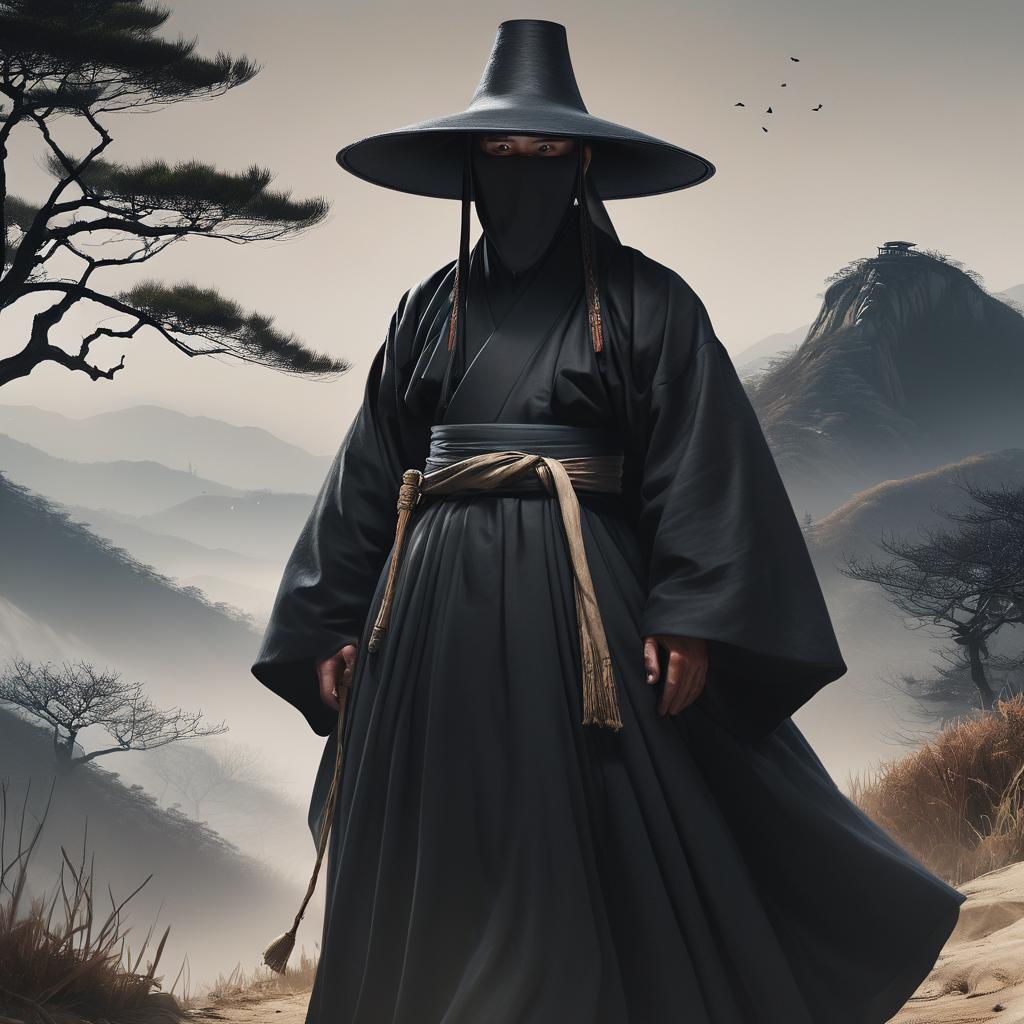
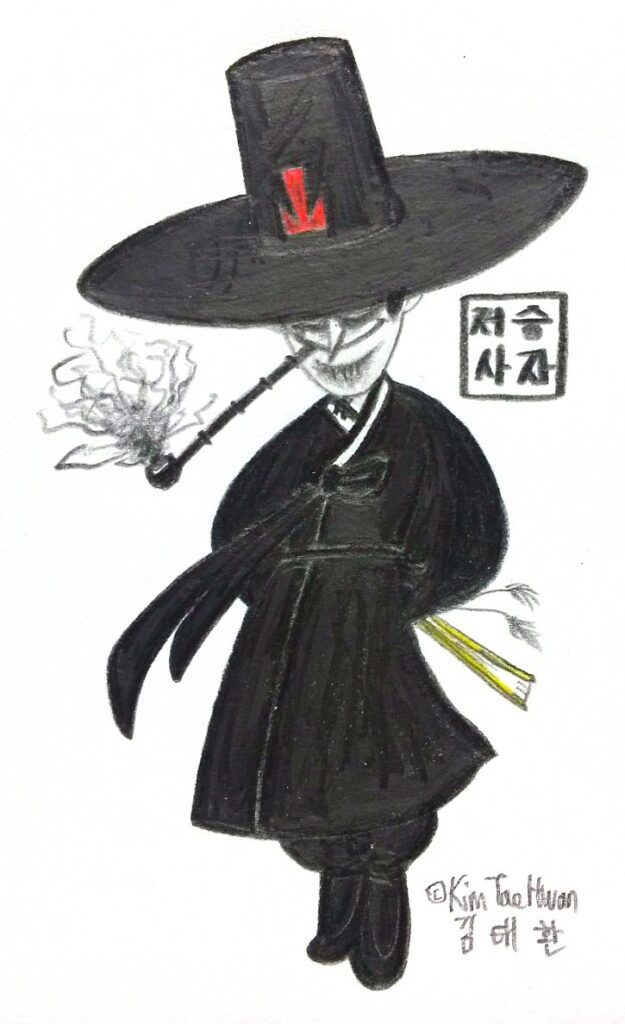
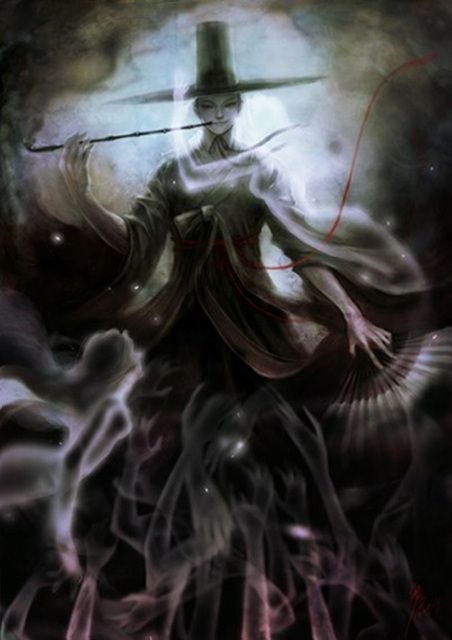
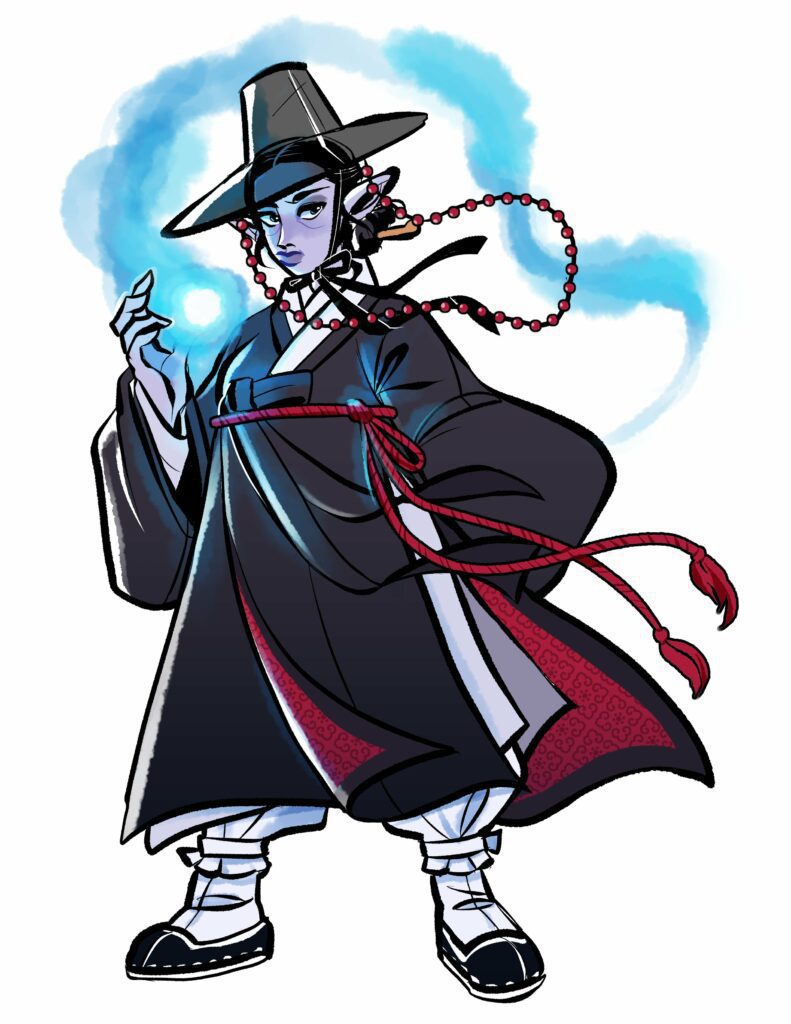
The Jeoseung Saja are traditionally depicted as imposing figures dressed entirely in black, adorned with a “hanbok,” the traditional Korean attire modified to suit their solemn role. Topping their attire is a wide-brimmed black hat known as a “gat,” adding to their authoritative presence. Contemporary interpretations, influenced by media, sometimes portray them in long black coats and fedoras, maintaining their aura of mystery and authority with shadow-obscured faces. In Korean folklore, they are commonly depicted as a male figure with pale complexion and sunken eyes, enhancing his eerie depiction in both traditional culture and modern imagination.
Family
In Korean mythology, Jeoseung Saja is often depicted as a solitary figure whose primary duty is guiding souls to the afterlife. Any familial connections mentioned are typically peripheral to his role as the harbinger of death. However, some variations of the mythos may attribute familial ties or relationships that underscore his broader connection to celestial or divine hierarchies. They themselves are not individual deities but rather servants under the authority of King Yeomna, the ruler of the Korean underworld. King Yeomna oversees the judgment of souls and determines their fate after death, with the Jeoseung Saja acting as his emissaries, executing their duties with steadfast dedication. While their family ties are not extensively explored in mythology, his solitary role as a psychopomp implies an independent operation, serving as a crucial link between life and death.
Other names
The term “Jeoseung Saja” is highly descriptive in Korean mythology. “Jeoseung” translates to “afterworld” or “land of the dead,” while “saja” means “messenger,” thus rendering “Jeoseung Saja” as “underworld messenger.” Alternatively, they are sometimes simply called “Saja” or “ölüm sut-geri,” which translates to “death taker.” In different regions and eras of Korean mythology, Jeoseung Saja is known by various names. One such name is “Cheonyeo Gwishin” (처녀귀신), meaning “Virgin Ghost,” highlighting its role as a guardian or escort of souls. Moreover, regional variations or local beliefs might assign him additional titles or epithets that reflect specific cultural views on death and the afterlife. While it shares similarities with the Grim Reaper of other cultures, distinct differences underscore their unique role in Korean folklore.
Powers and Abilities
Jeoseung Saja wields powers centered on guiding souls to the afterlife and enforcing death’s laws, maintaining order for the deceased. Its solemn demeanor reflects the gravity of its task, often making its presence felt in places like hospitals, cemeteries, and accident sites.
As the Messenger of Death in Korean mythology, they possesses formidable abilities aligned with its divine role. These include effortlessly traversing between realms, perceiving impending deaths, and appearing before individuals to guide their souls upon passing. Its aura carries an air of reverence, ensuring the departed find their rightful place in the afterlife.
While he is capable of supernatural feats such as perceiving the deceased and traveling inter-dimensionally, it maintains a role more aligned with maintaining cosmic balance than with malevolence. In some tales, it exhibits compassion, granting brief reprieves to those with unfinished business in the living world.
The being appear in various Korean myths and folktales, often serving as a reminder of death’s inevitability. One popular story tells of General Sinui, a powerful warrior who desperately sought to cheat death. When a Jeoseung Saja arrives to claim him, Sinui uses various wards and tricks to delay the inevitable, only to be reminded that death cannot be outrun.
Modern Day Influence
The Jeoseung Saja remains a powerful symbol in Korean culture, transcending into the modern era through various adaptations in popular media such as television shows, films, and video games. For instance, the K-drama “Goblin” features a character resembling Jeoseung Saja, portrayed with a more human-like appearance and nuanced characteristics. Beyond entertainment, it continues to shape Korean customs and beliefs. A shooting star sighting is sometimes interpreted as collecting a soul, while dreaming of them can be seen as a harbinger of death, though not necessarily one’s own.
In contemporary Korean culture, remnants of Jeoseung Saja’s influence persist in literature, art, and media, where his character resonates deeply. This enduring presence in popular culture reflects broader societal views on mortality, spirituality, and the enduring legacy of ancient beliefs in a modern context. Korean mythology, with figures like Jeoseung Saja, continues to inspire and provoke contemplation about the mysteries surrounding life and death.
Related Images

Sources
Jeoseung Saja (Grim Reaper). (n.d.). K-Occult. https://www.koccult.com/creatures/jeoseung-saja
Jeoseung Saja. (n.d.). Villains Wiki – Fandom. https://villains.fandom.com/wiki/Jeoseung_Saja
Honorary Reporters – Who Is Jeoseung Saja? (2025, July 16). Korea.net. https://honoraryreporters.korea.net/board/detail.do?articlecate=1&board_no=29698
Grayson, J. H. (2002). Korea: A Religious History (Rev. ed.). Routledge.
Lee, P. H., & De Bary, W. T. (Eds.). (1997). Sources of Korean Tradition: From Early Times through the Sixteenth Century. Columbia University Press.
Kim, S. (2002). Korean Folk Tales. Yonsei Press.
Park, C. (2009). Eclipse myths and cosmological imagination in Korean folklore. Acta Koreana, 12(2), 45–68.
Frequently Asked Questions
What is Jeoseung Saja?
Jeoseung Saja are figures in Korean folklore known as “messengers of the afterlife.” They serve as guides who escort souls from the living world to the Korean underworld after death.
Does Jeoseung Saja kill people?
No. Unlike Western grim reapers who are sometimes shown as causing death, Jeoseung Saja do not kill. They simply collect and guide souls whose time to die has already been decided.
What does Jeoseung Saja look like?
Traditionally, Jeoseung Saja are depicted wearing black hanbok and a wide-brimmed black hat (gat), with pale skin and a solemn, calm demeanor.
Is Jeoseung Saja evil?
No. In Korean belief, Jeoseung Saja are neutral guides of souls rather than malevolent beings. Their role reflects duty and cosmic balance rather than terror.
How is Jeoseung Saja different from the Western Grim Reaper?
Jeoseung Saja are similar to the Grim Reaper as soul guides, but they are viewed more as civil servants of the afterlife and are not associated with killing or fear in the same way.
Watch
Mythlok Perspective
In Mythlok’s perspective, Jeoseung Saja are not grim specters of terror but embodiments of inevitable transition. They represent a cultural understanding of death not as final destruction but as an ordered passage — a duty performed without malice or malediction. Their role highlights how Korean tradition perceives every end as part of a greater cosmic rhythm, where life and death are steps within the same journey. Unlike the Western Grim Reaper’s skeletal solitude or the reaper figures in some European myths that inspire trepidation, Jeoseung Saja reflects the Confucian and Buddhist values of balance and duty. In that sense, they stand closer to psychopomp figures like the Egyptian Anubis or the Japanese Shinigami — not as destroyers of life, but as respectful custodians of the soul’s next stage. Through their solemn, bureaucratic role, Jeoseung Saja remind us that death is a passage that respects order and harmony rather than fear.