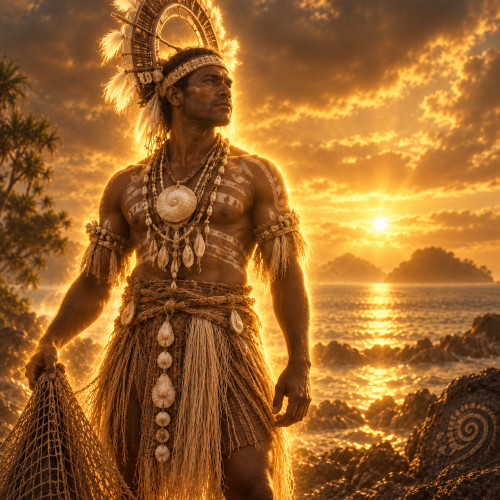
Torres Strait Islander Mythology
Torres Strait Islander mythology encompasses the diverse traditional stories, ancestral knowledge, ceremonial practices, and spiritual traditions of the Indigenous peoples of the Torres Strait, the waters between northern Australia and Papua New Guinea. The region is home to many distinct communities and languages, including Meriam and Kala Lagaw Ya-speaking peoples, and their traditions are not a single unified mythology. Instead, each island and cultural group preserves its own stories concerning ancestors, heroes, supernatural beings, landscapes, seasons, and the stars.
The sea is fundamental to Torres Strait Islander culture and appears throughout traditional knowledge and storytelling. Island communities developed detailed knowledge of currents, winds, reefs, marine animals, seasons, and weather patterns, allowing people to travel between islands and make use of the surrounding waters. Stories and songs helped preserve this knowledge while also connecting the natural environment with ancestry, identity, and cultural responsibility.
One of the most important traditions associated with the Torres Strait is the story of Tagai. Tagai is a major cultural figure whose story is closely connected with the stars and the organization of the seasonal year. Traditional stories under Tagai have been shared by Elders with younger generations through storytelling, <a class="wpil_keyword_link" href="https://mythlok.com/archetypes/music-dance/” title=”Music and Dance : Gods, Spirits and Legendary Figures of Rhythm” data-wpil-keyword-link=”linked” data-wpil-monitor-id=”534620″>music, dance, and visual art. The continued retelling of Tagai demonstrates how mythology can function simultaneously as cultural knowledge, environmental knowledge, and a means of strengthening identity.
The stars have therefore played an important role in Torres Strait Islander knowledge systems. Celestial observations could be connected with seasonal changes, winds, weather, marine conditions, and appropriate times for different activities. Rather than separating astronomy from mythology, traditional knowledge brought the sky, sea, land, and human community into a connected cultural framework.
Torres Strait traditions also contain numerous stories about supernatural beings and extraordinary creatures. The State Library of Queensland’s community-led ReTold project, for example, preserves stories from several islands and languages. These include Wawa, a supernatural creature from Badu, as well as stories from Mabuiag, Saibai, and other communities. Such stories demonstrate that Torres Strait mythology is remarkably varied, with individual narratives belonging to particular places, languages, and story traditions.
Gelam is another important traditional figure, particularly in the mythology of Mer, also known as Murray Island. The story of Atmer and Gelam describes Gelam as a skilled hunter who leaves his island in a wooden dugong and travels eastward. His journey is connected with the creation of the islands of Mer, Waier, and Dauar, giving the story an important place in Meriam traditions concerning the origins of the local landscape.
The traditions of Mer also include highly sacred stories concerning Malo. Historical collections record that some Malo stories and songs were regarded as especially sacred and access to them was restricted. This is an important reminder that Torres Strait mythology is not simply a collection of public folktales. Some traditional knowledge carries cultural restrictions concerning who may hear, perform, or transmit particular stories.
Ancestors also occupy an important place in many Torres Strait Islander traditions. Relationships between people, ancestral figures, particular islands, and significant places help establish cultural identity and obligations. Stories can explain the origins of geographical features, establish connections to country, and preserve knowledge about previous generations.
Ceremony provides another important means of keeping these traditions alive. Dance, song, storytelling, visual art, and traditional forms of adornment can all carry cultural knowledge. Contemporary community projects demonstrate that traditional stories continue to be shared across generations, including through schools, Indigenous Knowledge Centres, recordings, and community-led cultural programs.
Christianity has become an important part of contemporary Torres Strait Islander life, following major changes brought by missionary activity and colonial history. Traditional knowledge has nevertheless continued in many communities, sometimes alongside Christian beliefs and sometimes through cultural revitalization. The continued teaching of traditional stories demonstrates that mythology remains connected to living cultural identity rather than existing only as a record of the distant past.
Torres Strait Islander mythology is therefore best understood as a collection of interconnected but distinct island traditions. The stories of Tagai, Gelam, Malo, Wawa, and many other figures belong to particular communities and cultural contexts rather than to one standardized pantheon. Together, they reveal a worldview in which the sea, stars, ancestors, landscapes, seasons, and human communities are connected through stories that continue to carry knowledge from one generation to the next.