Sami Mythology
Sámi mythology encompasses the diverse spiritual traditions, sacred stories, supernatural beliefs, and ritual practices of the Sámi people, the Indigenous people of northern Norway, Sweden, Finland, and the Kola Peninsula of Russia. Rather than representing a single standardized religion or pantheon, Sámi traditions varied between regions and communities. They developed through close relationships with landscapes, animals, seasonal cycles, and ancestral traditions, and were transmitted largely through oral culture. Archaeological discoveries, historical accounts, traditional place names, folklore, and surviving ritual objects provide important evidence for reconstructing aspects of this spiritual world.
A central feature of traditional Sámi religion was the understanding that particular places, animals, and natural features could possess spiritual significance. Mountains, lakes, rivers, forests, and stones could be associated with supernatural forces or sacred places. One important category was the sieidi, a sacred natural object or place that could receive offerings. Sieidi traditions demonstrate that Sámi spirituality was closely connected to specific landscapes rather than being based exclusively on temples or permanent sacred buildings. Offerings could be made in connection with hunting, fishing, reindeer, travel, or other aspects of community life, reflecting relationships between people and the powers they believed influenced their environment.
The noaidi was an important ritual specialist in several Sámi traditions. Often translated as a shaman, the noaidi could act as a mediator between the human community and supernatural realms. Historical descriptions associate noaidi practices with ritual drumming, chanting, divination, healing, and journeys into other realms. The goavddis, or Sámi ritual drum, is especially important in the study of these traditions. Many surviving drums contain intricate designs representing animals, people, sacred places, celestial bodies, and supernatural beings. Their precise meanings varied, and scholars must be cautious about interpreting every symbol as part of one universal Sámi cosmology.
Sámi traditions also contain a range of supernatural and divine figures, although their names and roles differ between regions. Horagalles, for example, is a thunder-associated deity particularly documented in northern Sámi traditions. Other sources record figures such as Radien and the female beings associated with Máttaráhkká, including Sárahkká, Uksáhkká, and Juksáhkká. These figures are often connected in historical sources with fertility, childbirth, family, and protection. However, descriptions of these beings come from different traditions and periods, so they should not be treated as members of a single fixed Sámi pantheon comparable to the Olympian or Norse gods.
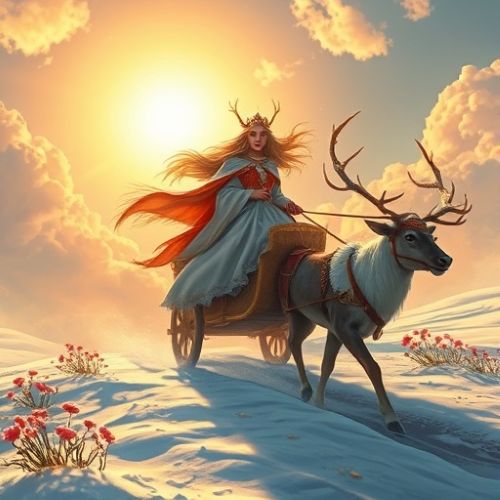
Animals were also deeply important within Sámi spiritual traditions. Reindeer were central to many Sámi communities, although different Sámi groups historically depended on different combinations of reindeer herding, <a class="wpil_keyword_link" href="https://mythlok.com/archetypes/hunting-fishing/” title=”Hunting : Gods, Heroes and Legendary Figures of the Wild Chase” data-wpil-keyword-link=”linked” data-wpil-monitor-id=”416749″>hunting, fishing, gathering, and other livelihoods. Bears held particular significance in several Sámi traditions, with bear ceremonies and beliefs surrounding the animal appearing in historical and ethnographic records. Birds and other animals could also appear in stories and spiritual practices. These traditions reflected relationships with the natural world that were practical as well as spiritual, since knowledge of animals, weather, terrain, and seasonal changes was essential to survival.
Sámi cosmological traditions could include multiple levels or realms connected through ritual and supernatural movement. Historical descriptions sometimes distinguish an upper world, a human world, and an underworld or realm of the dead, although terminology and interpretations differ between regions. The ritual drum could function as a symbolic map of such a universe, allowing the noaidi to navigate between different realms during ritual activity. These ideas were closely connected with healing, divination, community protection, and relationships with supernatural powers.
Christianization profoundly transformed Sámi religious life. From the Middle Ages onward, Christian missionaries sought to replace or suppress traditional practices, and ritual drums were confiscated or destroyed in some areas. Written accounts of Sámi religion were consequently often produced by outsiders who viewed Indigenous practices through Christian European perspectives. This makes the surviving evidence valuable but also complicated. Traditional beliefs nevertheless survived in stories, customs, place names, material culture, and oral traditions, while elements of Sámi cultural knowledge continued alongside Christianity.
Today, Sámi mythology and traditional spirituality remain important subjects of cultural revitalization and scholarship. Contemporary Sámi artists, writers, musicians, and cultural institutions continue to engage with traditional stories, symbols, landscapes, and historical practices, while modern Sámi communities also maintain diverse religious and cultural identities. It is important, however, to distinguish cultural revival and contemporary interpretation from the claim that a single unchanged ancient religion has survived intact.
Sámi mythology is therefore best understood as a diverse collection of regional Indigenous traditions rather than a unified pantheon. From sacred sieidi places and ritual drums to noaidi traditions, thunder-associated beings, ancestral powers, and the spiritual significance of animals and landscapes, these traditions reveal a worldview in which human life was deeply connected with the environment. Their enduring importance lies not only in their supernatural stories but also in the cultural memory, ecological knowledge, and relationship to land that they continue to express.