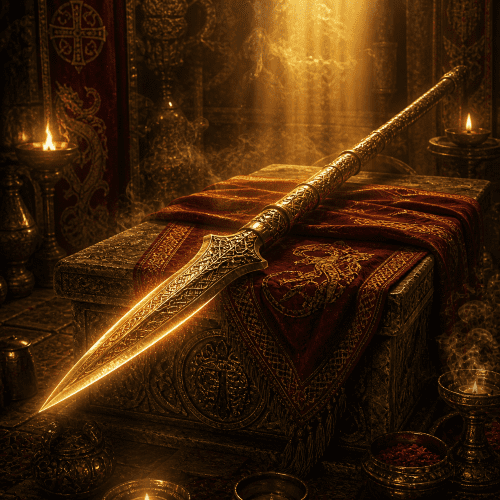


Caledfwlch : The Original Sword of King Arthur
At a glance
| Description | |
|---|---|
| Mythology | Welsh Mythology |
| Type | Carried |
| Power | 08/10 |
Mythlok Perspective
In Mythlok’s Perspective, Caledfwlch represents a stage of Arthurian tradition that is often overshadowed by the more famous Excalibur. The Welsh sword reflects a society that valued proven leadership and battlefield achievement rather than divine selection. Its significance comes not from miraculous origins but from the reputation of the hero who carried it. This mirrors other legendary weapons across cultures. Caledfwlch shares similarities with the Irish sword Caladbolg, which likewise symbolizes heroic might, and with the Indian weapon wielded by Arjuna, whose power is closely tied to the worthiness of its bearer. Like the Japanese sword Kusanagi-no-Tsurugi, Caledfwlch ultimately serves as a symbol of legitimacy and cultural identity. The sword reminds us that legendary weapons endure not because of their magic, but because they embody the ideals a civilization chooses to remember.
Caledfwlch
Introduction
Caledfwlch is one of the most important weapons in Welsh legend and represents the earliest known form of King Arthur’s famous sword. Long before the name Excalibur appeared in French romances and English literature, Welsh storytellers celebrated Caledfwlch as the blade carried by Arthur, the heroic war leader of Britain. In these early traditions, Arthur was not primarily a divinely appointed monarch but a champion who led warriors against both human and supernatural threats.
The sword occupies a central place in Welsh Arthurian tradition because it reflects the values of the Celtic heroic age. Strength, loyalty, leadership, and martial excellence are all embodied in the weapon. Unlike later medieval stories that focus on magical ceremonies and royal destiny, the Welsh accounts present Caledfwlch as a symbol of Arthur’s reputation and authority earned through deeds.
Although modern audiences are far more familiar with Excalibur, understanding Caledfwlch provides valuable insight into the original Arthurian legends. It reveals how the myth evolved over centuries while preserving enduring themes of power, legitimacy, and heroism.
Origins
The name Caledfwlch comes from the Welsh words caled, meaning “hard,” and bwlch, meaning “breach,” “cleft,” or “gap.” Together, the name is generally interpreted as “hard cleaver” or “hard breach,” suggesting a weapon capable of cutting through even the strongest defenses. The name itself conveys strength and destructive force, making it an ideal weapon for a legendary warrior king.
Caledfwlch first appears in Culhwch and Olwen, one of the oldest surviving Arthurian tales and part of the Welsh collection later known as the Mabinogion. Dating from roughly the eleventh or twelfth century, this text preserves traditions that are likely much older. In the story, Arthur already possesses the sword, and it is regarded as one of his greatest treasures. This differs significantly from later legends in which the weapon is acquired through supernatural means.
Many scholars have noted similarities between Caledfwlch and the Irish legendary sword Caladbolg. Both names share linguistic connections and both weapons are associated with extraordinary cutting power. Rather than one being directly copied from the other, they may reflect a shared Celtic tradition in which powerful swords symbolized heroic authority.
The transformation of Caledfwlch into Excalibur occurred during the medieval period. Geoffrey of Monmouth rendered the name as Caliburnus in his influential twelfth-century work Historia Regum Britanniae. French writers later adapted this form into Escalibor and eventually Excalibur. Through these literary developments, a distinctly Welsh artifact became one of the most famous legendary weapons in world literature.
Powers
Unlike the richly detailed magical swords of later medieval romances, Caledfwlch is not frequently described with elaborate supernatural abilities in surviving Welsh sources. Nevertheless, the sword possesses an aura of exceptional power that sets it apart from ordinary weapons. Its very name implies unmatched cutting strength. Early Welsh audiences would have understood Caledfwlch as a blade capable of breaking through armor, shields, and any obstacle standing before its wielder. The weapon’s reputation alone was enough to establish its legendary status.
A striking description appears in The Dream of Rhonabwy, where Arthur’s sword is depicted with a golden hilt decorated by two chimerical creatures. When the blade is drawn, flames seem to emerge from their mouths, creating a dazzling and terrifying spectacle. This imagery emphasizes the sword’s supernatural presence and the awe it inspired among those who witnessed it.
Beyond physical power, Caledfwlch carried profound symbolic significance. The sword reinforced Arthur’s authority and united his followers around a common leader. In Celtic tradition, weapons often served as extensions of a hero’s identity, and Caledfwlch was no exception. It represented courage, honor, and the responsibility of leadership. The sword therefore functioned not merely as a tool of war but as a cultural symbol. It embodied the ideals expected of a ruler and reflected the values that Welsh storytellers sought to celebrate and preserve.
Owners/Users
King Arthur is the primary and most famous wielder of Caledfwlch. In Welsh tradition, the sword is closely associated with his role as the leader of an elite band of warriors. It is one of the possessions that define his status and distinguish him from ordinary kings.
Unlike later Arthurian romances, Welsh sources do not connect Caledfwlch to the Lady of the Lake, Merlin, or the Sword in the Stone. These elements emerged centuries later as continental writers reshaped Arthur’s story for new audiences. The original Welsh narratives focus instead on Arthur’s achievements and the loyalty of his companions.
One notable exception to Arthur’s exclusive use of the weapon occurs during the quest for Diwrnach’s cauldron in Culhwch and Olwen. During this dangerous mission, Arthur’s companion Llenlleawg the Irishman seizes Caledfwlch and uses it to kill Diwrnach and his followers. This episode demonstrates the trust Arthur placed in his warriors and highlights the sword’s importance during critical moments. Although later traditions expanded the circle of figures associated with Excalibur, the Welsh Caledfwlch remains primarily Arthur’s weapon. Its identity is inseparable from his legend, and its significance derives from its connection to the heroic king himself.
Instances used
Caledfwlch appears most prominently in Culhwch and Olwen, where it is included among Arthur’s treasured possessions. The sword’s presence immediately signals Arthur’s importance and reinforces his reputation as a legendary warrior.
The most memorable action involving the weapon occurs during the expedition to Ireland to obtain the magical cauldron of Diwrnach. When negotiations fail, Llenlleawg uses Caledfwlch to strike down Diwrnach and his retinue. The successful acquisition of the cauldron helps fulfill one of the seemingly impossible tasks required for Culhwch to win the hand of Olwen. This episode demonstrates the sword’s role in overcoming challenges that ordinary heroes could not face alone.
The sword also appears in Arthur’s inventory of prized possessions. Its inclusion alongside other legendary items such as his ship Prydwen and dagger Carnwennan shows that Caledfwlch was regarded as an essential component of Arthur’s heroic identity.
While Welsh texts contain fewer detailed battle scenes than later romances, the sword’s repeated association with quests, leadership, and heroic achievement makes its importance unmistakable. It serves as a constant reminder of Arthur’s role as protector, warrior, and leader.




Source
Gantz, J. (Trans.). (1976). The Mabinogion. Penguin Classics.
Koch, J. T. (Ed.). (2005). Celtic culture: A historical encyclopedia (Vols. 1-5). Bloomsbury Academic.
Nightbringer. (n.d.). Caledfwlch. The Legend of King Arthur. https://nightbringer.se/the-legend-of-king-arthur/arthurian-items/c-arthurian-items/caledfwlch/
Sarah Woodbury. (2011, October 5). Excalibur (Caledfwlch). https://www.sarahwoodbury.com/excalibur-caledfwlch/
Wikipedia. (2001, September 4). Excalibur. In Wikipedia. https://en.wikipedia.org/wiki/Excalibur
Bromwich, R., & Evans, D. S. (1992). Culhwch and Olwen: An Edition and Study of the Oldest Arthurian Tale. University of Wales Press.
Geoffrey of Monmouth. (1136/1966). The History of the Kings of Britain (L. Thorpe, Trans.). Penguin Classics.
Koch, J. T. (2006). Celtic Culture: A Historical Encyclopedia. ABC-CLIO.
Pyle, H. (1903). The Story of King Arthur and His Knights. Scribner.
Frequently Asked Questions
What is Caledfwlch?
Caledfwlch is the original Welsh name of King Arthur’s legendary sword and the earliest known predecessor of Excalibur.
Is Caledfwlch the same as Excalibur?
Excalibur evolved from Caledfwlch through Latin and French adaptations, but the Welsh sword has its own distinct cultural identity.
Where does Caledfwlch first appear?
The sword first appears in Culhwch and Olwen, a Welsh Arthurian tale dating to the 11th or 12th century.
Did the Lady of the Lake give Arthur Caledfwlch?
No. In Welsh tradition, Arthur already possesses Caledfwlch. The Lady of the Lake story appears in later continental romances.
What does the name Caledfwlch mean?
The name combines Welsh words meaning “hard” and “breach” or “cleft,” suggesting a powerful weapon capable of cutting through any obstacle.