
Mictlan : The Dark Aztec Underworld of the Dead
| Description | |
|---|---|
| Mythology | Aztec Mythology |
| Description | Nine levels of trials, four-year journey |
| Ruler/Guardian | Mictlantecuhtli & Mictecacíhuatl |
| Inhabitants | Spirits, Xolotl, beasts |
| Nature | Neutral |
Mythlok Perspective
In Mythlok’s Perspective, Mictlan reflects a worldview where death is neither punishment nor reward but a stage of cosmic balance. The Aztec underworld emphasizes endurance and transformation rather than judgment. Comparable ideas appear in other cultures. The Greek realm of Hades also served as a neutral resting place for most souls, while the Norse Hel received those who died outside heroic battle. Across civilizations, these underworlds reveal a shared human attempt to understand death as part of a greater cosmic cycle rather than its end.
Mictlan
Introduction
Mictlan was the vast underworld in Aztec cosmology and served as the final destination for most human souls. In the worldview of the Nahua peoples of central Mexico, death did not represent a moral judgment or a final reward. Instead, it marked a transition into another stage of existence within the cosmic cycle. Mictlan was therefore not a place of punishment but a realm that awaited those who died from ordinary causes such as illness or old age.
The Nahua belief system categorized the afterlife based largely on the circumstances of death rather than moral behavior. Warriors who died in battle, women who died during childbirth, and those who drowned were believed to enter special sacred realms associated with specific gods. However, the majority of people were destined for Mictlan. Their souls embarked on a long and demanding journey through the underworld before reaching their final rest.
In Nahuatl language, the word Mictlan literally means “place of the dead.” It formed part of a larger cosmological structure in which the universe consisted of multiple layers. Above the earth were thirteen heavens, while below lay nine levels of the underworld. Mictlan occupied these lower realms and symbolized the mysterious domain where human existence ultimately dissolved back into the cosmos.
Description
Mictlan was imagined as a dark and remote region located far beneath the earth. Ancient sources describe it as a cold, shadowy place sometimes called Yohua ichan or “house of night.” Unlike heavenly realms associated with abundance and sunlight, Mictlan reflected stillness, darkness, and the slow passage of time.
The journey to reach the deepest part of Mictlan was believed to last four years. During this time, the soul traveled through nine separate layers, each presenting unique challenges. These trials gradually stripped away the remnants of earthly identity and prepared the spirit for its final transformation.
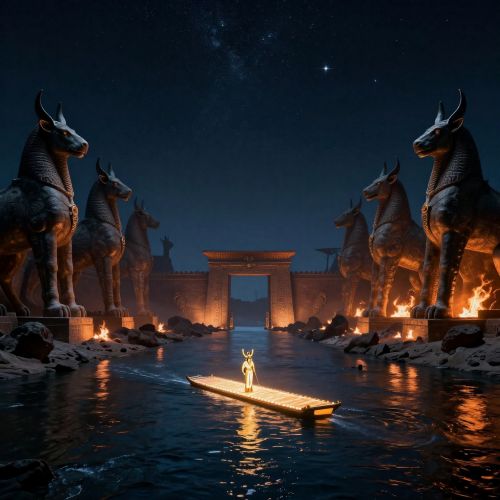
The first stage of the journey began when the soul left the physical body and entered the underworld path. One of the earliest obstacles was a river known as Apanohuaya. To cross it, the soul relied on the help of a sacred dog, often represented by the Xoloitzcuintli, a hairless breed native to Mesoamerica. This dog acted as a guide and companion, helping the dead navigate the dangerous waters.
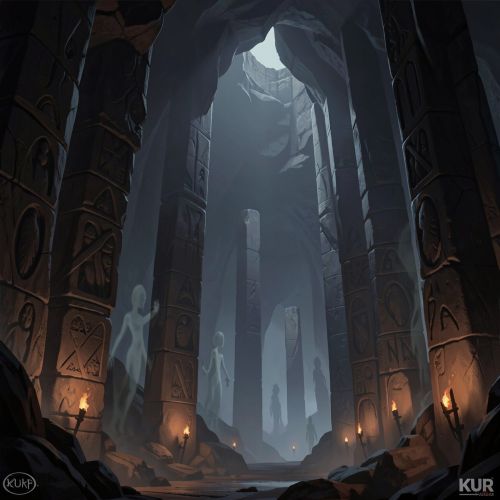
Further along the journey were terrifying landscapes. Some levels contained mountains that violently crashed together, forcing the soul to pass between them at exactly the right moment. Others featured fields of obsidian blades and fierce winds that cut like knives. Another region was covered in darkness so thick that the traveler could barely see the path ahead.
The final level, known as Chicunamictlan, was the deepest realm of the underworld. After completing the long journey through these trials, the soul finally reached a state of rest where it ceased its earthly struggle. Rather than eternal reward or punishment, this destination represented the end of the soul’s long passage through the world.
Ruler/Guardian
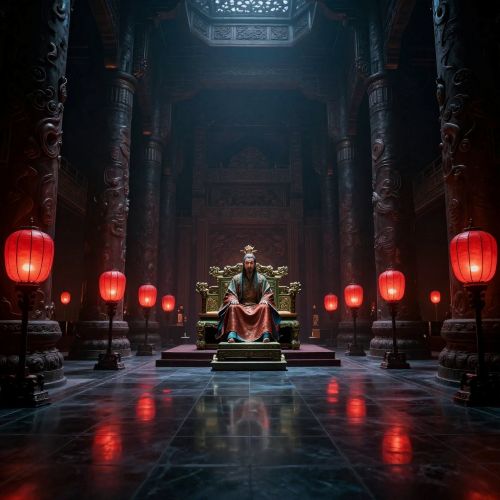
The rulers of Mictlan were the powerful death deities Mictlantecuhtli and Mictecacíhuatl. Mictlantecuhtli, whose name means “Lord of the Land of the Dead,” governed the underworld and oversaw the bones of the deceased. He was one of the most recognizable figures in Aztec religious imagery.
He was usually depicted as a skeletal figure or as a corpse-like deity adorned with bones and skull ornaments. Ancient codices show him with bone earspools, owl feathers, and necklaces made of eyeballs. His frightening appearance symbolized death’s inevitable presence and the silent authority of the underworld.
Beside him ruled Mictecacíhuatl, often called the “Lady of the Dead.” She shared control of Mictlan and was associated with the protection of bones and the rituals honoring ancestors. According to some traditions, she watched over the bones of the dead so that they could later be used by the gods in acts of creation.
Together, the divine couple maintained the order of the underworld. Their role was not to judge human souls but to guard the domain of death and ensure that the cosmic balance between life and death remained intact.
Inhabitants
The inhabitants of Mictlan were primarily the spirits of those who had died natural deaths. These souls were sometimes described as mictecah, meaning “people of the place of the dead.” Over time, they gradually lost their physical characteristics and became skeletal or fleshless beings within the underworld.
Animals also played symbolic roles in the landscape of Mictlan. Owls were particularly important because they were seen as messengers of death and guardians of the night. In Aztec belief, the cry of an owl could signal the approach of death or the presence of spirits moving between worlds.
Dogs held an especially sacred function in the mythology of Mictlan. They were believed to guide souls through the underworld journey. For this reason, dogs were sometimes buried with their human companions so that they could assist them in crossing the dangerous river and navigating the dark paths ahead. These inhabitants were not tormentors or demons. Instead, they represented companions and symbols within the natural order of death.
Access
In Aztec thought, the entrances to Mictlan existed in places where the earth opened into deeper realms. Caves, springs, and fissures in the ground were often believed to serve as gateways to the underworld. These locations were regarded as sacred spaces connecting the world of the living with the hidden domain beneath.
Although Mictlan was primarily a destination for the dead, some traditions suggested that certain individuals possessed knowledge of these spiritual pathways. Shamans or shape-shifting figures known as nahuales were believed to travel between worlds through ritual or spiritual power. These beliefs highlight how the Aztecs imagined the universe as interconnected rather than strictly separated. The realms of life, death, and the divine were linked through natural features of the landscape.
Instances of Visit
One of the most famous myths involving Mictlan tells of the god Quetzalcoatl descending into the underworld. According to Aztec creation stories, the gods wished to create a new generation of humanity after earlier worlds had been destroyed. To accomplish this, Quetzalcoatl traveled to Mictlan to retrieve the bones of previous human races.
Mictlantecuhtli attempted to prevent him from taking the bones and challenged him with impossible tasks. One of these challenges required Quetzalcoatl to blow a conch shell trumpet that had no holes. Using cleverness rather than force, he asked worms to drill holes into the shell and bees to produce sound from within it. Despite these obstacles, Quetzalcoatl eventually escaped with the bones. During his escape, he stumbled and dropped them, breaking them into different pieces. This myth was used to explain why humans vary in height and appearance.
Symbolism
Mictlan represents more than a simple realm of the dead. It reflects the Aztec understanding of existence as a continuous cycle of transformation. Life emerges from the earth, and eventually all living things return to it. The long journey through the underworld symbolizes the gradual release of earthly attachments. Each level strips away elements of identity until the soul becomes part of the cosmic balance once again.
The Aztec worldview often emphasized reciprocity between humans and the universe. Just as people depended on the earth for food and life, the earth ultimately reclaimed all things in death. Mictlan therefore represents a natural stage within the ongoing rhythm of creation and dissolution.
Comparative Analysis
Mictlan shares similarities with several other mythological underworlds around the world. In Greek tradition, the realm ruled by Hades also served as a neutral destination for most souls rather than a place of punishment. Similarly, the Norse underworld Hel received those who died of natural causes. However, Mictlan differs from many moralistic afterlife systems. The fate of the soul was not determined by virtue or sin but by the circumstances surrounding death. The emphasis was placed on the journey itself rather than judgment.
Modern Influence
Mictlan continues to influence Mexican cultural traditions today, particularly during the celebration of Día de los Muertos, or Day of the Dead. During this annual festival, families create altars known as ofrendas to welcome the spirits of their ancestors. These altars often include marigold flowers, food offerings, photographs, and symbolic objects. The belief is that the barrier between the worlds of the living and the dead temporarily becomes thin, allowing loved ones to return.
Imagery associated with Mictlan, such as skeleton figures and skull motifs, has become a powerful symbol of remembrance rather than fear. These artistic traditions appear in festivals, crafts, museums, and public celebrations across Mexico and beyond. In modern culture, Mictlan also appears in films, literature, and visual art, reflecting the enduring fascination with Aztec cosmology and its vision of life and death as interconnected forces.
Sources
Britannica. (n.d.). Mictlantecuhtli. https://www.britannica.com/topic/Mictlantecuhtli
López Austin, A. (1986). Mictlan and the Aztec underworld. History of Religions, 26(2), 257–272. https://doi.org/10.1086/463050
Malevus. (2023, November 6). Mictlan: The underworld in Aztec mythology. https://malevus.com/mictlan/
Soustelle, J. (1970). Daily life of the Aztecs (J. Fielding, Trans.). Stanford University Press.
Taube, K. A. (1993). Aztec mythology and religion. University of Texas Press.
Taube, K. (2004). The mythology of Mexico and Central America. Oxford University Press.
Wikipedia. (2026, January 8). Mictlān. https://en.wikipedia.org/wiki/Mictl%C4%81n
World History Encyclopedia. (2013, September 21). Mictlantecuhtli. https://www.worldhistory.org/Mictlantecuhtli/
Frequently Asked Questions
What is Mictlan in Aztec belief?
Mictlan is the underworld in Aztec cosmology where most souls travel after death, especially those who died of natural causes.
Who ruled Mictlan?
Mictlan was ruled by the death god Mictlantecuhtli and his consort Mictecacíhuatl, who governed the realm of the dead.
How many levels are in Mictlan?
According to Aztec mythology, Mictlan contains nine levels that souls must travel through during a four-year journey.
Why were dogs important in the journey to Mictlan?
Dogs, particularly the Xoloitzcuintli, were believed to guide souls across the underworld river and help them navigate the path to Mictlan.
Is Mictlan a place of punishment?
No. Unlike many religious afterlives, Mictlan was not based on moral judgment but served as the natural destination for most souls.