

Temples of Baalbek : The Roman Marvel of Lebanon
At a glance
| Description | |
|---|---|
| Mythology | Roman Mythology |
| Country | Lebanon |
| Closest airport | Beirut–Rafic Hariri International Airport (BEY) |
| Type | Constructed |
| Accessibility | 08/10 |
Mythlok Perspective
The Temples of Baalbek are less about stone and more about scale as theology. Here, divinity was expressed through magnitude. The Romans did not simply build upward; they built outward, expanding sacred space into an architectural declaration of cosmic authority. The sanctuary transforms thunder, fertility, and ecstasy into geometry and weight. In this, Baalbek mirrors the monumental impulse seen at Karnak in Egypt and Angkor Wat in Cambodia. Like those sacred complexes, it converts local belief into imperial architecture. Where Angkor dissolves into jungle and Karnak aligns with the Nile, Baalbek stands against open sky, a sanctuary of storm and sun carved into permanence.
Temples of Baalbek
Introduction
The Temples of Baalbek rise from the fertile Bekaa Valley in eastern Lebanon like fragments of a vanished empire. Known in antiquity as Heliopolis, meaning “City of the Sun,” Baalbek became one of the most important religious centers of the Roman world. Today, the surviving ruins—massive columns, towering staircases, and carved stone blocks of unimaginable size—remain among the most imposing monuments of Imperial Roman architecture.
Long before the Romans arrived, Baalbek was a sacred Phoenician site dedicated to local storm and fertility deities. Under Roman rule, beginning in the first century BCE and expanding dramatically in the first to third centuries CE, the sanctuary was transformed into a monumental complex that rivaled any in the empire. The Temples of Baalbek were not merely places of worship. They were political statements carved in stone, announcing Rome’s authority while absorbing and reshaping older local beliefs.
Connection with Mythology
The mythology of Baalbek reflects a powerful fusion between Phoenician religion and Roman theology. Before Roman control, the region honored a triad of Semitic gods, including Baal-Hadad, a thunder and fertility deity. When Rome absorbed the city, this local god was identified with Jupiter, forming what scholars call Jupiter Heliopolitanus. This was not a simple renaming. It was a deliberate blending of identities, combining the sky authority of Jupiter with the agricultural and storm attributes of Baal.
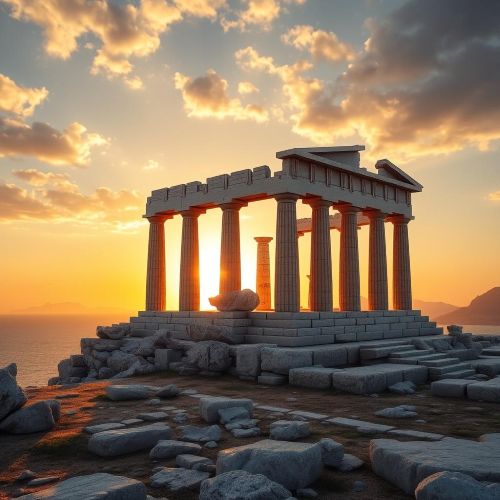
The Temple of Jupiter at Baalbek became one of the largest religious structures in the Roman Empire. Originally surrounded by 54 massive columns, only six remain standing today, each rising approximately 20 meters high. The scale alone communicated divine supremacy. Pilgrims traveled from across the region to honor Jupiter in his Heliopolitan form, seeking protection, prosperity, and divine favor.
Adjacent to it stands the Temple of Bacchus, remarkably preserved and dating largely to the second century CE. Though slightly smaller than Jupiter’s temple, it is more intact. Its carved reliefs show vines, mythological processions, and ritual symbolism associated with Bacchus, the Roman god of wine and ecstasy. This temple suggests that Baalbek was also connected to mystery cult practices and fertility rites, possibly continuing older agricultural traditions under Roman interpretation.
The Temple of Venus, often called the Round Temple, differs dramatically in design. Its curved structure and more intimate scale contrast with the monumental severity of Jupiter’s sanctuary. Venus here likely absorbed aspects of local fertility goddesses such as Astarte or Atargatis. Together, these temples demonstrate how mythology at Baalbek was not static. It evolved, merged, and adapted to imperial power while preserving echoes of earlier belief systems.
Ways to Get There
The Temples of Baalbek are located in the Bekaa Valley of eastern Lebanon, approximately 85 kilometers northeast of Beirut. The closest international gateway is Beirut–Rafic Hariri International Airport (BEY), which serves as Lebanon’s primary airport.
From Beirut, the journey by car takes roughly two to three hours depending on traffic and security checkpoints. Private taxis and guided tours are common options for visitors. Public buses and shared minibuses also travel from Beirut to Baalbek at lower cost, though schedules can vary.
Because Baalbek sits at an elevation of around 1,130 meters above sea level, the drive passes through mountain roads and scenic valley landscapes. The modern town of Baalbek lies directly beside the archaeological complex, making access straightforward once you arrive.
What to Look For
The Temples of Baalbek are vast, and exploration reveals layers of engineering brilliance. The six remaining columns of the Temple of Jupiter dominate the skyline. These Corinthian columns once formed part of a grand colonnade surrounding the sanctuary. Beneath the temple platform lies the famous Trilithon, three enormous limestone blocks, each weighing an estimated 800 tons. Nearby in the ancient quarry rests an even larger unfinished stone, sometimes called the “Stone of the Pregnant Woman,” weighing over 1,000 tons. These blocks continue to puzzle engineers and historians.
The Temple of Bacchus is arguably the most impressive surviving structure on site. Its doorway carvings remain sharp and detailed, depicting vine motifs and mythological imagery. Inside, niches and decorative reliefs give insight into ritual practices and sacred symbolism.
The Temple of Venus, smaller and architecturally distinct, offers a contrasting experience. Its rounded plan and sculptural ornamentation highlight refinement rather than sheer scale.
Visitors should also explore the Great Court, the hexagonal forecourt unique in Roman architecture, remnants of Arab fortifications, and later Islamic-era additions. Baalbek is not a single-period site. It is a layered historical landscape.
Importance in cultural history
In 1984, Baalbek was designated a UNESCO World Heritage Site, recognized for its outstanding universal value. The Temples of Baalbek represent one of the grandest surviving Roman sanctuary complexes anywhere in the world.
The site reflects the Roman strategy of integrating local traditions into imperial religion. By merging Phoenician deities with Roman gods, the empire strengthened its political legitimacy in the region. Baalbek became both a religious center and a symbol of Roman power in the Near East.
Over centuries, the site evolved. Byzantine Christians built basilicas within the complex. Later Islamic rulers fortified the area. Crusader and Ottoman influences followed. Despite periods of conflict, the architectural integrity of the temples remains remarkably strong.
Today, Baalbek stands not only as a relic of antiquity but as a symbol of Lebanese heritage. Cultural events, including the Baalbek International Festival held during summer, bring music and performance back into the ancient stones, echoing the site’s long history as a gathering place.
Best time to travel
The best time to visit the Temples of Baalbek is during spring from April to June and autumn from September to October. During these months, temperatures are mild and comfortable for exploring the expansive ruins.
Summer months, particularly July and August, can be hot, with temperatures exceeding 30°C. However, this is also when the Baalbek International Festival typically takes place, offering a rare opportunity to experience performances within the ancient sanctuary.
Winter can bring cooler weather and occasional rain, but the site remains open year-round. Because Baalbek sits at a higher elevation than coastal Lebanon, evenings can be significantly cooler even during warmer seasons.




Source
Encounters Travel. (2023). The ultimate guide to the Baalbek Temple Ruins in Lebanon: Monolithic Roman ruins conquered by Alexander the Great. https://www.encounterstravel.com/in/blog/baalbek
Britannica. (n.d.). Baalbek | Lebanon, Temple, Ruins, Population, & Map. https://www.britannica.com/place/Baalbeck
Wikipedia. (n.d.). Baalbek. https://en.wikipedia.org/wiki/Baalbek
UNESCO. (n.d.). Baalbek. https://whc.unesco.org/en/list/294/
Come to Lebanon. (n.d.). Baalbek Roman Temples, Beqaa.
Lonely Planet. (2025). Baalbek travel guide. Retrieved February 17, 2026, from https://www.lonelyplanet.com/lebanon/baalbek
National Geographic. (2023). The colossal temples of Baalbek: Engineering marvels of Rome. Retrieved February 17, 2026, from https://www.nationalgeographic.com/history/article/baalbek-temples-rome
Lebanon Tourism Ministry. (2025). Visiting Baalbek. Retrieved February 17, 2026, from https://www.lebanon.travel/baalbek
Frequently Asked Questions
What are the Temples of Baalbek famous for?
The Temples of Baalbek are famous for their massive Roman architecture, including some of the largest stone blocks ever used in construction and the monumental Temple of Jupiter.
Where are the Temples of Baalbek located?
They are located in the Bekaa Valley of eastern Lebanon, about 85 kilometers northeast of Beirut.
How old are the Temples of Baalbek?
Most of the Roman construction dates from the first to third centuries CE, although the site was sacred long before Roman occupation.
Why are the stones at Baalbek so large?
The massive stones were used to create a raised temple platform that symbolized divine grandeur and imperial power. Their transport and placement remain subjects of engineering study.
Is Baalbek safe to visit?
Baalbek is open to visitors and regularly receives tourists, but travelers should always check current travel advisories before planning a trip.