


Shivuverre : The Mysterious Beast of Nandi Mythology
At a glance
| Description | |
|---|---|
| Origin | Nandi Mythology |
| Classification | Animals |
| Family Members | N/A |
| Region | Kenya |
| Associated With | Nocturnal hunting, Immense strength, Mystery |
The Mythlok Perspective
In Mythlok’s Perspective, the Shivuverre occupies a fascinating space between mythology and mystery. Unlike famous monsters such as the Minotaur or the Griffin, its legend isn’t built around impossible magic but around uncertainty. It represents humanity’s ancient fear of what waits just beyond the light of the campfire, a fear shared across cultures, from Europe’s Black Dog legends to North America’s Sasquatch. Whether it was inspired by an unknown predator, exaggerated encounters with wildlife, or purely oral tradition hardly matters. The Shivuverre survives because every generation leaves room for the possibility that nature still holds secrets we have yet to uncover.
Shivuverre
Introduction
The Shivuverre is one of the most mysterious creatures in Nandi mythology, belonging to the oral traditions of the Kalenjin people of western Kenya. Rather than being a god or spirit, it is remembered as a terrifying beast that stalks the night, making it one of Africa’s most famous cryptids. Many researchers consider Shivuverre to be part of the broader tradition surrounding the legendary Nandi Bear, although different communities sometimes describe them as separate creatures or regional variations of the same legend.
Unlike mythical beasts that possess magical powers, the fear surrounding the Shivuverre comes from its overwhelming physical presence and its reputation as an unstoppable predator. Stories describe it as attacking livestock, wandering near villages after sunset, and even breaking into homes in search of prey. These tales have been passed down through generations, blending genuine fears of dangerous wildlife with supernatural folklore.
Although no scientific evidence has confirmed the existence of the Shivuverre, it continues to occupy an important place in East African storytelling. It represents the unknown wilderness that surrounded early communities, where every unexplained sound in the darkness could become part of a lasting legend.
Physical Traits
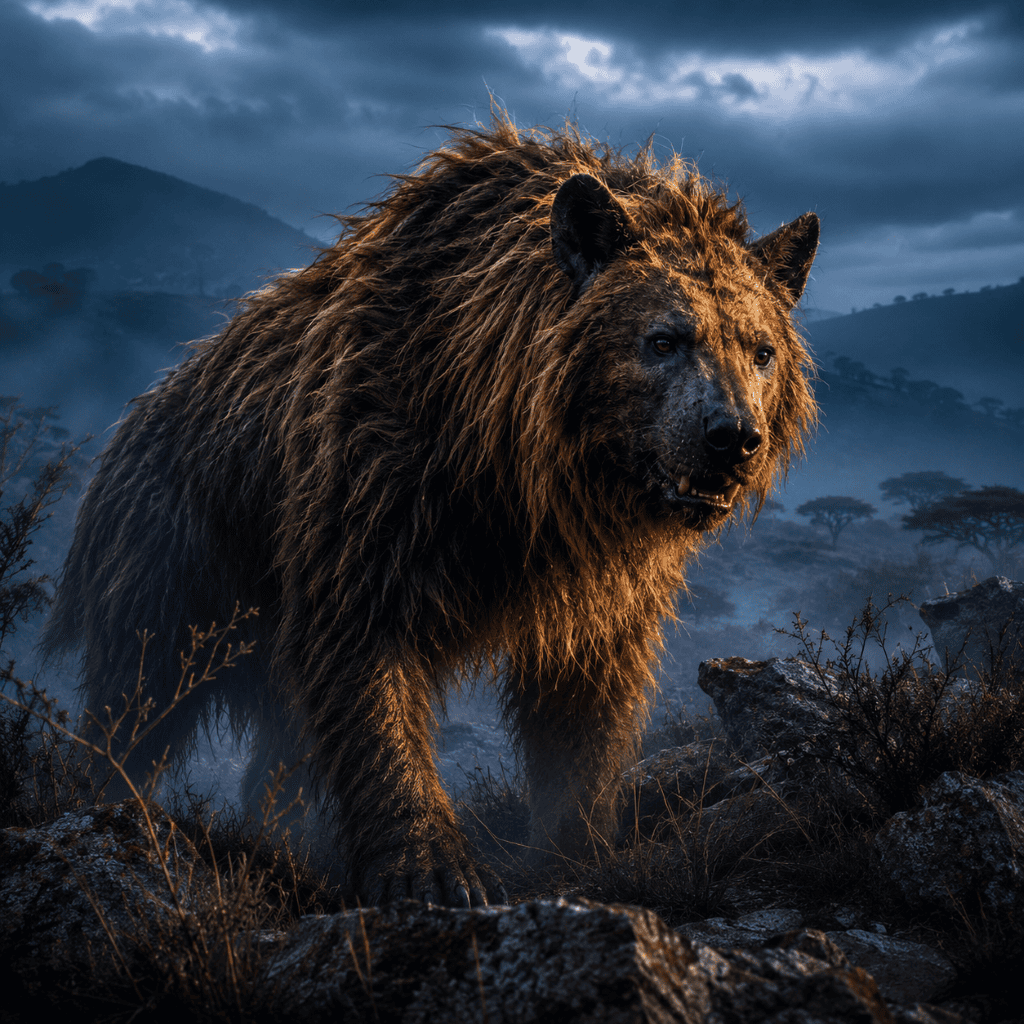
Descriptions of the Shivuverre vary across different regions, but several characteristics appear consistently in Nandi folklore. The creature is usually portrayed as much larger than a spotted hyena, with an unusually muscular body and immense strength. Witnesses often describe it as having a sloping back, powerful shoulders, thick forequarters, and a heavy build that gives it a bear-like silhouette despite its hyena-like appearance.
Its coat is generally said to be dark brown, reddish-brown, or nearly black, with shaggy fur around the neck and shoulders. The head features a long muzzle filled with strong teeth capable of crushing bone, while its small ears and short or nearly invisible tail further distinguish it from ordinary predators.
Some eyewitnesses have claimed the Shivuverre occasionally stands upright for brief moments, adding to its frightening appearance. Others describe its movement as an awkward shuffle before suddenly accelerating into a swift charge. Since these descriptions come from oral traditions and scattered eyewitness reports rather than verified observations, no single appearance can be considered definitive. Nevertheless, nearly every account agrees that the Shivuverre is an exceptionally large and intimidating nocturnal predator.
Family
Unlike many figures in mythology, the Shivuverre has no known parents, offspring, or divine ancestry. It is not viewed as a member of a supernatural family but instead belongs to a broader tradition of mysterious creatures found throughout East African folklore.
The Shivuverre is frequently associated with legendary beings such as the Chemosit, Kerit, and Koddoelo, which share similar reputations as dangerous predators lurking beyond the safety of human settlements. Some traditions treat these names as different creatures, while others use them interchangeably to describe the same legendary beast. Because these stories developed independently among neighbouring communities, their characteristics often overlap.
Rather than having a biological or mythological lineage, the Shivuverre forms part of a cultural family of legendary creatures that embody the dangers of the African wilderness and the mysteries that exist beyond human understanding.
Other names
The Shivuverre is known by several different names across Kenya and neighbouring regions, reflecting the diversity of local languages and storytelling traditions. The name most commonly associated with it is Chemosit, a Kalenjin term often translated as “devil” or “demon.” Other regional names include Kerit, Koddoelo, Ngoloko, and Nyangau, while some cryptozoological literature also connects it with the Mubende Beast of Uganda.
Outside Africa, researchers usually refer to the creature collectively as the Nandi Bear, a name popularized during the colonial period after European explorers recorded stories from the Nandi people. Although these names do not always describe identical creatures, they generally refer to the same tradition of a large, elusive predator that has resisted explanation for more than a century.
Powers and Abilities
The Shivuverre possesses no explicitly supernatural powers in traditional Nandi folklore. Instead, its fearsome reputation comes from its remarkable physical abilities and relentless hunting behaviour.
Legends describe the creature as extraordinarily strong, capable of overpowering livestock and, in some stories, breaking through the roofs or walls of huts to reach sleeping victims. It is almost always portrayed as a nocturnal hunter that moves silently under the cover of darkness before launching sudden attacks. This ability to remain unseen until the final moment has made it one of the most feared creatures in East African folklore.
Stories also emphasize its endurance and intelligence. The Shivuverre is said to avoid large groups of people while targeting isolated individuals or unattended animals. Some accounts even suggest it learns the habits of villages before striking, making it seem almost unnaturally cunning.
While these abilities belong to folklore rather than verified zoology, they reinforce the creature’s image as a perfect predator—one that survives because it is rarely seen and even more rarely escapes into daylight.
Modern Day Influence
Today, the Shivuverre remains one of Africa’s best-known cryptids and continues to inspire both folklore enthusiasts and cryptozoologists. Although mainstream zoology does not recognize it as a real species, theories about its identity continue to generate debate. Some researchers believe sightings may have involved unusually large hyenas, while others have proposed baboons, honey badgers, or even extinct mammals whose legends survived long after the animals disappeared.
Beyond scientific speculation, the Shivuverre has become a symbol of East Africa’s rich oral traditions. It frequently appears in books on mysterious creatures, documentaries about cryptids, online discussions, and fantasy games inspired by world folklore. Modern storytellers also use the legend to celebrate the cultural heritage of the Nandi people while exploring humanity’s enduring fascination with monsters hidden beyond the edge of civilization.
As forests continue to shrink and wildlife habitats change, reported sightings have become increasingly rare. Yet the legend endures because it represents something larger than an undiscovered animal. The Shivuverre reminds us that even in an age of satellites and scientific exploration, stories of the unknown continue to capture the human imagination.
Related Images


Source
Wikipedia. (2026). Nandi Bear. Retrieved from https://en.wikipedia.org/wiki/Nandi_bear
Cryptid Wiki. (2026). Nandi Bear. Retrieved from https://cryptid.fandom.com/wiki/Nandi_Bear
Hobley, C. W. (1913). Footprint of the Nandi Bear. Journal of the East Africa and Uganda Natural History Society.
Soule, G. (1961). The Mystery of the Nandi Bear. New York: Doubleday.
Leakey, L. (1930s). Speculations on the Nandi Bear. Nairobi: East African Natural History Society.
Andrews, C. W. (1923). On the Possible Identity of the Nandi Bear. Proceedings of the Zoological Society of London.
Jacobs, L. L. (2000). Cryptids and Extinct Mammals: A Paleontological Perspective. Dallas: Southern Methodist University Press.
Frequently Asked Questions
What is the Shivuverre in Nandi mythology?
The Shivuverre is a legendary cryptid from the oral traditions of the Nandi people of Kenya. It is described as a massive nocturnal predator feared for attacking livestock and, in some legends, humans.
Is the Shivuverre the same as the Nandi Bear?
Many researchers consider the Shivuverre to be a regional name or variation of the legendary Nandi Bear, although some local traditions distinguish them as separate creatures.
Does the Shivuverre have supernatural powers?
Traditional stories focus more on the Shivuverre’s incredible strength, stealth, and intelligence than on magical abilities. Its terrifying reputation comes from its behaviour as a relentless predator.
Has the Shivuverre ever been scientifically discovered?
No. Despite numerous eyewitness reports and cryptozoological investigations, there is no verified scientific evidence proving the existence of the Shivuverre as a distinct species.
Why is the Shivuverre important in Nandi folklore?
The Shivuverre symbolizes the dangers of the wilderness and the mysteries that exist beyond human knowledge. It remains one of the best-known legendary creatures in East African folklore and continues to inspire stories today
