


Ozidi : The Legendary Warrior of Ijaw Tradition
At a glance
| Description | |
|---|---|
| Origin | Ijaw Mythology |
| Classification | Mortals |
| Family Members | Ozidi Senior (Father), Oreame (Grandmother) |
| Region | Nigeria |
| Associated With | Vengeance, Justice, Superhuman Strength, Magic, Warfare |
The Mythlok Perspective
In Mythlok’s Perspective, Ozidi represents the archetype of the avenger shaped by destiny rather than choice. His story reflects a cycle where justice is pursued through destruction, raising questions about whether restoration can ever be separated from violence. The guiding presence of Oreame suggests that wisdom and power must coexist, yet even this balance does not prevent tragedy. This places Ozidi alongside figures like Achilles from Greek tradition and Bhima from Indian epics, both of whom embody strength tied to vengeance and duty. Yet Ozidi’s reliance on sorcery and ancestral guidance gives him a uniquely African identity rooted in communal memory rather than individual glory.
Ozidi
Introduction
Ozidi stands as one of the most powerful heroic figures in Ijaw tradition, emerging from the rich oral storytelling culture of Nigeria’s Niger Delta. At the heart of his legend lies the Ozidi Saga, a ritual epic performed through chant, music, and dramatic reenactment. The story originates from the ancient city-state of Orua and revolves around a deeply personal and political conflict that shapes the hero’s destiny.
Ozidi is not an ordinary warrior. He is born after the death of his father, Ozidi Senior, who was assassinated in a conspiracy tied to leadership struggles within the community. This makes Ozidi a posthumous child whose very existence is tied to vengeance and restoration. Guided by his formidable grandmother Oreame, a powerful sorceress, Ozidi grows into a warrior destined to confront those responsible for his father’s fall.
The saga itself gained wider recognition when it was documented by J. P. Clark-Bekederemo, based on a performance by the bard Okabou Ojobolo in the 1960s. Scholars such as Isidore Okpewho later examined its structure, placing it among the great oral epics of the world.
Physical Traits
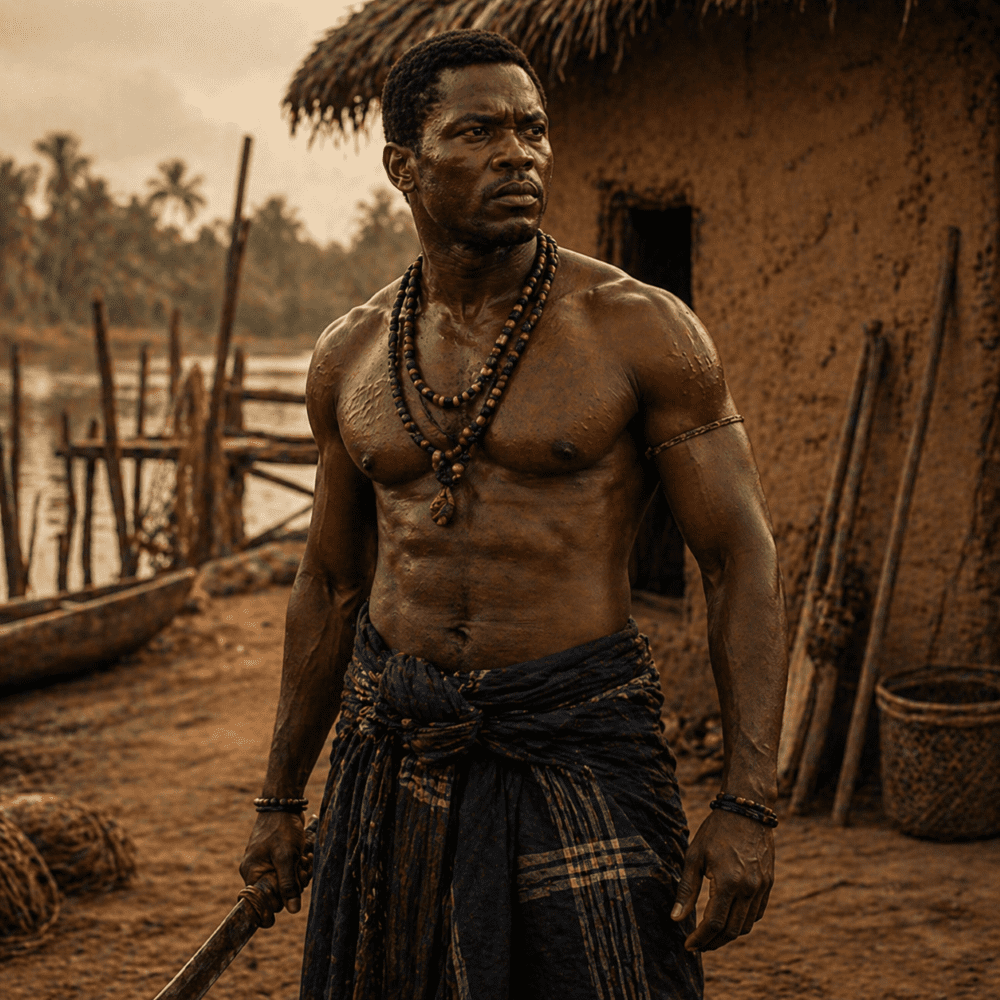
Ozidi’s physicality is described less through precise measurements and more through the overwhelming impression he leaves on those around him. From an early age, he displays unusual strength and dominance, often overpowering others unintentionally. This early display of power signals that he is no ordinary human but a figure shaped by destiny and supernatural influence.
As he matures, Ozidi becomes a warrior of immense presence, capable of confronting enemies who are themselves enhanced by magic or monstrous traits. His battles are not merely physical contests but symbolic clashes between order and chaos. Before combat, he undergoes a ritual transformation that elevates him beyond human limits. In some accounts, he produces his weapons from within himself, suggesting that his power is both internal and mystical.
Rather than focusing on appearance, the tradition emphasizes energy, intensity, and presence. Ozidi is portrayed as unstoppable in battle, his body fortified by protective charms and rituals that render him resistant to conventional weapons. This reinforces his identity as a hero shaped as much by spiritual forces as by physical strength.
Family
Family lies at the core of Ozidi’s story, providing both the motivation for his actions and the support system that enables his rise. His father, Ozidi Senior, was a respected figure within the council of Orua. However, political tensions and rivalries led to his assassination, an act that disrupts the balance of power within the community.
Ozidi’s birth after this tragedy gives his life a singular purpose. He is not raised in ignorance of his father’s fate; instead, he is guided toward fulfilling a mission of justice. His grandmother Oreame plays the most significant role in shaping his journey. As a sorceress with deep knowledge of spiritual forces, she trains, protects, and empowers him.
Oreame’s influence extends beyond guidance. She actively participates in his battles through magical intervention, ensuring that he survives encounters with enemies who possess their own supernatural abilities. Ozidi’s mother, though present in the narrative, remains a quieter figure, representing continuity and lineage rather than direct involvement in the conflict. Together, this family dynamic reflects a blend of ancestral duty and spiritual mentorship, emphasizing that Ozidi’s strength is not his alone but part of a larger lineage.
Other names
Ozidi is most commonly identified simply by his name, though distinctions are sometimes made between Ozidi Senior and Ozidi Junior to clarify generational roles within the story. The narrative itself is widely known as the Ozidi Saga, though variations such as the Ozidi Epic or Ijo Ozidi Saga appear in academic and cultural discussions.
These variations reflect the oral nature of the tradition. Different performers, communities, and interpretations may adjust elements of the story while preserving its central themes. Despite these variations, Ozidi’s identity as an avenger-hero remains consistent across versions.
Powers and Abilities
Ozidi’s abilities are a fusion of physical strength and magical empowerment. His invulnerability is one of his defining traits, achieved through ritual preparations involving potent mixtures and charms. These protections allow him to withstand weapons that would normally be fatal, reinforcing his role as a nearly unstoppable force.
His weaponry is equally extraordinary. One of the most notable is a multi-bladed sword often described as capable of attacking enemies from a distance, symbolizing both technological and mystical superiority. In addition to this, Ozidi demonstrates mastery in combat techniques that combine agility, precision, and overwhelming force.
Oreame’s influence enhances these abilities further. Through her magic, Ozidi gains access to tools such as enchanted arrows and healing substances that sustain him during battle. In some accounts, he can be revived or restored through her interventions, blurring the line between mortality and immortality. These powers are not merely for spectacle. Each ability serves a narrative purpose, reinforcing the idea that Ozidi is an agent of justice, equipped to confront forces that threaten the balance of his world.
Modern Day Influence
The legacy of Ozidi extends far beyond its origins as an oral performance. The work of J. P. Clark-Bekederemo transformed the saga into a written play, making it accessible to global audiences and academic study. His adaptation introduced elements of classical tragedy, highlighting the moral complexities of Ozidi’s actions.
Scholarly analysis by Isidore Okpewho further explored the narrative’s structure and thematic depth, positioning it within broader discussions of epic storytelling. The saga is now studied alongside other world epics, emphasizing the richness of African oral traditions.
In contemporary culture, Ozidi continues to influence literature, theater, and identity within the Niger Delta. Festivals and performances keep the story alive, ensuring that it remains a living tradition rather than a static text. Musicians and artists have also drawn inspiration from the saga, integrating its themes into modern creative expressions.
Related Images

Source
Clark, J. P. (1966). Ozidi. Oxford University Press.
Okpewho, I. (2014). Blood on the Tides: The Ozidi Saga and Oral Epic Narratology. University of Rochester Press.
Clark, J. P. (1991). The Ozidi Saga. Ibadan University Press. (Adapted from oral transcription.)
Wikipedia. (2024). The Ozidi Saga. https://en.wikipedia.org/wiki/The_Ozidi_Saga
Mythic Remembering. (2024). Ozidi Saga. https://mythicremembering.com/books/ozidi-saga/
Adeboyefa. (2019). Ozidi by J. P. Clark. https://adeboyefa.blogspot.com/2019/01/ozidi-by-j-p-clark-ijaw-play.html
TV Tropes. (n.d.). Ijaw Mythology. https://tvtropes.org/pmwiki/pmwiki.php/Myth/IjawMythology
Taylor, R. D. (n.d.). Essay on Ozidi. http://www.richard-dean-taylor.de/essay-ozidi_2.html
Frequently Asked Questions
Who is Ozidi in Ijaw tradition?
Ozidi is a legendary warrior-hero from Ijaw oral tradition, known for avenging his father and restoring justice in Orua.
What is the Ozidi Saga about?
It tells the story of Ozidi’s rise and his battles against those who murdered his father in a political conspiracy.
Is Ozidi a god or a human?
Ozidi is a mortal hero with supernatural powers granted through magic and spiritual guidance.
Who guided Ozidi in his journey?
His grandmother Oreame, a powerful sorceress, trained and protected him throughout his quest.
Why is Ozidi important today?
He remains a symbol of justice and cultural identity, influencing literature, performance, and African epic studies.
