


Minyma Kuniya : The Ancestral Python Woman of Aṉangu Tradition
At a glance
| Description | |
|---|---|
| Origin | Yankunytjatjara Mythology |
| Classification | Spirits |
| Family Members | N/A |
| Region | Australia |
| Associated With | Ancestral presence, Woma python identity |
The Mythlok Perspective
In Mythlok’s Perspective, Minyma Kuniya challenges the assumption that mythological power must be separated from the natural world. Unlike the Greek serpent Python, whose identity is framed through a conflict with Apollo, Kuniya belongs to a living cultural landscape where ancestral presence, law and responsibility remain connected. Her significance cannot be reduced to a battle or a supernatural ability. She represents a different way of understanding place: the land is not merely a setting for stories but an essential part of cultural knowledge and identity.
Minyma Kuniya
Introduction
Minyma Kuniya is an ancestral woma python woman associated with Uluru in Central Australia. She occupies an important place in the Tjukurpa traditions of the Aṉangu peoples, including the Pitjantjatjara and Yankunytjatjara communities. Her presence is closely connected with Muṯitjulu Waterhole, a significant cultural site at the base of Uluru. The name Kuniya refers to the woma python, while minyma means woman in the relevant Western Desert language context. Together, the name identifies her as the ancestral Python Woman, a figure whose significance extends beyond her animal form.
In Aṉangu tradition, Tjukurpa encompasses the ancestral foundations of Country, cultural law, relationships, knowledge and responsibilities. It is not simply a collection of stories about supernatural beings. It provides a framework for understanding the land and the obligations people have towards it. Minyma Kuniya is publicly associated with Wati Liru, the ancestral venomous snake figure whose path crosses hers at Uluru. Their connection gives the surrounding landscape cultural meaning that remains important to Aṉangu communities today.
However, the story belongs to its traditional custodians. Parks Australia emphasises that Tjukurpa knowledge must be approached with respect for Aṉangu cultural authority. Understanding Minyma Kuniya therefore involves recognising both her significance as an ancestral being and the continuing relationship between Indigenous knowledge and the land.
Physical Traits
Minyma Kuniya is identified with the woma python, a non-venomous Australian snake scientifically known as Aspidites ramsayi. Unlike mythological figures represented primarily through human appearance, her identity is inseparable from her serpent form. The woma python is a ground-dwelling snake native to Australia. Its physical characteristics provide a natural reference for understanding the animal associated with Kuniya, although the ancestral being should not be reduced to a zoological description.
Public cultural accounts identify Minyma Kuniya as a female ancestral python. They connect her movements with the rock formations and other physical features of Uluru, reflecting the understanding that ancestral activity and the landscape are inseparable within Tjukurpa. The rocks, caves and waterhole associated with her presence are not merely scenic features. They form part of a living cultural landscape in which the physical environment carries meaning, memory and responsibility.
It is important to distinguish these cultural associations from claims about her individual appearance. Publicly available sources do not establish a single detailed physical portrait that applies to every traditional account. A responsible description therefore focuses on her identity as the ancestral woma python woman rather than inventing details about her size, colours or supernatural appearance.
Family
Minyma Kuniya’s publicly documented narrative includes a relationship with a nephew whose death is associated with the conflict involving Wati Liru and other Liru figures. This family connection is central to widely published descriptions of the Kuniya and Liru tradition. It places Minyma Kuniya within a network of relationships rather than presenting her as an isolated supernatural character.
Her association with her nephew also illustrates why kinship is an important consideration when interpreting Indigenous ancestral traditions. Relationships between individuals, communities and Country carry responsibilities that cannot always be adequately explained through the categories used in European mythology.
The available public sources do not provide a complete family genealogy for Minyma Kuniya. They do not establish the names of her parents, siblings or partner. These details should not be invented to create a more conventional mythological family tree. Her relationship with her nephew is therefore the most appropriate family detail to include in a general reference article, with the understanding that published accounts do not necessarily represent every community’s version of the tradition.
Other names
Minyma Kuniya is commonly referred to as Kuniya or Python Woman in English-language accounts of the Uluru ancestral traditions. The expression Woma Python Woman identifies her association with the Australian snake species. Senior Python Woman also appears in published descriptions of her role in the publicly shared Kuniya and Liru narrative.
Wati Liru is the name associated with the male ancestral snake figure who appears alongside Kuniya in accounts of the tradition. English descriptions commonly translate this figure as Poisonous Snake Man or Deadly Snake Man. These names should be understood within their linguistic and cultural contexts. English translations help readers recognise the figures, but they cannot convey every meaning carried by the original terminology.
Minyma Kuniya is also sometimes discussed under the broader heading of Australian Aboriginal mythology. However, this label covers many distinct cultural traditions and should not obscure the specific Aṉangu context of her story. She should not automatically be classified as a Rainbow Serpent simply because she is a powerful ancestral snake. Her established identity is that of the woma python woman associated with Uluru. Maintaining this distinction helps preserve the cultural specificity of the tradition.
Powers and Abilities
Minyma Kuniya is recognised as an ancestral being whose significance is connected with the shaping and cultural meaning of Uluru. Public accounts describe her movements and her encounter with Wati Liru as part of the ancestral history associated with the landscape. Her association with the physical features of Uluru reflects a central aspect of Tjukurpa: the land is understood through the activities and continuing presence of ancestral beings. Rock formations and other geographical features can therefore hold cultural significance beyond their geological origins.
Published accounts also associate Minyma Kuniya with the use of a wana, or digging stick, during her confrontation with a Liru warrior. This object is part of the publicly documented narrative and provides a connection between an ordinary cultural implement and the actions attributed to an ancestral figure. Her importance should not be measured through a conventional catalogue of magical abilities. Tjukurpa does not function as a fantasy system in which powers are necessarily ranked, quantified or separated from the landscape.
Instead, Minyma Kuniya’s significance emerges from her status as an ancestral being and from the relationships among Country, cultural law and human responsibility. The public accounts establish her as a powerful figure within this tradition, but they do not provide a comprehensive inventory of her abilities. Respecting these distinctions allows readers to understand her cultural importance without imposing an unrelated framework of supernatural powers.
Modern Day Influence
Minyma Kuniya remains closely associated with Uluru and its continuing cultural significance for Aṉangu communities. Her presence is particularly connected with Muṯitjulu Waterhole, which visitors can reach by following the Kuniya Walk within Uluṟu-Kata Tjuṯa National Park. The walking track provides an opportunity to encounter the landscape in which the Kuniya and Liru traditions are situated. Parks Australia presents this area as a living cultural environment, where ancestral presence and cultural responsibilities remain relevant rather than belonging exclusively to the distant past.
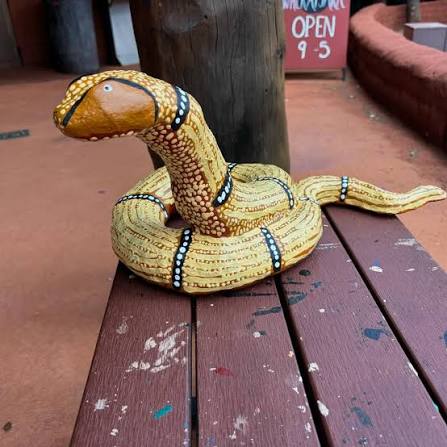
Her influence is also visible in the architecture of the Uluṟu-Kata Tjuṯa Cultural Centre. The centre’s design incorporates the form of Kuniya, the woma python woman, alongside Liru, reflecting the cultural significance of the ancestral figures associated with Uluru. Aṉangu art provides another means through which cultural knowledge and identity continue to be expressed. Community-based initiatives such as Walkatjara Art share selected cultural narratives through artistic practice while supporting the continuing cultural and economic life of the community.
These contemporary expressions demonstrate that Minyma Kuniya is not simply a character preserved in an old story. Her significance is connected with living traditions, cultural identity and the relationship between people and Country. Visitors can learn more about the publicly shared aspects of her cultural context through appropriate interpretation at Uluru. Such engagement should be guided by respect for Aṉangu custodianship, including restrictions on sensitive information, photography and the reproduction of traditional knowledge.
Minyma Kuniya’s continuing presence at Uluru ultimately highlights the importance of understanding ancestral traditions on their own cultural terms. Her significance lies not only in the figure herself but also in the enduring connection between Tjukurpa, the landscape and the people responsible for its care.
Related Images

Source
ArchitectureAu. (1996, March 1). Liru and Kuniya. https://architectureau.com/articles/liru-and-kuniya/
Australian Institute of Aboriginal and Torres Strait Islander Studies. (n.d.). An insight into Uluru: The Mala walk and the Mutitjulu walk [Catalogue record]. https://aiatsis.gov.au/collections/item/r000011385652
Layton, R. (1986). Uluru: An Aboriginal history of Ayers Rock. Australian Institute of Aboriginal Studies.
Museums Victoria. (2023, June 2). Liru: Animal figure, Pitjantjatjara, Ernabella, Desert Central, South Australia [Collection record]. https://collections.museumsvictoria.com.au/items/233591
Parks Australia. (2024, March 7). Cultural centre building. Uluṟu-Kata Tjuṯa National Park.
https://uluru.gov.au/things-do/cultural-centre/cultural-centre-building/
Parks Australia. (2025, June 4). The Kuniya & Liru stories. Uluṟu-Kata Tjuṯa National Park.
https://uluru.gov.au/discover/culture/stories/kuniya-liru-stories/
Parks Australia. (n.d.). Tjukurpa [Fact sheet]. Uluṟu-Kata Tjuṯa National Park.
https://uluru.gov.au/static/58c59795b85f20c2a46409965fb6416c/uktnp-document-fs-tjukurpa.pdf
Walkatjara Art. (2021, August 10). Kuniya & Liru (Python Woman & Poisonous Snake Man).
https://walkatjara.com/kuniya-liru-woma-python-woman-poisonous-snake-man/
Frequently Asked Questions
Who is Minyma Kuniya?
Minyma Kuniya is an ancestral woma python woman in Aṉangu traditions, associated with Uluru, Tjukurpa and the culturally significant Muṯitjulu Waterhole.
What animal is Minyma Kuniya?
Minyma Kuniya is associated with the woma python, a non-venomous Australian snake scientifically known as Aspidites ramsayi.
Which mythology does Minyma Kuniya belong to?
Minyma Kuniya belongs to Aṉangu ancestral traditions, including those associated with the Pitjantjatjara and Yankunytjatjara peoples of Central Australia.
Who is Wati Liru in Minyma Kuniya's story?
Wati Liru is the ancestral venomous snake man associated with Minyma Kuniya in publicly documented accounts of the traditions connected with Uluru.
Where is Minyma Kuniya associated with?
Minyma Kuniya is associated with Uluru and Muṯitjulu Waterhole in Australia’s Northern Territory, a culturally significant landscape within Uluṟu-Kata Tjuṯa National Park.


