
Melu : The Blaan Creator God of the Philippines
At a glance
| Description | |
|---|---|
| Origin | Philippine Mythology |
| Classification | Gods |
| Family Members | N/A |
| Region | Philippines |
| Associated With | Creation, Sky, Humanity, Correction of flaws |
The Mythlok Perspective
In Mythlok’s Perspective, Melu represents a deeply personal form of creation where the divine and the material are inseparable. Unlike distant creator gods, he embodies the world itself, making existence an extension of divine substance. His narrative reflects a balance between perfection and flaw, where creation is both intentional and evolving. This mirrors figures like the Mesopotamian creator deities who shape humans from clay, and the Norse giant Ymir whose body becomes the world. Across cultures, the idea remains consistent: creation is not just an act, but a transformation of being itself.
Melu
Introduction
Melu stands as one of the most fascinating creator figures in Philippine indigenous tradition. He belongs to the Blaan people of Mindanao, an ethnic group whose worldview is deeply rooted in oral storytelling and cosmological symbolism. In these narratives, Melu is not just a distant divine force but an active creator who shaped both the earth and humanity.
Unlike many creator gods who form the world from external elements, Melu’s creation is deeply personal. He crafts the earth from his own body, using material that reflects both purity and transformation. This idea positions him as a self-contained source of existence, embodying both creation and substance.
His myths also explore imperfection. Human flaws, rather than being accidental, are woven into the story of creation itself. Through these narratives, the Blaan express a worldview where divine intention and human limitation coexist. Melu’s story is therefore not just about beginnings, but about understanding the nature of life and its imperfections.
Physical Traits
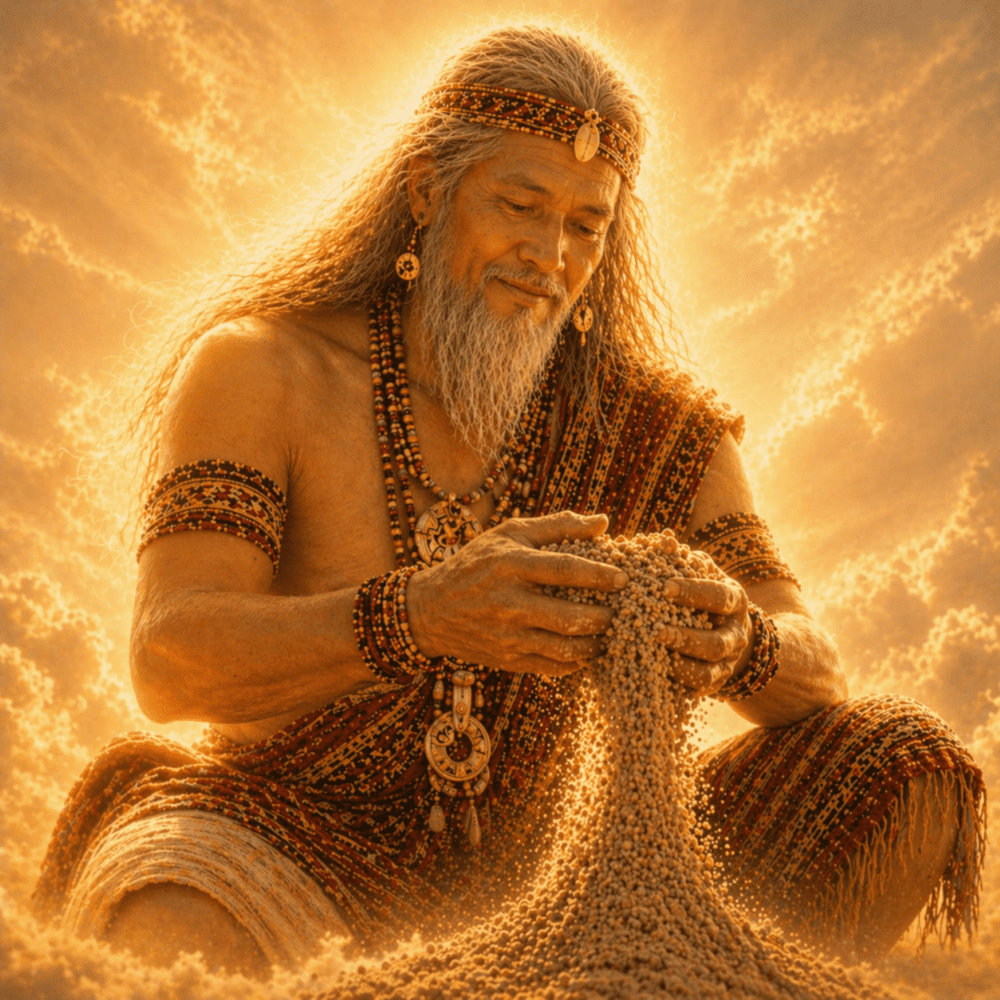
Melu’s physical description reinforces his divine status in a highly symbolic way. He is portrayed as an immense being who resides above the clouds, so vast that he fills the entire sky when seated. This scale is not merely visual but conceptual, representing his dominance over creation and existence.
His white skin is often explained through his constant act of cleansing himself. This detail is important because it connects purity with creation. The act of cleaning produces the material from which the earth is formed, turning a simple bodily process into a cosmic event.
Equally striking are his golden teeth, which signify not just wealth but divine perfection. Gold, in many cultures, represents incorruptibility and eternal value. In Melu’s case, it emphasizes that he exists beyond decay and imperfection, even though the world he creates does not.
Family
The role of Melu’s companions varies depending on the version of the myth, but these relationships add depth to the act of creation. One of the most notable figures associated with him is Tau Tana, also known as Tau Dalom Tana. This being emerges from beneath the earth and assists in shaping humanity.
Their collaboration is not without tension. In one version, Tau Tana mistakenly places human noses upside down, creating a flaw that could have endangered early humans. This moment highlights a key theme in Blaan mythology: creation is not always perfect, even among divine beings.
Other traditions introduce additional figures such as Fiuweígh, Dwata, and Saweígh. In these narratives, Melu is often the most powerful among them, acting as the central force of creation while others contribute to specific aspects of life. These variations suggest a shared cosmology where creation is both collaborative and hierarchical.
Other names
Melu is most consistently known by his primary name across Blaan oral traditions. Unlike many deities whose identities shift significantly across regions, Melu retains a stable identity, reinforcing his importance as a central creator figure.
Some variations in pronunciation or spelling appear due to oral transmission, but these do not alter his core identity. He is sometimes described simply as the supreme being or the creator of the world, titles that emphasize his role rather than introduce new names. This consistency makes Melu distinct within Philippine traditions, where many deities evolve differently across communities.
Powers and Abilities
Melu’s powers revolve around creation, transformation, and correction. His most defining act is the formation of the earth from the material produced by his own body. This act connects the divine directly to the physical world, making creation both intimate and tangible.
He also creates the first humans from leftover material, shaping them in his own image but on a smaller scale. This detail reflects a common theme in many traditions where humans are derived from divine essence, yet remain limited in comparison.
One of the most memorable aspects of his power is his ability to correct mistakes. When Tau Tana incorrectly places human noses, Melu intervenes and fixes them, ensuring human survival. This act shows that creation is not a single moment but an ongoing process that includes refinement.
However, Melu does not remain permanently involved with humanity. In some versions, he withdraws after humans begin to reproduce independently. This withdrawal introduces the idea of divine distance, where the creator steps back, allowing the world to function on its own.
Modern Day Influence
Melu continues to hold cultural significance, especially among the Blaan people. His stories are preserved through oral traditions, serving as a foundation for identity and heritage. These narratives connect modern generations to their ancestral worldview, reinforcing continuity in a rapidly changing world.
Anthropologists and scholars study Melu as part of Philippine indigenous cosmology, offering insights into how early communities understood creation, nature, and human existence. His myths provide valuable context for pre-colonial belief systems that existed long before external influences reshaped the region.
In recent years, there has been renewed interest in indigenous narratives across the Philippines. Cultural platforms, academic research, and digital storytelling initiatives have helped bring figures like Melu into wider awareness. While he may not appear prominently in mainstream media, his presence is growing in cultural preservation efforts and educational discussions.
Related Images
Source
Barton, R. F. (1940). The half-way sun: Life among the headhunters of the Philippines. American Philosophical Society.
Fansler, D. L. (1921). Filipino popular tales. American Folk-Lore Society.
Philippine mythology. (2005, February 3). In Wikipedia. https://en.wikipedia.org/wiki/Philippine_mythology
Raats, P. J. (1969). Symbols and sentiments: A structural study of Bagobo myths and rites. University of California Press.
Ramos, M. D. (1971). Creatures of Philippine lower mythology. University of the Philippines Press.
The story of the creation. (n.d.). In Creation myths from the Philippines. University of Pittsburgh. https://sites.pitt.edu/~dash/creation-phil.html
Philippine folk tales. (2017, December 31). SurLaLune Fairytales. https://surlalunefairytales.com/book.php?id=137&tale=4659
List of Philippine mythological figures. (2007, April 24). In Wikipedia. https://en.wikipedia.org/wiki/List_of_Philippine_mythological_figures
Frequently Asked Questions
Who is Melu in Philippine mythology?
Melu is a creator god of the Blaan people who formed the earth and humans from his own body.
How did Melu create the world?
He created the earth from dead skin he rubbed off his body, shaping it into land.
Why are humans imperfect in Melu’s myth?
Imperfections came from mistakes during creation, later corrected by Melu.
Who helped Melu create humans?
Tau Tana assisted but made errors, which Melu later fixed.
Where is Melu believed to live?
He is said to reside in the sky, above the clouds.