
Mai Gangadi : The Drummer Spirit of Hausa Tradition
At a glance
| Description | |
|---|---|
| Origin | Hausa Mythology |
| Classification | Spirits |
| Family Members | N/A |
| Region | Nigeria, Niger |
| Associated With | Rhythm, Drumming, Trance, Music |
The Mythlok Perspective
In Mythlok’s Perspective, Mai Gangadi represents the idea that sound itself can become sacred when structured with intention. He is less a character and more a force, embodying rhythm as a bridge between the physical and unseen worlds. Unlike deities who command through power, he operates through resonance, shaping experience rather than controlling it. This aligns closely with figures like the Yoruba drumming spirits or even the Greek concept of Orphic music, where sound influences reality. Across cultures, rhythm is rarely neutral; it is transformative. Mai Gangadi stands as a reminder that music, at its core, is one of humanity’s oldest spiritual technologies.
Mai Gangadi
Introduction
Mai Gangadi stands as one of the most fascinating spirits within Hausa spiritual tradition, particularly in the Bori possession system of West Africa. Rooted in regions of present-day Nigeria and Niger, Bori represents a deeply layered cosmology where spirits known as iskoki embody professions, emotions, and forces of nature. Within this system, Mai Gangadi is identified as the spirit of drumming and rhythm, a figure whose very identity is shaped by sound.
His name offers direct insight into his role. The word “ganga” refers to a traditional double-headed drum used widely in Hausa musical culture, while “Mai” signifies mastery or ownership. Together, the name translates to “Master of the Drum,” a title that reflects both authority and function. Mai Gangadi is not simply associated with music; he represents the idea that rhythm itself is a gateway between worlds.
In Bori belief, music is not entertainment but invocation. Spirits do not arrive without rhythm, and rhythm does not exist without intention. Mai Gangadi occupies this intersection, acting as both the energy behind ceremonial drumming and the force that allows trance to unfold. His presence reinforces the idea that sound, when structured with purpose, becomes a spiritual language.
Physical Traits
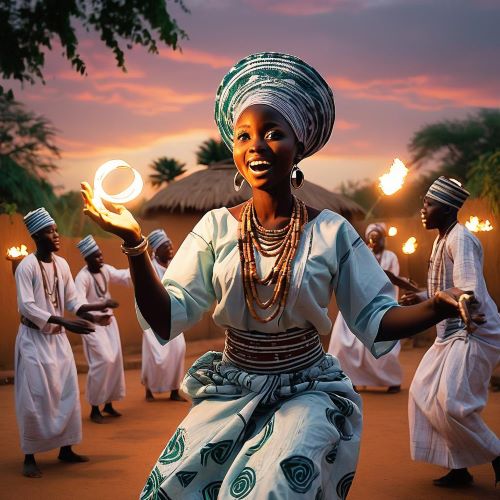
Mai Gangadi does not possess a fixed physical form in the conventional sense, as his presence is primarily experienced through spirit possession. When he manifests through a medium during Bori rituals, his identity becomes visible through movement rather than appearance.
Possessed individuals often display sharp, rhythmic gestures that mirror the act of drumming. Their hands strike thighs or air in controlled patterns, feet stamp in repeated beats, and the entire body seems to move in synchronization with an invisible instrument. The performance is energetic and precise, reflecting not chaos but controlled intensity.
Unlike calmer spirits associated with healing or introspection, Mai Gangadi is loud, expressive, and commanding. His presence fills the ritual space, drawing attention through motion and sound. In Bori ceremonies, the accuracy of these movements is essential, as the medium must embody the spirit convincingly. A successful manifestation is one where the rhythm feels authentic, as if the body itself has transformed into a drum.
Family
Mai Gangadi does not belong to a biological lineage, as Hausa spiritual systems define relationships through hierarchy and function rather than bloodlines. Instead, he exists within the structured framework of Bori spirit “Houses,” which categorize spirits based on roles and domains.
He is commonly associated with the Sixth House, a grouping that includes spirits linked to musicians and certain occupational identities. Within this structure, Mai Gangadi is often described as a subordinate or companion to more dominant spirits such as Sarkin Filani or Sarkin Aljan. These figures represent higher authority within the spirit hierarchy, while Mai Gangadi operates within a more specialized domain.
This positioning highlights an important feature of Hausa cosmology. Power is not always measured by dominance but by function. Mai Gangadi’s role is not to rule but to enable, to create the conditions through which rituals succeed. His relationships within the hierarchy emphasize cooperation rather than competition, reflecting a system where every spirit contributes to a larger balance.
Other names
While Mai Gangadi is the most widely recognized name, variations exist depending on regional dialects and oral traditions. He is sometimes referred to simply as the Drummer Spirit or the Master of the Ganga.
These titles do not alter his identity but reinforce it. In Hausa culture, names often describe function, and in this case, every variation continues to emphasize rhythm, sound, and musical authority. The consistency across names reflects how deeply his role is embedded in cultural understanding.
Powers and Abilities
Mai Gangadi’s influence is rooted in rhythm, but that rhythm carries multiple layers of meaning within Bori practice. His primary ability lies in transforming music into a medium of communication between humans and spirits.
Through drumming, he enables spirit possession. The steady beat of the ganga is not random; it acts as a signal that prepares the ritual space and guides the medium into trance. In this process, musicians are not performers but facilitators, using rhythm to “speak” in a language that spirits recognize.
Mai Gangadi governs this exchange. When he is present, the rhythm becomes sharper, more deliberate, and more powerful. The medium’s body responds instinctively, aligning movement with sound until the boundary between human and spirit begins to dissolve.
He also serves as a patron of musicians. In a cultural sense, he represents the idea that drumming is not merely learned but inspired. Musicians working within traditional frameworks are believed to channel a form of spiritual guidance, and Mai Gangadi embodies that connection.
Another aspect of his power lies in energizing ceremonies. His presence intensifies the atmosphere, drawing participants deeper into collective experience. The rhythm he represents is not passive; it drives emotion, movement, and transformation.
Modern Day Influence
Despite historical suppression due to the spread of Islam and colonial interventions, the legacy of Bori—and figures like Mai Gangadi—continues to persist in Hausa culture. While formal rituals may be less visible, their influence remains embedded in music, performance, and identity.
Traditional drumming styles still carry echoes of spiritual significance, even when performed in secular settings. Instruments like the ganga and kalangu are used in festivals and contemporary music, preserving the connection between rhythm and cultural expression.
Mai Gangadi also survives through oral tradition. Stories, songs, and ritual knowledge continue to pass between generations, ensuring that his role is not forgotten. In some cases, Bori practices have adapted into more private or syncretic forms, blending older beliefs with newer religious frameworks.
Modern artists and performers often draw inspiration from these traditions, incorporating rhythmic patterns and movement styles rooted in possession ceremonies. This evolution demonstrates that while the context may change, the core idea remains intact: rhythm is more than sound; it is identity.
Anthropologists and ethnomusicologists frequently study figures like Mai Gangadi to understand how music functions as both cultural expression and spiritual technology. His presence in academic discourse further highlights his importance as a symbol of how societies interpret sound as meaning.
Related Images




Source
Besmer, F. (1973). Hausa spirit possession and trance dance. Africa: Journal of the International African Institute, 43(1), 1–13.
Danfulani, U. H. D. (1999). Factors contributing to the survival of the Bori cult in Northern Nigeria. Numen, 46(4), 412–447.
Frank, B. (1998). Status and identity in Hausa society: Occupational spirits in Bori. Ethnology, 37(2), 123–139.
Greenberg, J. H. (1946). The influence of Islam on a Sudanese religion. Journal of the American Oriental Society, 66(1), 39–47.
Last, M. (1967). The Sokoto Caliphate. London: Longman.
Masquelier, A. (1994). Narratives of power, spirits of resistance: Muslim women’s engagement with Bori in Niger. Trenton: Africa World Press.
Masquelier, A. (2001). Prayer has eaten up the spirit: The decline of Bori spirit possession in Niger. Portsmouth: Heinemann.
Tremearne, A. J. N. (1914). The Ban of the Bori: Demons and Demon-Dancing in West Africa. London: Heath Cranton.
African Studies Center, Michigan State University. (2023). Hausa Animism and Spirit Possession. Retrieved April 20, 2026, from https://africa.isp.msu.edu/resources/hausa-animism
Encyclopedia.com. (2024). Bori Cult (Hausa Religion). In Encyclopedia of Religion. Retrieved April 20, 2026, from https://www.encyclopedia.com/environment/encyclopedias-almanacs-transcripts-and-maps/bori-cult
Frequently Asked Questions
Who is Mai Gangadi?
Mai Gangadi is a Hausa spirit of drumming in Bori tradition, representing rhythm, trance, and musical power in rituals.
What does Mai Gangadi represent?
He represents rhythm as a spiritual force that enables communication between humans and spirits through music.
Is Mai Gangadi a god or spirit?
Mai Gangadi is a spirit within the Bori system, not a supreme god.
What is the role of drums in Bori?
Drums act as a medium to invoke spirits and guide trance during possession ceremonies.
Does Mai Gangadi still influence culture today?
Yes, his influence survives in Hausa music, performance, and oral traditions.