
K’iche’ : The Sacred Language of Mayan Mythology
Mythlok Perspective
In Mythlok’s Perspective, K’iche’ occupies a role similar to that of Ancient Greek in relation to Homer or Sanskrit in relation to the Vedas. It is more than a language, it is a vessel carrying an entire worldview. What makes K’iche’ exceptional is that it preserved one of the world’s greatest Indigenous mythological works, the Popol Vuh, during a period when many native traditions faced extinction. Through K’iche’, we hear the voices of the Hero Twins, the creators of humanity, and generations of Maya storytellers. Its survival reminds us that language is not merely communication; it is memory, identity, and the bridge between ancestors and the future.
K’iche’
Introduction
K’iche’ (formerly spelled Quiché in many Spanish-language sources) is one of the most important Indigenous languages of the Americas. Spoken by more than one million people, primarily in Guatemala, it is the most widely spoken Mayan language today. Beyond its linguistic importance, K’iche’ occupies a unique place in world mythology because it is the language in which the famous Popol Vuh was recorded during the colonial era.
For the K’iche’ Maya, language has always been more than a tool of communication. It preserves sacred stories, ancestral knowledge, ceremonial traditions, and a worldview that stretches back centuries before European contact. Through K’iche’, generations have passed down myths of creation, the adventures of the Hero Twins, and the origins of humanity, ensuring that Mayan cosmology remains alive in the modern world.
Geographic Context
The K’iche’ language is primarily spoken in the western and central highlands of Guatemala. Major concentrations of speakers are found in the departments of Quiché, Totonicapán, Quetzaltenango, Sololá, and parts of Suchitepéquez. These mountainous regions formed the heartland of the historic K’iche’ civilization and continue to serve as important centers of Indigenous culture.
Historically, the K’iche’ people established one of the most powerful Maya states of the Postclassic Period. Their capital, Q’umarkaj (also known as Utatlán), emerged as a major political and religious center before the Spanish conquest in the sixteenth century. The influence of this kingdom helped elevate K’iche’ as a language of governance, ritual, and historical record.
Migration over the last century has also spread K’iche’ communities beyond Guatemala. Today, speakers can be found in southern Mexico and among Indigenous diaspora communities throughout the United States.
Script/Writing System
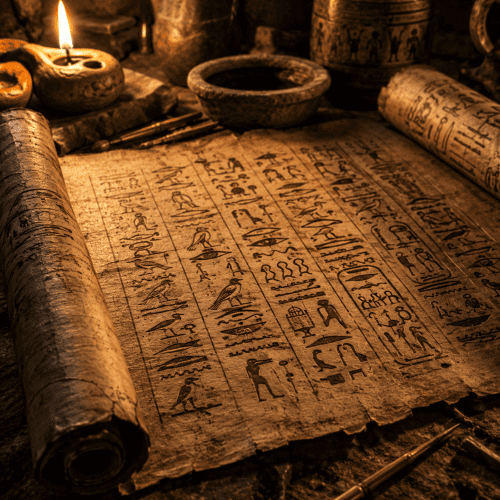
Like other Maya peoples, the ancestors of the K’iche’ were part of a broader civilization that developed one of the world’s most sophisticated writing systems. Ancient Maya scribes used hieroglyphic writing to record historical events, astronomical observations, royal genealogies, and religious beliefs.
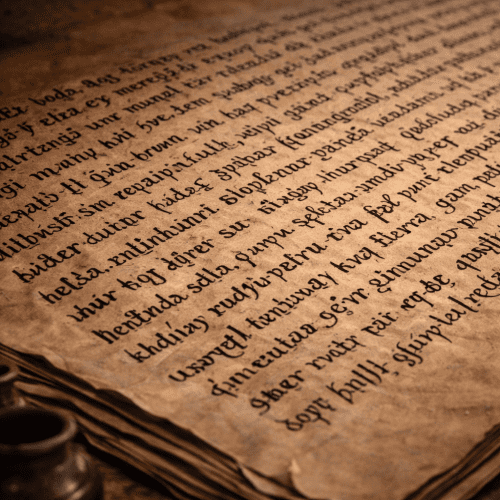
Following the Spanish conquest, however, the use of Maya glyphs rapidly declined. Indigenous scholars and community leaders began adapting the Latin alphabet to record their language. This transition proved crucial for the survival of K’iche’ mythology because it allowed traditional stories to be written down rather than relying solely on oral transmission.
The earliest surviving K’iche’ texts were produced during the sixteenth century using this adapted alphabet. In the twentieth century, efforts to standardize spelling led to the development of modern orthographies. Today, the Academia de Lenguas Mayas de Guatemala promotes an official writing system used in education, publications, and cultural preservation projects.
Mythological Texts Written
The most celebrated work associated with the K’iche’ language is the Popol Vuh (often written as Popol Wuj). Widely regarded as one of the greatest works of Indigenous literature, it preserves the sacred history of the K’iche’ Maya.
The text recounts the creation of the world, the formation of humanity, and the legendary adventures of the Hero Twins, Hunahpu and Xbalanque. It also traces the ancestral origins of K’iche’ ruling lineages, linking mythology with history and political identity.
Another important document is the Title of Totonicapán, a colonial-era text that combines genealogy, migration traditions, and cosmological narratives. Although often viewed as a historical record, it also preserves valuable mythological elements that illuminate K’iche’ beliefs about origins and sacred ancestry. Together, these texts provide some of the richest surviving evidence of pre-Columbian Indigenous thought anywhere in the Americas.
Transmission & Preservation
The survival of K’iche’ mythology is a remarkable story of resilience. Before European arrival, myths were primarily transmitted through oral tradition. Elders, ritual specialists, and storytellers ensured that sacred narratives remained part of community life.
Spanish colonization threatened many Indigenous traditions, and numerous cultural records were lost. However, K’iche’ scribes recognized the importance of preserving their heritage and began recording traditional narratives using the Latin alphabet. This decision allowed texts such as the Popol Vuh to survive despite centuries of political and religious pressure.
In the modern era, preservation efforts have expanded significantly. Schools in Indigenous regions increasingly teach K’iche’, while radio stations and community media broadcast in the language. Universities and cultural organizations have also digitized important manuscripts, making them accessible to scholars and community members around the world. These initiatives help ensure that K’iche’ remains a living language rather than simply a subject of historical study.
Symbolism & Cultural Role
For the K’iche’ people, language is deeply intertwined with identity. It carries the vocabulary of ceremonies, agricultural traditions, sacred geography, and social relationships that define community life.
Many traditional rituals continue to be conducted in K’iche’, particularly those connected to the Maya calendar, ancestral veneration, and agricultural cycles. The language preserves concepts that cannot always be translated directly into Spanish or English because they reflect uniquely Maya ways of understanding the universe.
K’iche’ also symbolizes cultural survival. Despite centuries of colonization, discrimination, and assimilation pressures, the language remains vibrant and widely spoken. For many Indigenous activists and cultural leaders, speaking K’iche’ represents both a connection to ancestral heritage and a commitment to preserving Indigenous knowledge for future generations.
Comparative Analysis
Among the many Indigenous languages of Mesoamerica, K’iche’ holds a distinctive position because of its extensive literary tradition. While Classical Nahuatl possesses a rich historical record, K’iche’ is uniquely associated with the Popol Vuh, one of the world’s most complete Indigenous creation narratives.
Compared with other Mayan languages such as Kaqchikel and Tz’utujil, K’iche’ enjoys greater international recognition due to both its large speaker population and its celebrated body of literature. The language’s role in preserving foundational Maya myths has made it a focal point for scholars studying Indigenous religion and cosmology.
Unlike the ancient Maya hieroglyphic tradition, which often requires specialized interpretation, K’iche’ texts written in the Latin alphabet became more accessible to later generations. This accessibility played a significant role in ensuring the survival and global influence of K’iche’ mythology.
Modern Influence
K’iche’ continues to shape cultural and intellectual life in Guatemala. Language revitalization programs have strengthened its presence in schools, universities, and public institutions. Organizations such as the Academia de Lenguas Mayas de Guatemala actively promote literacy and linguistic preservation.
Internationally, K’iche’ has gained recognition through the enduring influence of the Popol Vuh, which is studied in fields ranging from mythology and anthropology to comparative literature and religious studies. Its narratives have inspired writers, artists, filmmakers, and scholars across the globe.
The language has also become a symbol of Indigenous rights movements. Nobel Peace Prize laureate Rigoberta Menchú helped bring global attention to the experiences and cultural heritage of the K’iche’ people, highlighting the importance of preserving Indigenous languages in the modern era. Today, K’iche’ remains both a living language and a bridge to one of humanity’s most remarkable mythological traditions.

Sources
Britannica. (1998). K’iche’ | Maya, Guatemala, language. In Encyclopedia Britannica. Retrieved June 22, 2026, from https://www.britannica.com/topic/Kiche
Britannica. (1998). Popol Vuh | Mayan mythology, creation story, sacred text. In Encyclopedia Britannica. Retrieved June 22, 2026, from https://www.britannica.com/topic/Popol-Vuh
Centralspeak. (2024, April 14). Beyond words: The cultural significance of K’iche’ in Mayan history. Retrieved June 22, 2026, from https://centralspeak.com/beyond-words-the-cultural-significance-of-kiche-in-mayan-history/
History of Information. (2026, May 5). Popol Vuh, the Book of the People, is known from a single manuscript transcribed by Father Ximénez. Retrieved June 22, 2026, from https://www.historyofinformation.com/detail.php?id=3398
Mayan Languages.net. (2025, May 19). K’iche’. Retrieved June 22, 2026, from https://www.mayanlanguages.net/mayan-languages/kiche
Omniglot. (n.d.). Kʼicheʼ language and alphabet. Retrieved June 22, 2026, from https://www.omniglot.com/writing/kiche.htm
Pueblos Indígenas. (2025, April 21). K’iche’: Tradiciones, cultura, vestimenta y lengua. Retrieved June 22, 2026, from https://pueblosindigenas.es/guatemala/kiche-tradiciones-cultura-vestimenta-y-lengua/
Shaw, A. (2011). The Popol Vuh and the Dominican religious extirpation in highland Guatemala: Prologues and annotations of Fr. Francisco Ximénez. The Americas, 67(4), 503–528. Retrieved June 22, 2026, from https://www.cambridge.org/core/journals/americas/article/abs/popol-vuh-and-the-dominican-religious-extirpation-in-highland-guatemala
Wikipedia contributors. (2005–2026). Maya script. In Wikipedia, The Free Encyclopedia. Retrieved June 22, 2026, from https://en.wikipedia.org/wiki/Maya_script
Frequently Asked Questions
What is K’iche’?
K’iche’ is a Mayan language spoken primarily in Guatemala and is the most widely spoken Indigenous language in the country.
Why is K’iche’ important in mythology?
K’iche’ is the language in which the Popol Vuh, one of the most important Indigenous creation narratives in the world, was recorded.
Where is K’iche’ spoken today?
Most K’iche’ speakers live in the western highlands of Guatemala, though communities also exist in Mexico and the United States.
Is K’iche’ still spoken?
Yes. More than one million people speak K’iche’, making it one of the strongest surviving Indigenous languages in the Americas.
What is the Popol Vuh?
The Popol Vuh is a sacred K’iche’ text that tells the story of creation, the Hero Twins, and the ancestral origins of the K’iche’ Maya.