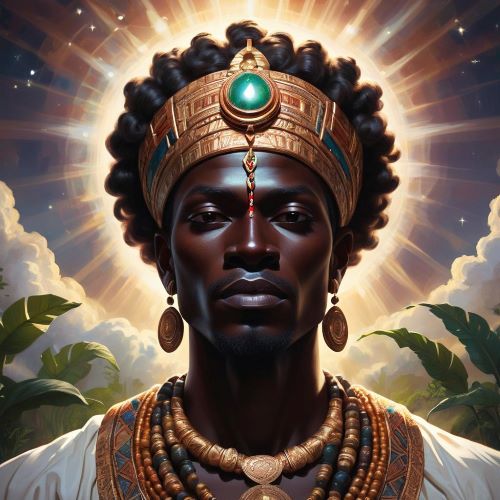
Ku-Jopleh : The Sacred Oracle and Storm Deity of the Kru People
At a glance
| Description | |
|---|---|
| Origin | Kru Mythology |
| Classification | Gods |
| Family Members | N/A |
| Region | Liberia |
| Associated With | Oracles, Wisdom, Storms, Thunder, Justice, Warfare, |
The Mythlok Perspective
In Mythlok’s Perspective, Ku-Jopleh resembles a blend of Odin’s wisdom, Zeus’s command of thunder, and the prophetic authority of ancient oracles, yet he remains uniquely Kru in character. Unlike many famous gods who dominate myths through battles and dramatic adventures, Ku-Jopleh’s greatest strength is guidance. His power comes from wisdom rather than conquest. The image of a deity whose voice echoes through thunder while advising entire communities makes him a striking symbol of leadership rooted in foresight. His story reminds us that the most influential figures are not always warriors or kings—they are often the voices that help societies make the right choices before conflict begins.
Ku-Jopleh
Introduction
Ku-Jopleh is one of the most fascinating divine figures in Kru mythology. Revered by the Kru people of present-day Liberia, especially the Sasstown Kru, he was regarded as a powerful deity whose wisdom guided entire communities. Unlike many gods who were worshipped primarily through temples or elaborate rituals, Ku-Jopleh was known for his role as an oracle. People sought his counsel before making important decisions involving leadership, warfare, farming, trade, and family matters.
According to tradition, Ku-Jopleh dwelled within a sacred cave on Mount Jidiah, also known as Mount Gedeh. From this remote location, his influence extended across the region. Oral traditions describe him as a divine authority whose judgments were trusted without question. Long before other spiritual figures rose to prominence among certain Kru communities, Ku-Jopleh occupied a position of immense religious importance.
His influence was not limited to spiritual matters. Historical traditions state that the Sasstown Kru consulted him when selecting the location of their coastal settlement. This connection between divine guidance and community development highlights how deeply Ku-Jopleh was woven into everyday life. Even today, he remains a respected figure in discussions of Kru heritage and indigenous Liberian spirituality.
Physical Traits
Ku-Jopleh differs from many mythological gods because stories rarely focus on his physical appearance. Traditional accounts emphasize that he was not a human being and was never commonly portrayed in human form. Instead, his presence was understood through the natural world around him.
Thunder was believed to be the voice of Ku-Jopleh. During violent storms, many interpreted the rumbling sky as evidence of the deity expressing anger or issuing warnings. Lightning was likewise associated with his power and presence. These connections transformed ordinary weather events into sacred manifestations of divine activity.
One of the most intriguing traditions linked to Ku-Jopleh is the existence of a massive footprint said to belong to him. Measuring roughly four feet in length, the footprint became a symbol of his extraordinary nature and supernatural power. Whether viewed as a sacred relic or a legendary marker, it reinforced the belief that Ku-Jopleh existed beyond the limits of ordinary humanity.
Rather than being defined by a body or physical form, Ku-Jopleh was defined by his presence. The storm clouds, thunderous skies, and sacred mountain landscapes served as reminders of the deity’s enduring influence.
Family
Unlike the gods of Greek, Norse, or Egyptian mythology, Ku-Jopleh is not associated with an extensive divine family tree. Available traditions do not identify parents, siblings, spouses, or children. Instead, he appears as a singular and independent deity whose authority existed without reference to a larger pantheon.
The closest thing to a familial relationship in the traditions surrounding Ku-Jopleh involves the Gbae-wynpo family, sometimes recorded as Gbao-Wynpo. This lineage held a unique and sacred responsibility within the community. Members of the family served as the only authorized intermediaries between the deity and the people.
Whenever individuals sought guidance from Ku-Jopleh, communication passed through these custodians. The family managed rituals, delivered messages, and received offerings brought by visitors. Since Ku-Jopleh was viewed as a spiritual being who had no need for material possessions, the gifts remained with the custodians rather than the deity himself. This special relationship elevated the Gbae-wynpo family to a position of considerable respect and authority within Sasstown society. Through them, the wisdom of Ku-Jopleh reached the wider community.
Other names
The name Ku-Jopleh appears in several forms throughout historical records and oral traditions. Differences in spelling often reflect variations in pronunciation, dialect, or the way early researchers recorded indigenous names. One commonly encountered variation is Ku Jopleh, which simply removes the hyphen while referring to the same deity. Historical documents also occasionally use Ku-jopleh with different capitalization.
Some traditions refer to him as Queer-Jorplehb, a title linked to his role as a powerful war deity and spiritual protector. Other descriptions emphasize his function rather than his name, leading to titles such as Oracle of Ku-Jopleh or Deity of the Kru. Although spellings vary, all of these references point to the same revered figure whose wisdom and authority shaped the lives of generations of Kru people.
Powers and Abilities
Ku-Jopleh’s greatest power was his extraordinary wisdom. Traditional accounts describe his counsel as flawless and beyond ordinary human understanding. Communities trusted his guidance because they believed his knowledge originated from a divine source.
As an oracle, Ku-Jopleh was consulted on nearly every important aspect of life. Leaders sought his approval before major decisions. Farmers looked for guidance regarding planting and harvests. Traders requested advice before embarking on commercial ventures. Families consulted him on marriages and social disputes.
His influence also extended into matters of governance and justice. Oral traditions suggest that he played a role in determining leadership and resolving conflicts within the community. His judgments carried tremendous weight because they were viewed as expressions of divine truth.
Beyond wisdom and divination, Ku-Jopleh possessed authority over natural forces. Thunder represented his voice, while storms signaled his emotional state. This connection to the weather made him both respected and feared. A powerful storm was not simply a natural event but a reminder that divine forces remained active in the world.
Because of his influence over both spiritual and practical affairs, Ku-Jopleh occupied a unique position among Kru deities. He was not merely a god to be worshipped but a source of guidance whose wisdom shaped the destiny of entire communities.
Modern Day Influence
Although Ku-Jopleh is no longer consulted as an active oracle, his legacy continues to survive within Kru cultural memory. Stories about the deity remain an important part of Liberian folklore and indigenous history.
One of the most remarkable traditions associated with Ku-Jopleh persists in Sasstown. During storms accompanied by thunder and lightning, a sacred elephant tusk horn is reportedly blown in his honor. The sound serves as a gesture of respect and remembrance, acknowledging the deity’s connection to the forces of nature.
The decline of the Gbae-wynpo custodial lineage marked the end of the traditional oracle system, yet reverence for Ku-Jopleh did not disappear. Instead, he evolved into a symbol of ancestral wisdom and cultural identity. His stories help preserve knowledge about pre-colonial Kru spirituality and the ways communities once sought guidance from sacred powers.
Today, he appears in collections of Liberian folklore, historical writings, and cultural studies. As interest in African mythology continues to grow worldwide, his story offers valuable insight into the rich spiritual traditions of the Kru people and the enduring relationship between humanity, nature, and the divine.
Related Images






Source
Akpan, P. U. (1997). Information on the customs and rituals of the Krahn, Kru, Kwa, Gio and Kpelle tribes (Immigration and Refugee Board of Canada, Response to Information Request No. LBR27521.E). ecoi.net. https://www.ecoi.net/en/document/1258124.html
Liberia Forward. (2020, April 20). Deity of the Kru tribes – Ku-Jopleh. Liberia Forward. https://www.liberiaforward.org/post/diety-of-the-kru-tribes
McDougall, E. A. (2023). “For king and empire”: The changing political, economic, and cultural identities of Kru mariners in Atlantic Africa, 1460–1945. The Journal of African History, 64(3), 321–345. https://doi.org/10.1017/S0021853723000432
Sawyer, A. (1992). The emergence of autocracy in Liberia: Tragedy and challenge. Institute for Contemporary Studies Press.
Schroder, R. (1988). Traditional religion and social organization among the Kru of Liberia. Journal of Religion in Africa, 18(2), 102–121.
Tonah, S. (2005). Ethnicity, conflicts and the state in contemporary Africa: The case of the Kru in Liberia. University of Ghana Press.
Wold, J. (2000). Indigenous religious practices in coastal Liberia: Notes on shrines, oracles, and sacred landscapes. Africa: Journal of the International African Institute, 70(4), 601–620.
Wyse, A. (1989). Hinterland Christianity and traditional belief in Liberia. In J. K. Olupona (Ed.), African traditional religions in contemporary society (pp. 145–162). Paragon House.
Patrick. (2015, October 31). The Oracle of Ku-Jopleh.
Retrieved from: https://www.patricksplace.org/the-oracle-of-ku-jopleh
Frequently Asked Questions
Who is Ku-Jopleh in Kru mythology?
Ku-Jopleh is a revered deity and oracle in Kru mythology who was believed to provide divine guidance on leadership, warfare, farming, trade, and justice.
Where did Ku-Jopleh live?
According to tradition, Ku-Jopleh lived in a sacred cave on Mount Jidiah, also known as Mount Gedeh, in present-day Liberia.
What powers did Ku-Jopleh possess?
Ku-Jopleh was known for his supernatural wisdom, prophetic abilities, authority over storms, and role as an infallible oracle.
Why is thunder associated with Ku-Jopleh?
Kru traditions describe thunder as the voice of Ku-Jopleh, reflecting his emotions and divine presence during storms.
Is Ku-Jopleh still worshipped today?
Ku-Jopleh is no longer formally consulted as an oracle, but he remains an important cultural and spiritual figure in Kru heritage, with traditions honoring him continuing in Sasstown.