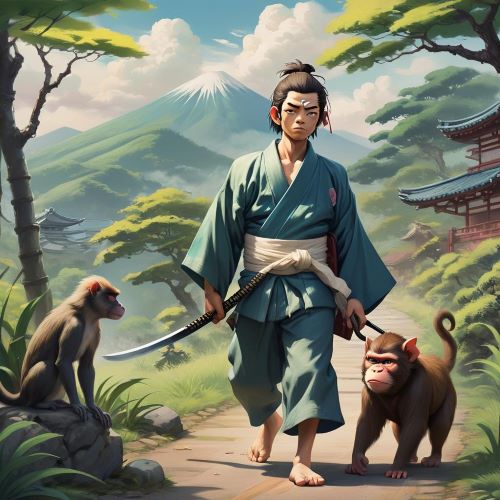


Kintaro : The Golden Child of Japanese Folklore
Listen
At a glance
| Description | |
|---|---|
| Origin | Japanese Mythology |
| Classification | Mortals |
| Family Members | N/A |
| Region | Japan |
| Associated With | Strength |
Kintaro
Introduction
Kintaro, often remembered as the “Golden Child,” stands among the most enduring heroic figures of Japanese folklore. Emerging from early medieval oral traditions, his story captures the imagination through a rare blend of innocence, supernatural strength, and harmony with the natural world. Unlike courtly heroes or celestial gods, Kintaro begins life far from civilisation, raised deep in the mountains where spirits, animals, and untamed forces shape his destiny. His legend reflects Japan’s animistic worldview, where mountains are alive, beasts are companions, and strength is inseparable from moral purity.
The earliest forms of Kintaro’s story circulated during the Heian period, when folklore and historical memory frequently overlapped. Over time, the wild mountain child of legend became closely associated with the historical warrior Sakata no Kintoki, a retainer of Minamoto no Yorimitsu. This merging of folklore and history allowed Kintaro’s narrative to evolve from local myth into a national symbol of youthful power, loyalty, and transformation. Today, Kintaro continues to represent the ideal of strength guided by kindness rather than cruelty.
Physical Traits
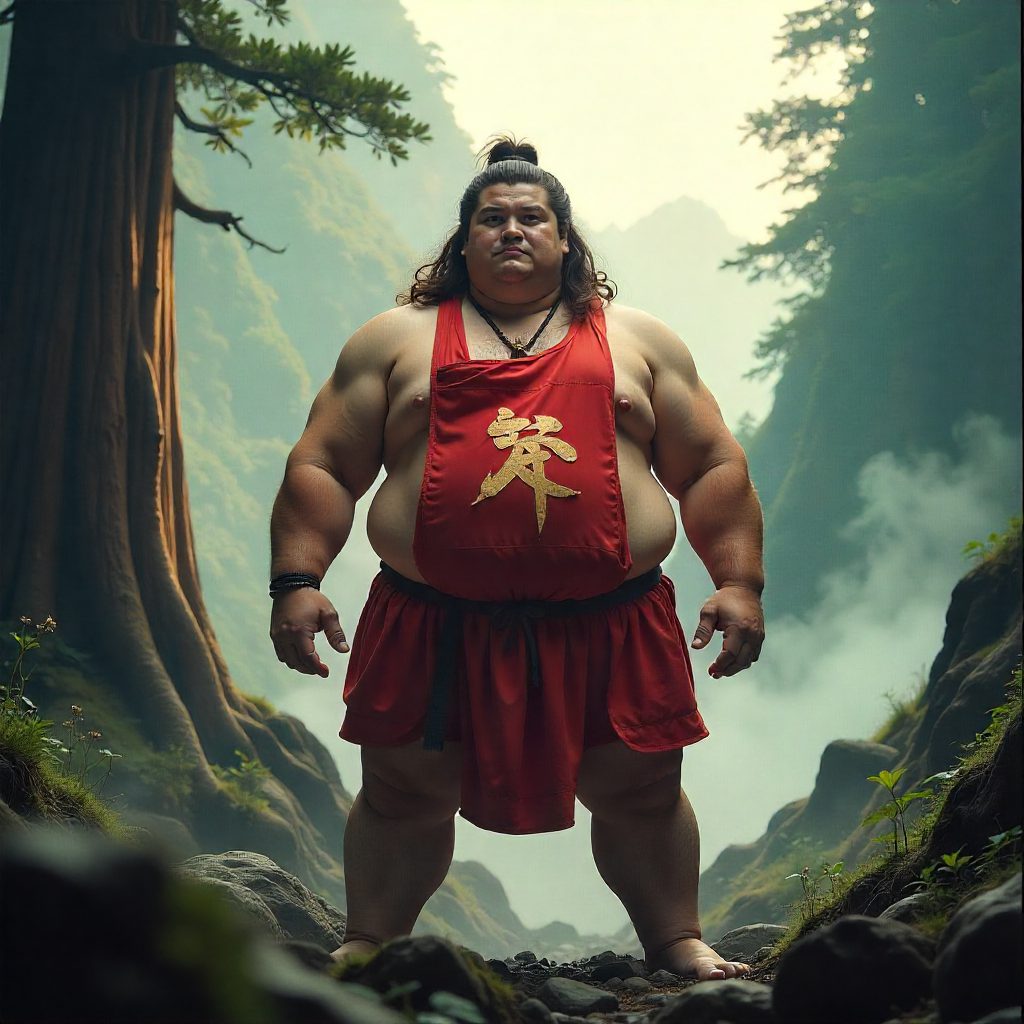
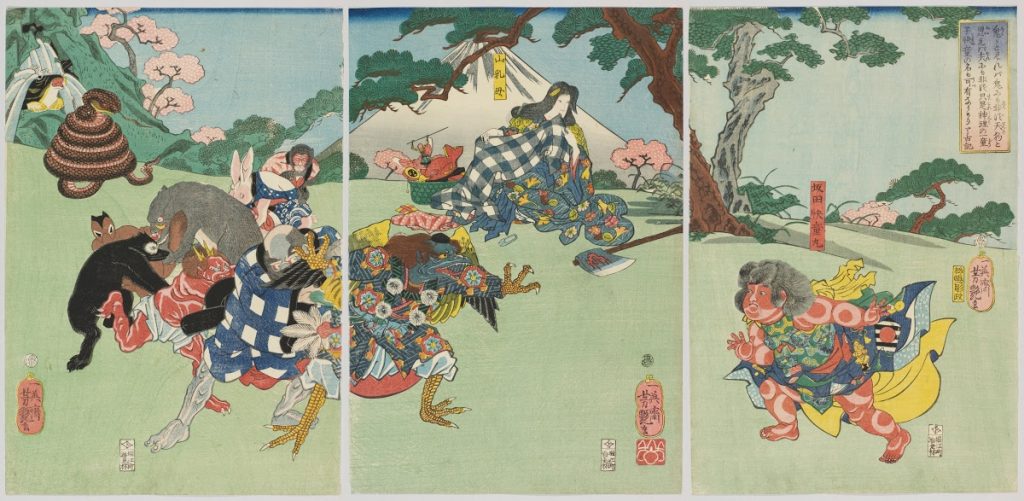
Kintaro’s physical appearance is instantly recognisable across centuries of Japanese art and storytelling. He is consistently portrayed as a young boy with a powerful, muscular build that contrasts strikingly with his age. His skin is often depicted with a reddish hue, a visual shorthand for vitality, life force, and supernatural energy rather than literal coloration. This exaggerated physique conveys the idea that his strength is innate, not learned through training or discipline.
He traditionally wears little more than a simple bib or loincloth marked with the character for “gold,” symbolising both his name and his extraordinary worth. Wild, untamed hair frames a cheerful yet fearless expression, reinforcing his identity as a child of the mountains rather than society. In most depictions, Kintaro carries a large axe or hatchet, not as a symbol of violence but as a tool of survival and strength. His appearance communicates a deliberate paradox: a child who looks capable of feats no grown warrior could match.
Family
Kintaro’s family background varies depending on regional tradition, but certain elements remain consistent across most versions of the legend. He is typically said to be the child of a noblewoman who fled into the mountains after tragedy or social disgrace. In these accounts, his mother represents lost refinement and human society, while the mountains represent rebirth and raw potential. Unable to raise him alone, she either entrusts him to fate or disappears from the story entirely.
Kintaro is most famously raised by a yama-uba, a mountain woman who exists somewhere between spirit, witch, and guardian. While yama-uba figures are often portrayed as fearsome in folklore, Kintaro’s adoptive mother is nurturing and protective, guiding his growth without restraining his natural power. His true “family,” however, consists of the animals of the forest. Bears, deer, rabbits, and birds are depicted as his companions, reinforcing his role as a bridge between humanity and nature.
Other names
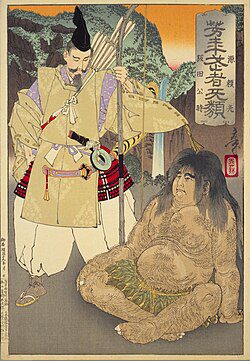
The name Kintaro literally means “Golden Child,” a title that reflects both his supernatural aura and his symbolic value. As his legend evolved, this childhood identity became paired with an adult name that anchored him within Japan’s warrior tradition. Upon entering the service of Minamoto no Yorimitsu, Kintaro is said to have taken the name Sakata no Kintoki, marking his transformation from untamed prodigy to disciplined protector.
This dual naming is crucial to understanding his cultural role. Kintaro represents primal strength and innocence, while Kintoki represents loyalty, order, and social responsibility. The coexistence of these names allows the figure to move fluidly between myth and history, folklore and recorded tradition, ensuring his relevance across different eras and audiences.
Powers and Abilities
Kintaro’s powers are defined foremost by his immense physical strength, which appears effortlessly from early childhood. Legends describe him uprooting massive trees, lifting boulders, and wrestling bears without injury or fear. These feats are not portrayed as aggressive acts but as playful demonstrations of his connection to the natural world. His strength is instinctive, guided by curiosity rather than domination.
Equally important is Kintaro’s ability to communicate with animals. This power reflects ancient Japanese beliefs that humans and animals once shared a common spiritual language. Through these bonds, Kintaro becomes a guardian rather than a conqueror of nature. Later tales add martial prowess to his abilities, particularly during his service as Sakata no Kintoki, where he participates in the defeat of powerful oni such as Shuten-dōji. His strength, however, is always framed as righteous, used in defense of balance rather than personal glory.
Modern Day Influence
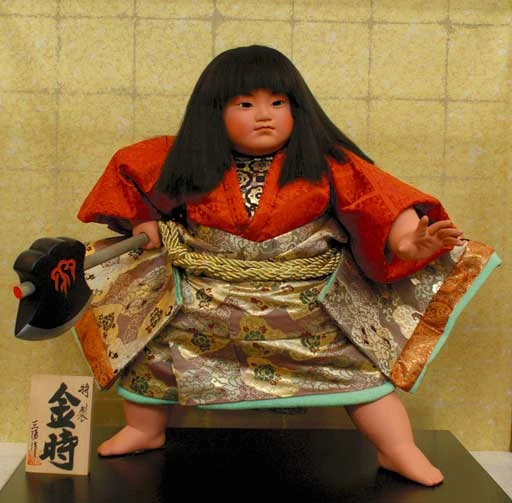
Kintaro’s presence in modern Japanese culture remains remarkably strong. He is a central figure in Children’s Day celebrations, where families display Kintaro dolls to symbolise wishes for strength, courage, and healthy growth. His image appears in traditional sweets, festival decorations, and educational stories aimed at inspiring young children.
Beyond tradition, Kintaro has found new life in manga, anime, video games, and advertising, often reimagined as a heroic archetype or playful symbol of endurance. His story continues to resonate because it reflects a universal journey: the transition from innocence to responsibility, from raw potential to purposeful strength. In a rapidly modernising world, Kintaro endures as a reminder that true power is most meaningful when tempered by kindness.
Related Images

Source
Bokksu. (2024). Exploring the legend of Kintaro: Japan’s boy of strength and valor.
https://bokksu.com/blogs/news/exploring-the-legend-of-kintaro-japans-boy-of-strength-and-valor
Google Arts & Culture. (2023). Kintaro: The legendary folk hero. https://artsandculture.google.com/story/xAWBpJ-5kIfCLw
JREF. (2025). Kintarō the Golden Boy. https://jref.com/articles/kintar%C5%8D-the-golden-boy.317/
Wikipedia contributors. (2024). Kintarō. Wikipedia. https://en.wikipedia.org/wiki/Kintar%C5%8D
Yoda, H., & Alt, M. (2016). Yokai attack! The Japanese monster survival guide. Kodansha USA.
Foster, M. D. (2009). Pandemonium and parade: Japanese monsters and the culture of yokai. University of California Press.
Ouwehand, C. (1964). Namazu-e and their themes: An interpretative approach to some aspects of Japanese folk religion. Brill.
Frequently Asked Questions
Who is Kintaro in Japanese folklore?
Kintaro is a legendary child hero known for his supernatural strength, animal companionship, and eventual transformation into a samurai warrior.
Is Kintaro based on a real historical figure?
Kintaro is associated with the historical warrior Sakata no Kintoki, though his childhood exploits belong firmly to folklore.
What powers does Kintaro have?
Kintaro possesses immense physical strength, the ability to communicate with animals, and later becomes a formidable demon-slayer.
Why is Kintaro important in Japanese culture?
He symbolises childhood strength, moral purity, and growth, making him a central figure in Children’s Day traditions.
Is Kintaro a god or a human?
Kintaro is generally classified as a mortal folk hero with supernatural abilities rather than a god or spirit.