

Fylgja : The Norse Spirit Companion of Fate
Listen
At a glance
| Description | |
|---|---|
| Origin | Norse Mythology |
| Classification | Spirits |
| Family Members | N/A |
| Region | Iceland, Norway |
| Associated With | Fate, Destiny, Protection |
The Mythlok Perspective
In Mythlok’s Perspective, the Fylgja reveals how the Norse understood identity as layered rather than singular. A person was not merely flesh and thought but shadowed by destiny itself. This belief mirrors the Egyptian concept of the Ka, a spiritual double, and parallels the Japanese idea of the guardian spirit found in certain Shinto traditions. Across cultures, humanity has imagined that something unseen walks beside us. The Fylgja stands as the Norse expression of that universal intuition: fate is never truly alone.
Fylgja
Introduction
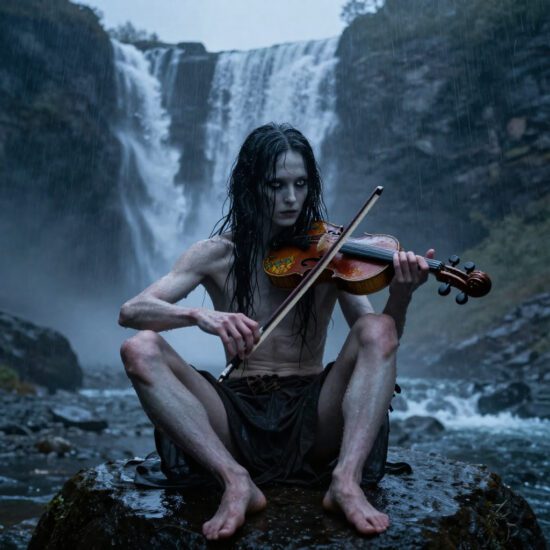
In Norse tradition, the Fylgja is not a god, monster, or wandering ghost. It is something far more intimate. The word comes from Old Norse fylgja, meaning “to follow” or “to accompany.” A Fylgja is a spiritual double, a presence bound to an individual or family, reflecting destiny, character, and fortune.
Unlike other beings in Norse belief, it is deeply personal. It is not worshipped. It does not rule a realm. Instead, it walks silently beside a person throughout life. It may appear in dreams, manifest during moments of crisis, or reveal itself as an omen of death. The idea reflects the complex Norse understanding of the soul, where identity was not a single essence but a collection of spiritual forces intertwined with fate.
It appears in several Icelandic sagas, including Njáls saga, where characters with second sight glimpse the animal spirits of their enemies before battle. These accounts show that medieval Scandinavians regarded the Fylgja as a serious spiritual reality rather than symbolic folklore.
Physical Traits
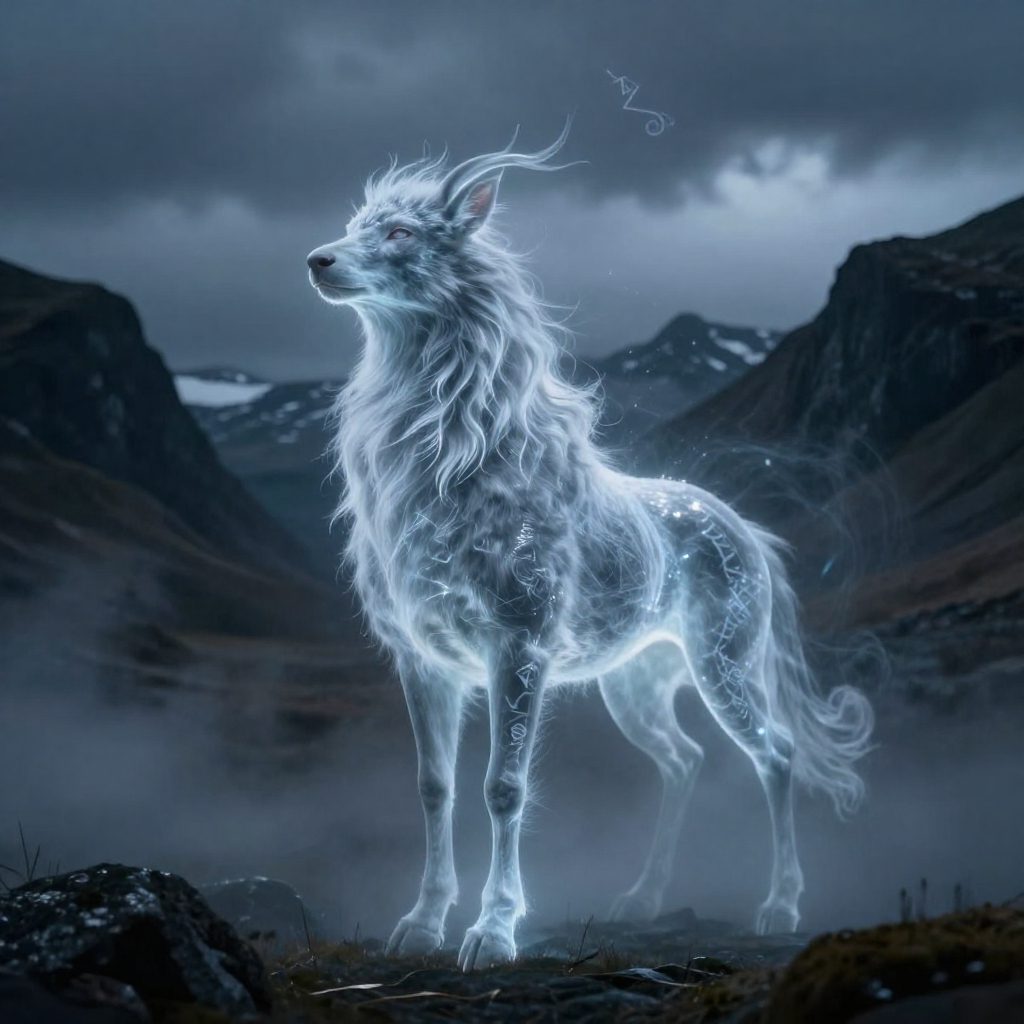
The Fylgja does not have one fixed form. Instead, it manifests in ways that reveal the nature of the person it accompanies. Most commonly, it appears as an animal. This animal form mirrors personality, temperament, and destiny. A powerful warrior might be followed by a bear or wolf. A cunning individual might have a fox. A stubborn or resilient figure could be associated with a bull. The animal is not random. It represents the inner qualities of the person, externalized into visible form.
The condition of the animal also carries meaning. A strong, healthy animal signals vitality and good fortune. A wounded or dying creature may foretell illness or death. In some sagas, the appearance of a person’s Fylgja before battle predicts the outcome of conflict.
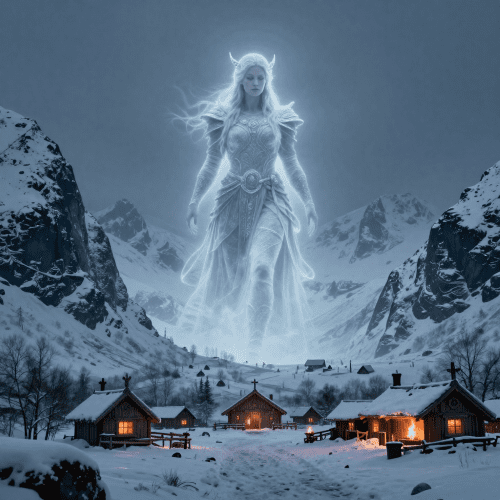
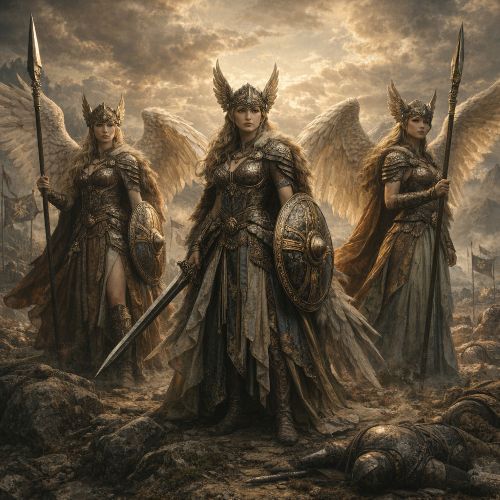
Less commonly, it appears in human form, usually as a woman. This feminine manifestation often appears in dreams and is sometimes described as an ancestral guardian. Scholars have connected this form to the Dísir, female ancestral spirits, and even to Valkyrie imagery. When seen in human shape, it often delivers warnings or silently observes events tied to fate.
A defining trait is invisibility. Most people cannot see their own Fylgja. When it becomes visible in waking life, this is usually interpreted as a sign that death is near. Visibility is not a blessing but an omen.
Family
The Fylgja is not part of a divine genealogy. It does not belong to the Æsir or Vanir. Instead, it belongs to individuals and lineages.
Some traditions suggest that each person possesses their own Fylgja, bound to their life from birth to death. Other accounts indicate that certain families share a collective Fylgja, an ancestral spirit that protects the household across generations. In this interpretation, it functions almost like inherited luck or fate.
When a family member dies, it may attach itself to another descendant. This reinforces the Norse belief that destiny and fortune were not purely individual but woven into the fabric of kinship. Honor, reputation, and lineage were sacred in Norse society, and the idea of a shared spirit companion reflects that cultural emphasis.
Unlike guardian angels in later Christian tradition, the Fylgja is not morally instructive. It does not judge. It reflects. If a person behaves dishonorably, it may appear aggressive, diminished, or absent in visions.
Other names
The term “Fylgja” directly translates to “follower,” but related concepts exist within Norse thought. One comparison is the Irish “fetch,” a spirit double seen as a harbinger of death. While culturally distinct, both ideas involve a spectral counterpart linked to fate.
In Norse belief, scholars also connect it to the concept of hamr, meaning shape or skin. The hamr refers to the spiritual form that could shift or travel independently of the body. Though not identical, both ideas involve a dual nature of the self.
There is also the concept of hamingja, often translated as luck or fortune. The hamingja could be inherited and passed through generations, much like some interpretations of the Fylgja. However, the hamingja represents fortune more abstractly, while the Fylgja appears as a more personal, visible companion. Interestingly, the word fylgja can also mean “afterbirth” in Old Norse. Some scholars believe this linguistic connection reflects ancient beliefs linking birth, destiny, and spiritual attachment.
Powers and Abilities
The Fylgja’s powers revolve around protection, foresight, and reflection. It serves as a guardian presence, accompanying a person through life’s turning points. This protection is not always direct intervention. Rather, it manifests as spiritual alignment. If the Fylgja is strong, the individual thrives. If weakened, misfortune may follow.
Premonition is another key ability. The Fylgja frequently appears in dreams to warn of danger or signal change. In saga literature, those gifted with second sight could see animal Fylgjur before battles, revealing the strength and fate of opponents.
The Fylgja also influences fortune. Closely related to inherited luck, it embodies the idea that destiny is both personal and ancestral. However, it is not omnipotent. A stronger opposing spirit could overpower it in spiritual conflict, as hinted in saga accounts. Above all, the Fylgja reflects the moral and psychological state of its human counterpart. It is not an independent deity but a mirror of the soul.
Modern Day Influence
The concept of the Fylgja continues to inspire modern thought and creativity. In academic studies of Norse belief, the Fylgja is often discussed as evidence of the Norse multi-part soul system. It demonstrates that Viking Age spirituality was far more complex than simple warrior mythology.
In fantasy literature and gaming, the idea of animal spirit companions echoes the Fylgja tradition. While modern adaptations often simplify it into the idea of a “spirit animal,” historical sources show it was more closely tied to ancestry and fate than personal empowerment.
In contemporary Norse-inspired spiritual movements, some practitioners attempt to reconnect with the idea of a Fylgja as a guiding presence. However, historical accounts emphasize its ancestral and destiny-bound role rather than voluntary summoning.
Psychologically, the Fylgja can be interpreted as a projection of the unconscious self. It embodies traits we carry but may not consciously recognize.
Related Images



Source
Larrington, C. (2009). Icelandic fylgjur tales and a possible Old Norse context: A translation and discussion of several Icelandic folktales [Scholarly paper]. Academia.edu. https://www.academia.edu/2633416/Icelandic_Fylgjur_Tales_and_a_Possible_Old_Norse_Context_A_Translation_and_Discussion_of_severa
Mundal, E. (n.d.). Fylgja. In Wikipedia. https://en.wikipedia.org/wiki/Fylgja
Puryear, M. (2021, June 16). The fylgja. The Norroena Society. https://norroena.org/the-fylgja/
Simek, R. (2007). Dictionary of Northern Mythology (A. Hall, Trans.). D.S. Brewer. (Original work published 1984)
Turville-Petre, E. O. G. (1964). Myth and religion of the North: The religion of the ancient Scandinavians. Holt, Rinehart and Winston. https://ia800508.us.archive.org/34/items/TurvillePetreMythAndReligionOfTheNorth/Turville-Petre_Myth_and_Religion_of_the_North_te
Unknown. (2025, June 22). Fylgja in the Norse sources & religion. Norse Imports.
https://norseimports.com/blogs/news/fylgja
Unknown. (2022, December 28). Fylgja: The Viking guardian spirit. NorseMythologist.
https://norsemythologist.com/fylgja/
Unknown. (2022, October 26). Fylgja. Wikipedia Nucleos. https://wikipedia.nucleos.com/viewer/wikipedia_en_all/A/Fylgja
Frequently Asked Questions
What is a Fylgja in Norse belief?
A Fylgja is a guardian spirit or spiritual double in Norse tradition that accompanies a person and reflects their fate and character.
Can a Fylgja appear as an animal?
Yes. The Fylgja most commonly appears as an animal that symbolizes the personality or destiny of the individual it follows.
Is the Fylgja the same as a spirit animal?
Not exactly. While similar in appearance, the Fylgja is tied to ancestry and fate rather than personal identity exploration.
Does seeing your Fylgja mean death?
In saga literature, seeing one’s Fylgja in waking life was often interpreted as a sign that death was near.
Is the Fylgja inherited?
Some traditions suggest that certain families share a collective Fylgja passed down through generations.