


Zuni Creation Story : How the A:shiwi Emerged into the World
| Description | |
|---|---|
| Origin | Zuni Mythology |
| Country | United States of America |
| Deities Involved | Awonawilona, Sun Father, Earth Mother, Sky Father, Twin War Gods, Kachinas |
| Symbolism | Emergence, Balance, Transformation, Reciprocity with nature |
| Process | Humanity ascends through four underworlds guided by twins into the daylight world |
Mythlok Perspective
From the Mythlok perspective, the Zuni Creation Story stands apart by treating emergence as a journey toward belonging rather than a single act of creation. Unlike Mesopotamian traditions that emphasise divine intervention in shaping the cosmos, Zuni cosmology resembles Hopi and Diné traditions where passage through successive worlds shapes human existence. Creation here is gradual, relational, and place-centred. Identity emerges through transformation, and belonging is defined not simply by where people arrive, but by the ancestral connections they carry into the world.
A:shiwi Creation Story
Introduction
The Zuni Creation Story explains how the universe took shape, how living beings came into existence, and how the Zuni people emerged from the depths of the Earth into the world illuminated by the Sun. The Zuni, who call themselves the A, have preserved these traditions through generations of oral storytelling, ceremonial practices, and cultural teachings. Their ancestral homeland is centred on Zuni Pueblo in present-day New Mexico, United States.
Unlike creation narratives that describe the world appearing through a single divine command, Zuni traditions explore creation as a gradual process involving transformation, emergence, and the development of life. The journey from darkness into daylight is especially significant because it connects the origins of humanity with the establishment of the Zuni people’s relationship with their homeland. Several versions of these traditions have been recorded, including those published by ethnographer Frank Hamilton Cushing in 1896. These accounts provide valuable historical documentation, although they should not be treated as a complete or definitive representation of all Zuni beliefs.
Cosmic Origins
In one influential account of the Zuni Creation Story, the beginning of existence is associated with Áwonawílona, a primordial creative being whose name is translated in Cushing’s work as the Maker and Container of All. Before the familiar universe existed, there was darkness, emptiness, and the potential for creation.
Through thought, Áwonawílona brought forth mists that expanded through the primordial void. These mists gathered into clouds, which eventually produced the Great Waters. The creative force then manifested as the Sun Father, Yatoka, whose light brought illumination and generative power to the emerging cosmos.
From the waters, Earth Mother, Áwitelin Tsíta, and Sky Father, Ápoyan Ta’chu, came into being. Their relationship established a fundamental connection between the Earth and the heavens. Together, these parental beings became associated with the origins of humans, animals, and other living creatures.
This account presents the universe as an interconnected system rather than a collection of unrelated creations. Light, water, earth, and sky participate in a continuing process through which life becomes possible. The imagery of mist transforming into water and the emergence of the cosmic parents also gives natural elements a central place in the explanation of existence.
Deities and Forces Involved
Áwonawílona occupies a central position in Cushing’s recorded account. As the primordial creative power, this being represents the source from which the cosmos develops. The transformation into the Sun Father connects creation with light, growth, and the conditions necessary for life. The Sun Father, Yatoka, is associated with illumination and the unfolding of the world. Earth Mother and Sky Father represent complementary cosmic forces whose union brings forth living beings. Their relationship reinforces the importance of cooperation between the natural elements that sustain existence.
The Twin War Gods, Ko’wituma and Wats’usi, also play important roles in recorded emergence narratives. Associated with the Sun’s children, they are presented as powerful guides who help the people move through successive underworlds toward the daylight world. Their role connects divine guidance with humanity’s transition into its earthly existence.
The Kach’ina tradition is another important aspect of Zuni religious life, involving spiritual beings and ceremonial relationships with the natural world. However, Kach’inas should not simply be reduced to generic nature spirits or treated as interchangeable with the creators and guides in the emergence narrative. Their significance belongs to a wider ceremonial and cultural context that cannot be fully explained through the creation story alone. These figures and traditions illustrate how Zuni cosmology connects the origins of the universe with the spiritual responsibilities of the community.
Process
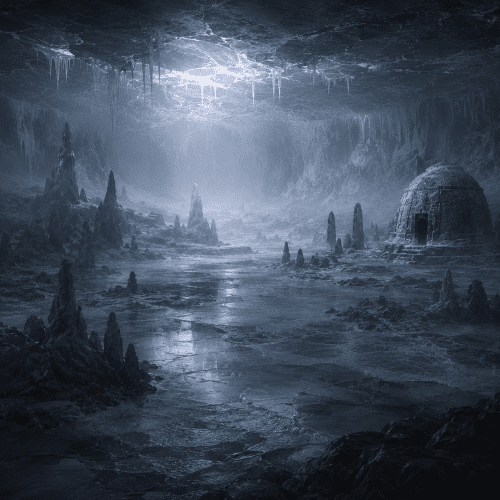
The Zuni Creation Story combines the formation of the cosmos with the emergence of humanity. In Cushing’s account, the Earth becomes a place of gestation, while the underworlds function as stages through which living beings develop before reaching the surface. The earliest people and creatures exist in the depths of the Earth, where darkness limits their understanding of the world above. Their eventual emergence is not immediate. They must pass through successive environments before reaching the daylight world.
One recorded version describes four underworld levels, associated with names including Ánosin Téhuli, K’ólin Téhuli, Áwisho Téhuli, and Tépahaian Téhuli. These are commonly rendered in English as the First Underworld, Moss World, Mud World, and Wing World. The precise terminology and presentation vary between published retellings.
The Twin War Gods guide the people through this process, using means of ascent that include ladders or pathways between worlds. Each stage brings them closer to the conditions required for life on the surface. The journey culminates in emergence into the daylight world, where humanity can begin to inhabit the Earth in its familiar form.
Some recorded versions also describe early beings with animal-like characteristics who undergo physical transformation before becoming recognisably human. Such details belong to particular tellings and should not be assumed to occur identically in every Zuni account. Emergence is therefore both a physical journey and a transformation in the condition of life. The people move from a concealed existence toward a world in which they can establish communities, cultivate the land, and develop their cultural practices.
Symbolism
The symbolism of the Zuni Creation Story centres on emergence, transformation, and the relationship between humanity and the natural world. Darkness represents the condition that precedes the people’s arrival in the visible world. Their emergence into daylight marks a transition into a new stage of existence, bringing opportunities for growth, knowledge, and community life.
Mist and water represent the early stages of creation. Their transformation into a more ordered world suggests that existence develops through successive changes rather than appearing fully formed. The Sun symbolises illumination and the conditions that make life possible. Earth Mother and Sky Father express the relationship between the ground that sustains living beings and the heavens above. Their connection reinforces the interdependence of the natural world.
The successive underworlds represent stages in the people’s journey toward their earthly existence. Their passage through these environments emphasises that emergence involves development rather than an instantaneous transformation. The idea of a sacred homeland carries particular importance. The Zuni people’s relationship with their ancestral territory connects the creation narrative with collective identity, cultural continuity, and responsibility to the land. Together, these themes present creation as more than an explanation of beginnings. They connect the origins of life with the relationships and responsibilities that sustain a community.
Comparative Analysis
The Zuni Creation Story shares important features with other Indigenous emergence traditions, particularly those of the Pueblo peoples of the American Southwest. Hopi traditions include accounts of people passing through earlier worlds before entering the present one. Both Zuni and Hopi narratives connect the development of humanity with a journey from an earlier state of existence. However, their respective sacred beings, ceremonial practices, and cultural histories are distinct and should not be treated as interchangeable.
Diné traditions also contain emergence narratives involving successive worlds. The similarities reflect a broader regional interest in transformation and the origins of human life, rather than proof that the traditions share one identical account. The Zuni story also differs from creation narratives in which a deity brings the universe into existence through a sequence of spoken commands. In Cushing’s account, thought, mist, water, sunlight, and the emergence of living beings form an interconnected process.
Unlike earth-diver traditions, in which an animal retrieves material from primordial waters to create land, the best-known Zuni account emphasises the development of the cosmos and the people’s eventual emergence from within the Earth. These comparisons reveal a recurring human interest in explaining how life begins and how people acquire their place in the world. The distinctive character of the Zuni tradition lies in the way cosmic origins, human emergence, and cultural identity come together.
Legacy
The Zuni Creation Story remains an important part of understanding A cultural identity, ancestral relationships, and religious traditions. Its emphasis on emergence connects the people’s origins with their homeland and the collective experiences that shape community life. The narrative also reflects a worldview in which humans exist within a larger network of natural and spiritual relationships. Earth, sky, water, sunlight, plants, animals, and people are connected through the processes that make life possible.
Frank Hamilton Cushing’s Outlines of Zuñi Creation Myths, published in 1896, remains a significant historical source for studying these traditions. His work documented multiple narratives concerning creation, the origins of living beings, religious organisation, and Zuni cultural history. However, the circumstances of this documentation deserve consideration. Cushing’s accounts emerged from a period when outside researchers frequently recorded Indigenous religious knowledge without the cultural safeguards expected today. His publications are valuable historical sources, but they should not replace Zuni voices or be treated as unrestricted access to sacred knowledge.
Modern Influence
Today, Zuni cultural traditions continue to connect ancestral knowledge with community life, ceremonial practice, farming, and relationships with the land. The creation narrative provides a framework for understanding how the people belong to their homeland and how cultural responsibilities extend across generations.
Agricultural practices offer a particularly meaningful connection between traditional knowledge and everyday life. Smithsonian documentation describes Zuni planting traditions that include prayers and songs associated with seeds, planting, and harvest. These practices demonstrate how relationships with the natural world remain embedded in cultural activities beyond the telling of origin narratives.
The modern study of Zuni mythology also raises important questions about cultural preservation. Written records allow researchers and readers to learn about traditions that might otherwise remain unfamiliar to outsiders. At the same time, published accounts cannot capture every dimension of oral storytelling, ceremonial knowledge, or community interpretation. Respectful engagement therefore requires recognising the A as the continuing custodians of their traditions. The Zuni Creation Story is not merely a historical explanation of how the world began. It is part of a living cultural heritage through which ancestry, place, and collective identity remain connected.


Sources
Benedict, R. (1935). Zuni mythology (Columbia University Contributions to Anthropology, Vol. 21). Columbia University Press.
Cushing, F. H. (1896). Outlines of Zuni creation myths (Thirteenth Annual Report of the Bureau of Ethnology, 1891–92). Smithsonian Institution, Bureau of Ethnology. https://sacred-texts.com/nam/zuni/cushing/cush07.htm
Emergence Magazine. (2024, February 29). Counter mapping. https://emergencemagazine.org/feature/counter-mapping/
Harvey Mudd College. (n.d.). Notes on the Zuni origin myth. https://pages.hmc.edu/beckman/western/zuni.htm
Stifler, B. (n.d.). Zuni creation myth. https://www.billstifler.org/myth/files/2D-001-06-zuni_creation.htm
The Tony Hillerman Portal. (n.d.). A’wonawilona. University of New Mexico. https://ehillerman.unm.edu/2801
Wikipedia. (n.d.). Zuni mythology. https://en.wikipedia.org/wiki/Zuni_mythology
Frequently Asked Questions
What is the Zuni Creation Story?
The Zuni Creation Story explains how the universe developed and how the A:shiwi, or Zuni people, emerged from the Earth’s underworlds into the daylight world. It connects cosmic creation with humanity’s origins and relationship with the ancestral homeland.
Who created the world in Zuni mythology?
In a prominent account recorded by Frank Hamilton Cushing, Áwonawílona is the primordial creative being who brings forth the cosmos and manifests as the Sun Father. Earth Mother and Sky Father subsequently emerge and become associated with the origins of living beings.
How many worlds appear in the Zuni emergence story?
One influential account describes four underworlds through which the people pass before emerging into the daylight world. These stages are associated with the First Underworld, Moss World, Mud World, and Wing World, although details vary between recorded versions.
Who are the Twin War Gods in the Zuni Creation Story?
Ko’wituma and Wats’usi are the Twin War Gods in Cushing’s recorded tradition. They guide the people through the underworlds and help them ascend toward the daylight world.
Why is the Zuni Creation Story important today?
The story connects Zuni cultural identity with ancestral origins, sacred geography, and relationships with the natural world. It also provides insight into the traditions through which the A:shiwi preserve their cultural heritage across generations.
