
Chinese Creation Story : The Legend of Pangu and the Birth of the Universe
| Description | |
|---|---|
| Origin | Chinese Mythology |
| Country | China |
| Deities Involved | Pangu |
| Symbolism | Balance of Yin-Yang, Unity of cosmos and humanity |
| Process | Pangu splits cosmic egg, separates heaven and earth, body becomes nature |
Mythlok Perspective
In Mythlok’s Perspective, the Chinese Creation Story reflects a worldview where the universe is not built through command but through transformation. Pangu represents the idea that creation is an organic process rather than an act of domination. His body becoming the landscape suggests a deep philosophical link between life and environment. Comparable themes appear in other traditions. The Norse giant Ymir and the Indian cosmic being Purusha also become the substance of the world after death. Yet Pangu differs because his transformation emerges from endurance and balance rather than divine conflict. This makes the Chinese Creation Story one of the clearest mythological expressions of cosmic harmony.
Chinese Creation Story
Introduction
The Chinese Creation Story centered on Pangu (盘古) is one of the most famous origin narratives in Chinese tradition. It explains how the universe emerged from chaos and gradually took the form of the world we recognize today. Unlike many creation myths where gods simply command the universe into existence, the Chinese Creation Story emphasizes growth, transformation, and balance. The narrative reflects deep philosophical ideas that later became central to Daoist cosmology, particularly the interplay between opposing forces such as Yin and Yang.
The story first appears in written form during the Three Kingdoms period in texts attributed to the scholar Xu Zheng in the third century CE. However, scholars widely believe the myth itself is far older and may have originated among southern Chinese ethnic groups such as the Miao, Yao, or Zhuang before spreading into broader Chinese folklore.
At its heart, the Chinese Creation Story tells of a primordial giant named Pangu who emerges from a cosmic egg, separates heaven and earth, and ultimately transforms into the natural world. Mountains, rivers, wind, and celestial bodies are all said to originate from his body. Through this poetic transformation, the myth illustrates the interconnectedness between humanity, nature, and the cosmos. The world is not created from nothing; it is born through a process of transformation, sacrifice, and cosmic balance. Because of these themes, the Chinese Creation Story is not simply a tale about beginnings. It also serves as a philosophical metaphor for harmony, natural order, and the dynamic balance that underlies existence.
Cosmic Origins
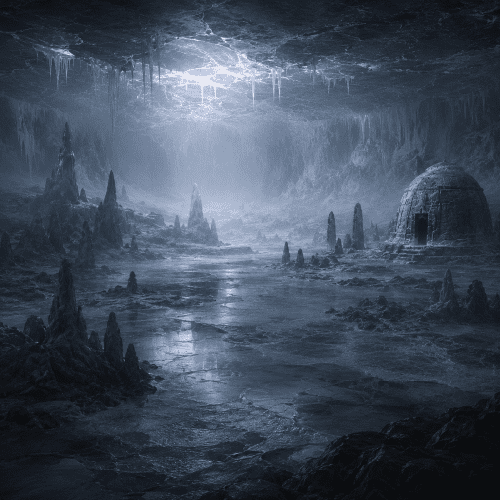
According to the Chinese Creation Story, the universe began in a state known as hundun, a chaotic and formless condition where nothing had yet taken shape. Everything existed within a vast cosmic egg, a symbol of potential and unity before the separation of the cosmos.
Inside this cosmic egg, two fundamental forces slowly formed and matured: Yin and Yang. Yin represented darkness, heaviness, and the earthbound qualities of existence, while Yang represented light, clarity, and upward movement. For thousands of years—traditionally said to be 18,000 years—these forces remained in balance within the egg.
Eventually, from within this swirling mixture of primordial energy, the giant Pangu came into being. Some versions of the story describe him awakening from a long slumber inside the egg, while others describe him gradually forming as the Yin and Yang energies separated.
The cosmic egg itself represents the early unity of the universe before differentiation occurred. In Chinese cosmological thinking, this stage corresponds to the concept of Taiji, the original state from which all dualities emerge. The emergence of Pangu marks the moment when chaos begins to organize itself into structure. His awakening symbolizes the universe becoming conscious of itself and initiating the process of creation.
Deities and Forces Involved
The Chinese Creation Story is unusual compared with many mythologies because it features very few divine beings. Instead, the forces responsible for creation are often abstract cosmic principles. Pangu stands at the center of the narrative. He is usually portrayed as a massive, hairy giant, sometimes with horns or animal-like features, reflecting early shamanistic imagery. In traditional paintings and sculptures, he is often shown holding a large axe used to split the cosmic egg.
Alongside Pangu, the most important forces in the story are Yin and Yang. Rather than being gods in a human sense, they represent the fundamental energies that shape the universe. Yin embodies darkness, earth, and stability, while Yang represents light, heaven, and movement. The cosmic egg also functions as a symbolic force within the story. It represents the unity of existence before differentiation. Everything in the universe existed within it in an undivided state.
Some later versions of the myth introduce mythical animals that assist or accompany Pangu. These creatures sometimes include the dragon, phoenix, turtle, and qilin. However, these additions appear mainly in later folklore and are not present in the earliest recorded versions of the myth. Overall, the Chinese Creation Story emphasizes cosmic forces rather than a hierarchy of gods, reflecting philosophical traditions that view the universe as governed by natural balance rather than divine command.
Process
The process of creation begins when Pangu awakens inside the cosmic egg and realizes he is trapped within the chaotic mass of Yin and Yang. Determined to escape, he takes up his axe and strikes the egg with tremendous force. When the egg splits open, the lighter and purer Yang energy rises upward to form the heavens, while the heavier Yin energy sinks downward to become the earth. However, the newly separated realms remain unstable and risk collapsing back into chaos.
To prevent this from happening, Pangu stands between heaven and earth. He pushes the sky upward while holding the earth firmly beneath his feet. According to the legend, this process lasts for 18,000 years. Each day during this immense span of time, Pangu grows taller, the sky rises higher, and the earth becomes thicker. Gradually, the universe stabilizes, allowing heaven and earth to remain permanently separated.
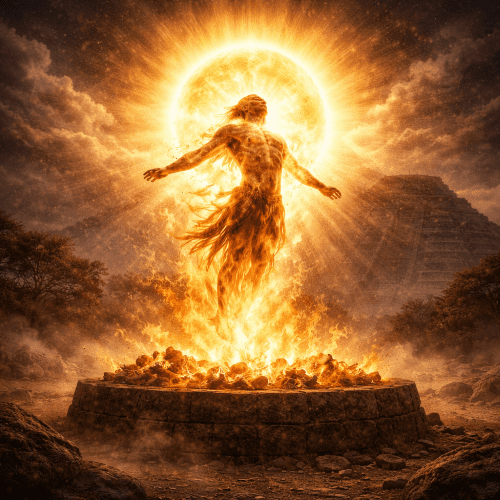
Eventually, after completing his cosmic task, Pangu dies. His death does not mark the end of creation but rather its final transformation. Every part of his body becomes a feature of the natural world. His breath becomes wind and clouds. His voice becomes thunder. His eyes transform into the sun and moon. His blood becomes rivers and oceans, while his bones form mountains and minerals.
His hair becomes stars, plants, and forests, while his sweat turns into rain. In some versions of the myth, insects or parasites on his body transform into animals or even human beings. Through this transformation, the Chinese Creation Story presents the universe as a living extension of the creator himself.
Symbolism
The Chinese Creation Story carries deep symbolic meaning rooted in traditional Chinese philosophy. One of its central themes is the balance of Yin and Yang. The separation of heaven and earth illustrates how harmony emerges when opposing forces find equilibrium. Rather than depicting conflict between good and evil, the myth portrays complementary energies working together to create stability.
Pangu’s transformation into the natural world also symbolizes the unity between humanity and nature. The mountains, rivers, winds, and celestial bodies all originate from the same source, suggesting that the universe functions as a single interconnected system. The cosmic egg symbolizes potential and transformation. Just as life emerges from an egg, the entire universe is depicted as being born from a single unified origin.
Pangu’s death also represents the idea that creation often requires sacrifice. His transformation into the elements of nature illustrates a worldview in which life continuously transforms rather than ending. These themes align closely with Daoist philosophy, which emphasizes harmony with natural processes and the dynamic balance of cosmic forces.
Comparative Analysis
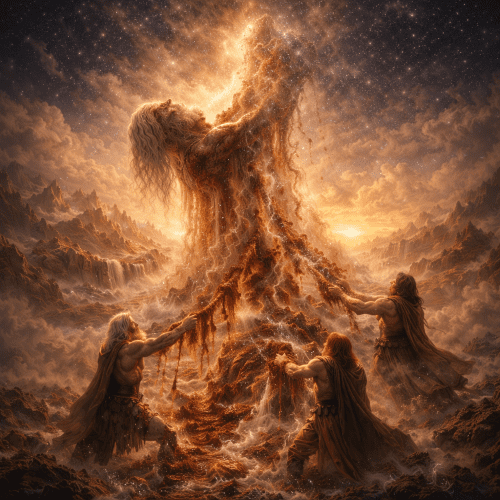
The Chinese Creation Story shares intriguing similarities with creation myths from other cultures around the world. In Norse mythology, the primordial giant Ymir is killed by the gods Odin, Vili, and Ve. His body is used to form the earth, seas, and sky. Like Pangu, Ymir becomes the physical structure of the universe.
In Hindu tradition, the cosmic being Purusha is sacrificed by the gods, and his body forms the universe and human society. This theme of cosmic dismemberment echoes Pangu’s transformation into the natural world. The Mesopotamian myth of Tiamat also presents a similar concept. After the god Marduk defeats the primordial sea goddess Tiamat, her body is divided to create heaven and earth.
Another notable parallel appears in the concept of the cosmic egg, which appears in multiple mythologies including Indian cosmology through the concept of the Brahmanda, or “cosmic egg.” Despite these similarities, the Chinese Creation Story stands apart because Pangu is not killed by other gods. Instead, he willingly sustains the universe through his effort and eventually transforms into it.
Legacy
Although the myth was first written down during the Three Kingdoms period, it quickly became one of the most recognizable origin stories in Chinese culture. The story spread through Daoist texts, folklore traditions, and regional legends. In southern China, temples and shrines dedicated to Pangu still exist today, including temples in Guangdong where he is honored as the creator of the world.
The myth also influenced traditional Chinese cosmology, particularly ideas about the structure of the universe and the balance between heaven, earth, and humanity. Throughout Chinese history, artists have depicted Pangu in paintings, sculptures, and wood carvings. His towering figure splitting the cosmic egg became a powerful visual metaphor for the birth of the universe.
Modern Influence
Even in modern times, the Chinese Creation Story continues to inspire cultural and philosophical discussions. Pangu appears in literature, films, animation, and video games. His imagery is frequently used in fantasy storytelling and visual art that explores ancient cosmological themes. The story also remains part of educational discussions about traditional Chinese culture and philosophy. Students often learn the myth as an introduction to concepts such as Yin and Yang and Daoist cosmology.
Beyond entertainment and education, the myth has also influenced environmental philosophy. The idea that the natural world originates from the body of a primordial being encourages respect for nature and reinforces the concept that humans are part of the same cosmic system as mountains, rivers, and forests. In this way, the Chinese Creation Story remains a powerful narrative that connects ancient mythology with modern ideas about balance, ecology, and cosmic harmony.
Sources
EBSCO Research Starters. (n.d.). Pangu (deity). https://www.ebsco.com/research-starters/religion-and-philosophy/pangu-deity
EBSCO Research Starters. (2013, May 19). Pangu creates world (Taoist creation myth). https://www.ebsco.com/research-starters/religion-and-philosophy/pangu-creates-world-taoist-creation-myth
Mythopedia. (2022, November 30). Pangu. https://mythopedia.com/topics/pangu/
Vocal Media. (2025, April 25). Pangu and the creation of the world: China’s cosmic origin myth. https://vocal.media/history/pangu-and-the-creation-of-the-world-china-s-cosmic-origin-myth
Guan, R. (2025, February 16). How Chinese Creation Myths Inspire Modern Thought. Chinese Mythology.
Luo, Z. (2025, January 29). How Chinese Creation Myths Inspire Modern Culture. Chinese Mythology.
The Archaeologist. (2025, July 24). The Worship of Pangu, the Creator God of China.
Frequently Asked Questions
What is the Chinese Creation Story?
The Chinese Creation Story commonly refers to the myth of Pangu, a primordial giant who separated heaven and earth and whose body became the natural features of the world.
Who is Pangu in Chinese mythology?
Pangu is the creator figure in the Chinese Creation Story who emerges from a cosmic egg and forms the universe through his actions and eventual transformation.
What does the cosmic egg represent in Chinese mythology?
The cosmic egg symbolizes the original unity of the universe before heaven and earth were separated and before Yin and Yang formed distinct forces.
How long did Pangu hold apart heaven and earth?
According to the myth, Pangu stood between heaven and earth for 18,000 years while the sky rose higher and the earth became thicker.
Is the Chinese Creation Story similar to other myths?
Yes. Similar themes appear in Norse mythology with Ymir and in Indian cosmology with Purusha, where the body of a primordial being forms the universe.