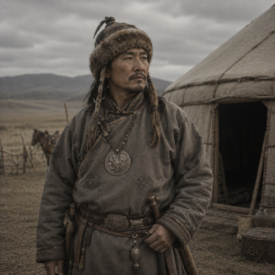
Central Asian Mythology
Central Asian mythology encompasses a diverse collection of beliefs, epic traditions, legends, and spiritual practices that developed across the steppes, mountains, forests, and deserts of the heart of Asia. Traditions associated with Mongolian, Turkic, Khakass, Tuvan, and other peoples of the region reflect long relationships with the sky, landscape, ancestors, animals, and the supernatural world. Many of these traditions contain elements associated with animism, shamanic practice, ancestor veneration, and reverence for powerful celestial and natural forces. Preserved through oral storytelling, epic poetry, ritual, music, and folklore, these traditions provide an important record of how Central Asian communities understood the relationship between humans, nature, and the wider cosmos.
One of the most important figures in the religious traditions of the Central Asian steppe is Tengri, a celestial deity or sacred sky power prominent in several early Turkic traditions. The Old Turkic inscriptions associate Tengri with the khagan and with the divine authority of rulership, while Umay is associated with the khagan’s wife and appears to have been understood as an important female divine figure. Later interpretations of these traditions vary considerably, and it is more accurate to speak of Tengri-centered traditions than to treat Tengrism as one uniform religious system shared by every Turkic and Mongolic people. Some traditions also contain ideas about sacred mountains, rivers, ancestors, animals, and spirits connected with particular places. In several Siberian and Central Asian traditions, ritual specialists commonly described as shamans acted as intermediaries between human communities and supernatural beings through ceremonies, songs, offerings, and other ritual practices.
Ideas about multiple levels or realms of existence also appear in several Central Asian and Siberian traditions. Tuvan mythology, for example, preserves a three-part conception of the cosmos involving distinct realms and a shamanic relationship between the human world, supernatural beings, and the afterlife. Modern scholarship on Tuvan traditions specifically identifies the three-part division of the world, the existence of an afterlife, and the powerful role of the shaman as important elements of Tuvan shamanic mythology. Similar three-level cosmological structures occur elsewhere in the wider religious traditions of Siberia and Central Asia, although their meanings and details vary between communities. These traditions often present mountains, rivers, animals, ancestors, and other elements of the natural world as spiritually significant, creating a worldview in which human actions are closely connected with the wider environment.
The individual mythologies of Central Asia add their own distinctive characters, stories, and symbols. In Mongolian mythology, traditions surrounding the sky, earth, ancestral figures, spirits, heroes, and legendary creatures form part of a rich body of oral and literary folklore. Figures such as the Mangadhai and the Khangarid appear in Mongolian legendary traditions, while horses occupy an important place in the mythology and epic traditions of the steppe. Khakass mythology is preserved through heroic epics, ritual poetry, legends, and shamanic traditions. Scholarly studies of Khakass folklore document mythological themes involving creation, miraculous birth, supernatural beings, spirits, sacred animals, and shamanic figures. Khakass traditions also contain beliefs concerning sacred animals and beings associated with particular spirits and deities.
Kazakh mythology likewise preserves a rich tradition of legends, epic poetry, ancestral figures, supernatural beings, and heroic warriors. The figure of the batyr, or heroic warrior, became especially prominent in Kazakh epic traditions, where stories frequently explore courage, loyalty, kinship, warfare, and the protection of community. Horses are particularly important throughout the nomadic cultures of the Eurasian steppe, appearing not only as practical companions but also as powerful symbols within heroic literature and folklore. Tuvan mythology contains extensive traditions concerning spirits, sacred landscapes, shamans, animals, and the relationship between different realms of existence. Tuvan heroic epics also preserve older mythological motifs and elements of shamanic cosmology. Meanwhile, Turkic mythology encompasses traditions from many different Turkic-speaking peoples rather than a single unified mythology. Across these traditions, recurring symbols include the sky, sacred landscapes, horses, wolves, ancestors, and powerful supernatural beings, although their meanings differ between cultures and historical periods.
Central Asian mythology continues to influence cultural identity, literature, art, music, and national symbolism across the region. Epic traditions remain important sources of cultural memory, while contemporary writers and artists reinterpret older legends and supernatural figures in new forms. In Siberia and Central Asia, scholars and cultural institutions continue to document oral traditions, ritual poetry, heroic epics, and folklore that might otherwise be lost. Research into Khakass folklore, for example, continues to preserve records of ritual poetry, shamanic incantations, appeals to protective deities, and traditions concerning spirits of nature. The continuing study and performance of these traditions demonstrates that Central Asian mythology is not simply a collection of ancient stories. It is a diverse and evolving body of cultural memory through which communities continue to explore ancestry, nature, heroism, spirituality, the supernatural, and humanity’s relationship with the vast landscapes of Central Asia.