


Hebe : Greek Goddess of Youth and Cupbearer of the Gods
At a glance
| Description | |
|---|---|
| Origin | Greek Mythology |
| Classification | Gods |
| Family Members | Zeus (Father), Hera (Mother), Ares, Eileithyia (Siblings), Heracles (Husband), Alexiares, Anicetus (Sons) |
| Region | Greece |
| Associated With | Youth, Vitality, Divine nectar, Cupbearing |
The Mythlok Perspective
In Mythlok’s Perspective, Hebe is interesting precisely because she does not need the dramatic mythology of Zeus or Heracles to matter. Her power lies in representing something every mortal understands but cannot permanently possess: youth. While other Greek gods control storms, oceans, war or wisdom, Hebe embodies a stage of life itself. Her role as cupbearer also makes her more than a symbol of beauty; she becomes part of the machinery of immortality. Her marriage to Heracles creates a striking contrast between earned immortality and inherited divinity. Heracles becomes immortal through extraordinary deeds, while Hebe represents the ageless condition he ultimately joins.
Hebe
Introduction
Hebe is the Greek goddess and personification of youth, representing the vitality, beauty, and energy associated with the prime of life. Her name comes from the Greek word hēbē, meaning youth or the bloom of life. Unlike many major Olympian gods, Hebe is not primarily remembered through a long cycle of independent myths. Instead, her importance comes from the symbolic role she plays within the divine household.
Daughter of Zeus and Hera, Hebe belongs to the central Olympian family. In Homeric tradition, she serves nectar to the gods at their heavenly feasts, making her the cupbearer of Olympus. Her role connects youth with the divine condition of immortality: the gods do not age as mortals do, and Hebe personifies the youthful state they perpetually retain.
Hebe later becomes the wife of Heracles after the hero’s apotheosis and admission among the immortals. Their marriage places the greatest Greek hero within the Olympian family and connects the concepts of heroic achievement, immortality, and eternal youth.
Her worship was not limited entirely to literary myth. Pausanias records sanctuaries and altars dedicated to Hebe, particularly at Athens and Phlius, while at Phlius she was associated with the granting of pardon to suppliants. Hebe therefore represents more than physical youth: in different contexts, she could embody renewal, transition, and the restoration of a person’s place within society.
Physical Traits
Ancient Greek literature provides relatively little detailed information about Hebe’s physical appearance. She is identified primarily through her youth, divine status, and duties rather than through a fixed description of her face, hair, height, or complexion.
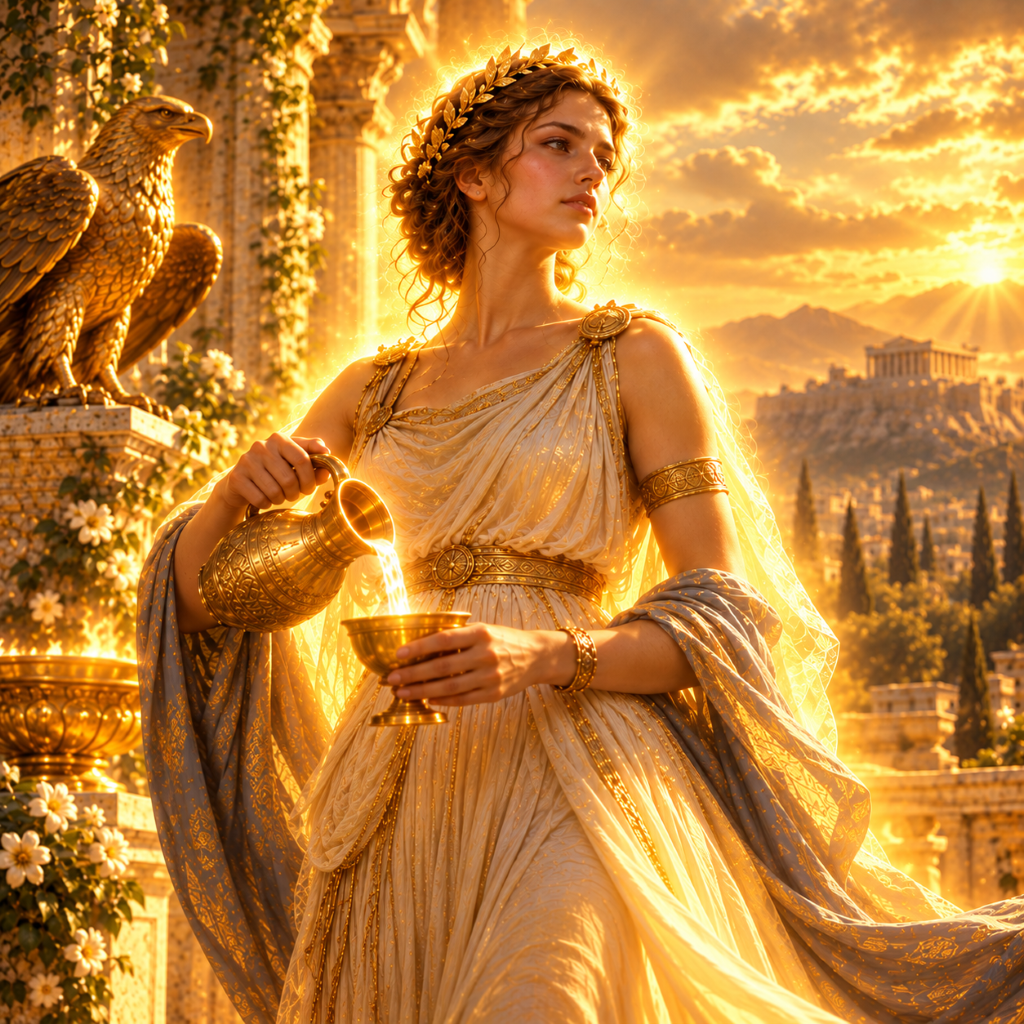
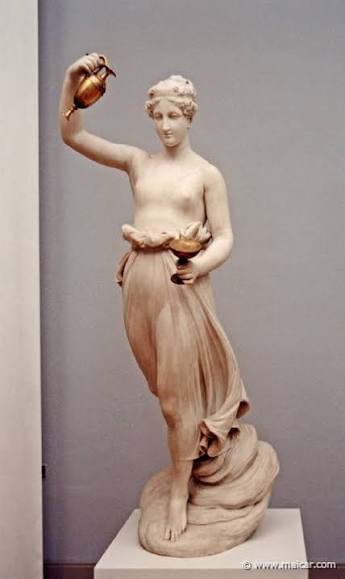
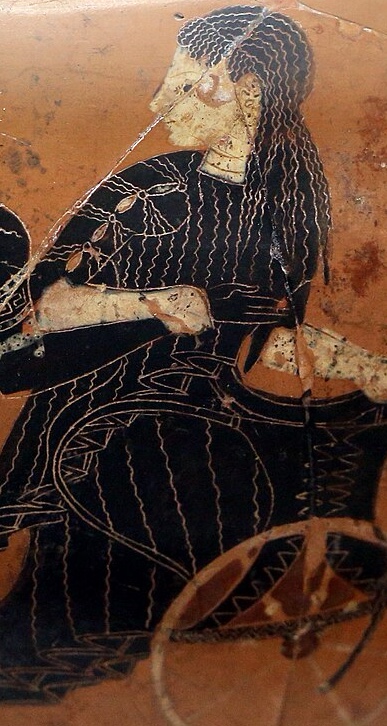
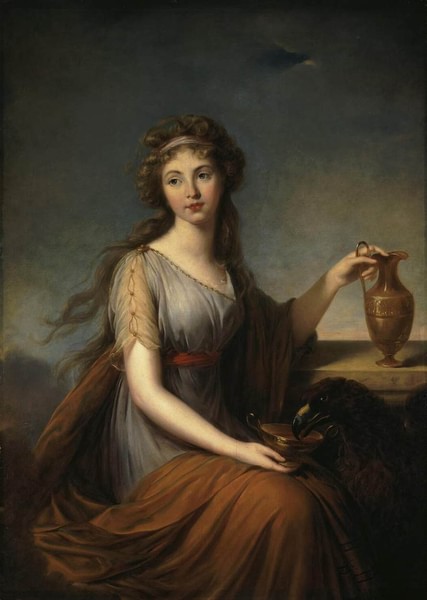
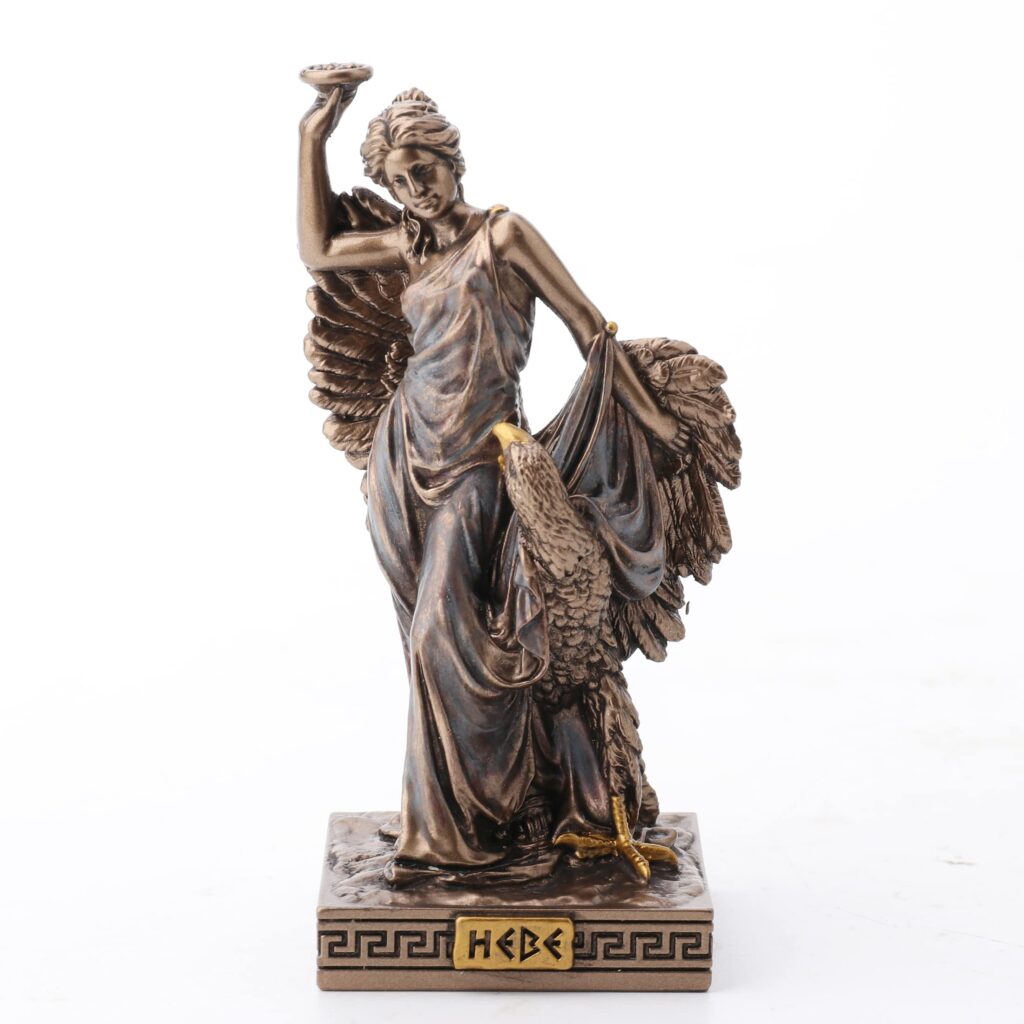
Greek poetry gives her youthful and beautiful qualities, while artistic representations generally present her as a young woman appropriate to her identity as the embodiment of youth. Her most important visual attribute is the vessel associated with her role as cupbearer. In vase painting and later classical art, she can be shown holding a cup, pitcher, or similar serving vessel.
Hebe is also sometimes represented with wings. This feature appears in some Greek artistic traditions and places her visually alongside other youthful female divine figures such as Iris and Nike. It should not, however, be treated as an essential feature of every depiction.
Her clothing varies according to artistic period and context. Ancient vase paintings can show her in the long garments customary for Greek women, while later European artists often transformed Hebe into an idealized neoclassical maiden. These later images helped establish the familiar visual concept of Hebe as an elegant young woman carrying a vessel of nectar. Consequently, the most reliable way to recognize Hebe is not through a single canonical appearance but through the combination of youthful femininity, divine status, and her association with the cupbearer’s vessel.
Family
Hebe is the daughter of Zeus and Hera, placing her among the children of the ruling pair of the Olympian gods. Hesiod’s Theogony names Hebe alongside Ares and Eileithyia among the children of Zeus and Hera. Her family relationships become especially significant through her marriage to Heracles. After Heracles achieves immortality, he becomes Hebe’s husband and joins the Olympian household. Their marriage appears in Homeric, Hesiodic, Pindaric, and later mythological traditions.
The marriage also carries an important symbolic meaning. Heracles had endured conflict with Hera during his mortal life, partly because of his complicated parentage and the circumstances surrounding his birth. His marriage to Hebe, Hera’s daughter, represents his final acceptance into the divine family.
Later mythography gives Hebe and Heracles two sons, Alexiares and Anicetus. Their names are associated with protection and invincibility. They are minor divine figures and do not have the extensive mythological traditions associated with their father. Hebe is also connected with Iolaus, Heracles’ nephew and companion, through one of the stories concerning her ability to restore youth. This episode further links her family relationships with her central divine function.
Other names
The name Hebe is itself closely connected to her nature. The Greek hēbē means youth, particularly the youthful period or prime of life. Her name therefore functions almost as a definition of what she represents. Hebe is also associated with the name Ganymeda, particularly in traditions connected with Phlius. Pausanias explains that the earlier inhabitants of Phlius called the goddess Ganymeda before the name Hebe became established. The name connects her with Ganymede, the youthful male cupbearer of Zeus.
At Phlius and Sicyon, she was also known as Dia. This was a local religious designation rather than simply another universally used name for Hebe. The evidence for her worship in these communities shows how Greek gods could possess different names and identities depending on local traditions.
In Roman religion, Hebe’s closest counterpart was Juventas, the goddess associated with youth. The Roman figure was not simply another Greek name for Hebe but part of the process through which Greek and Roman religious traditions identified corresponding divine concepts. Hebe’s associations with youth and young brides also connect her symbolically with marriage and the transition into adulthood.
Powers and Abilities
Hebe’s defining power is her association with youth. She embodies the vitality of the young and the unaging condition associated with the Olympian gods. Her most clearly documented divine function is serving nectar to the gods. Homer describes Hebe pouring nectar during the gathering of the Olympians. This makes her an important participant in the maintenance of the divine household, although ancient sources do not describe her as the creator of ambrosia or nectar.
Some later traditions give Hebe a more direct ability to restore youth. The most famous example involves Iolaus. In Ovid’s Metamorphoses, Hebe is involved in the restoration of Iolaus to youth, demonstrating that her connection with youth could be expressed as an actual divine ability rather than merely a symbolic identity. Her connection with youth is also meaningful because Greek mythology frequently contrasts youth with old age. Geras personifies old age, providing a conceptual counterpart to Hebe. Together, these figures express two opposite stages of human life.
Hebe was additionally associated with young brides. This connection reflects the transition from maidenhood into marriage, another stage of life in which youth and social transformation intersect. At Phlius, her sanctuary carried an unusual association with pardon. According to Pausanias, suppliants who reached her sacred grove received forgiveness, and freed prisoners dedicated their chains there. This local tradition adds mercy and release to Hebe’s wider symbolism.
Modern Day Influence
Hebe has remained an influential figure in the history of classical art, particularly because the idea of youth has appealed strongly to later European artists. Her identity as a beautiful divine maiden carrying nectar made her especially suitable for neoclassical painting and sculpture. Heracles and Hebe also appear together in ancient Greek art. A sixth-century BCE Attic hydria in The Metropolitan Museum of Art, for example, depicts Heracles and Hebe in a bridal chariot, demonstrating that their relationship was represented visually in antiquity.
Later artists continued to reinterpret Hebe. Antonio Canova’s Hebe became one of the best-known modern representations of the goddess and helped establish her image within the neoclassical tradition. Her appearance in museums and European art demonstrates how an ancient religious figure could be transformed into a broader artistic symbol of idealized youth.
Hebe also survives in modern discussions of Greek mythology because her concept remains easy to recognize. She represents a quality that humans cannot permanently possess: youth without aging. Her mythology therefore explores an idea that sits at the centre of many cultures—the desire to preserve vitality while escaping the effects of time.
Unlike Zeus, Athena, or Heracles, Hebe rarely occupies the centre of modern popular mythology. Yet her symbolic role remains distinctive. She is not simply another Olympian deity with a collection of supernatural abilities. Hebe represents youth itself, embodied within the divine family and expressed through service, renewal, marriage, and the possibility of restoration. Her story ultimately connects two different ideas of immortality. The Olympian gods possess immortality by nature, while Heracles earns a place among them through extraordinary deeds. Hebe, as the goddess of youth, becomes the figure who links that immortal existence with the condition of remaining forever young.
Related Images




Source
Britannica, T. Editors of Encyclopaedia. (1998, July 20). Hebe. Encyclopedia Britannica. https://www.britannica.com/topic/Hebe-Greek-goddess
Centre of Excellence. (2025, January 28). Hebe in Greek mythology: Myths, powers, and symbols.
https://www.centreofexcellence.com/hebe-in-greek-mythology/
Gods and Monsters. (2024, March 31). Hebe: Greek goddess of youth and cupbearer of Olympus.
https://godsandmonsters.info/hebe/
Marvel Database. (2020). Hebe Panhellenios (Earth-616). https://marvel.fandom.com/wiki/Hebe_Panhellenios_(Earth-616)
Mythology Source. (2020, June 30). Hebe: A complete guide to the Greek goddess of youth. https://mythologysource.com/hebe-greek-goddess/
Olympioi. (2024, December 12). Hebe | Goddess (Daemone) of youth in Greek mythology.
https://olympioi.com/demigods/hebe
Theoi Project. (n.d.). Hebe. https://www.theoi.com/Ouranios/Hebe.html
Wikipedia contributors. (2003, September 14). Hebe (mythology). In Wikipedia. https://en.wikipedia.org/wiki/Hebe_(mythology)
Frequently Asked Questions
Who is Hebe in Greek mythology?
Hebe is the Greek goddess and personification of youth, daughter of Zeus and Hera, and the divine cupbearer who serves nectar to the Olympian gods.
What is Hebe the goddess of?
Hebe is the Greek goddess of youth, vitality and the prime of life. She is also associated with young brides and, locally, forgiveness and pardon.
Who is Hebe married to?
Hebe is married to Heracles after his apotheosis. Their marriage brings the hero into the Olympian family and connects him with Hera, Hebe’s mother.
What are Hebe's powers in Greek mythology?
Hebe represents eternal youth and is associated with restoring youth. Later traditions describe her rejuvenating Iolaus, though this is not her primary role.
What is Hebe's Roman name?
Hebe’s Roman counterpart is Juventas, a goddess associated with youth. Roman religious tradition developed Juventas as the corresponding divine personification.
