Arthurian Mythology
Arthurian mythology is one of the most enduring bodies of legendary literature in Britain and Europe. Centered on the legendary King Arthur, his court, the Knights of the Round Table, and figures such as Merlin, Guinevere, Lancelot, and Morgan le Fay, the tradition brings together stories of kingship, warfare, chivalry, love, betrayal, magic, and spiritual quests. Although Arthurian mythology contains elements that may preserve echoes of earlier Celtic traditions, the Arthurian stories known today developed primarily through medieval Welsh, Latin, French, and English literature. Over centuries, writers repeatedly expanded and reshaped the tradition, transforming Arthur from a legendary British war leader into the idealized king familiar to modern audiences.
The historical identity of Arthur remains uncertain. Some early medieval sources describe a figure named Arthur associated with battles against enemies of the Britons, but there is no conclusive evidence establishing him as a historical king. The earliest substantial surviving account of Arthur appears in Geoffrey of Monmouth’s Historia Regum Britanniae, written in the 12th century. Geoffrey presented Arthur as a powerful king of Britain and introduced or developed many elements that would become central to later Arthurian storytelling. French writers, particularly Chrétien de Troyes, subsequently expanded the tradition with stories of courtly love, knights, and quests, while Thomas Malory’s Le Morte d’Arthur brought together many strands of the medieval tradition in the 15th century.
Arthur’s legendary kingship lies at the center of the tradition. He is often portrayed as a ruler who seeks to unite Britain and establish an ideal kingdom governed by justice and order. His famous sword Excalibur is closely associated with his authority and supernatural status, although medieval sources offer different accounts of the sword’s origin. In some traditions, Arthur draws a sword from a stone, proving his right to become king, while other versions connect Excalibur with the Lady of the Lake. These episodes were not originally a single fixed story but developed through different medieval texts.
The Round Table is another defining feature of Arthurian mythology. It represents the fellowship of Arthur’s knights and, in later interpretations, has come to symbolize equality and shared responsibility among rulers and warriors. The earliest surviving references to the Round Table do not necessarily establish the precise idea that every knight possessed exactly equal status, but later romances developed it into an important symbol of Arthur’s ideal court. Figures such as Guinevere, Lancelot, and Mordred introduce themes of loyalty, forbidden love, political conflict, and betrayal, ultimately contributing to the collapse of Arthur’s kingdom.
The Holy Grail became one of the most important elements of the later Arthurian tradition. Its story developed particularly through the medieval romances of Chrétien de Troyes and subsequent writers. Knights such as Perceval, Galahad, and Lancelot become associated with the quest in different versions of the tradition. The Grail increasingly acquired explicitly Christian significance, representing divine grace, spiritual purity, and the pursuit of a sacred ideal. Claims that the Grail was directly derived from a specific ancient Celtic magical cauldron should be treated cautiously. Scholars have identified possible parallels with Celtic and other earlier traditions, but there is no simple documented line of descent from one Celtic object to the medieval Grail.
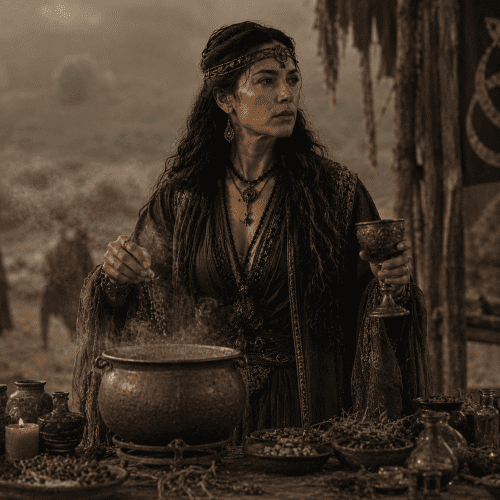
Magic and prophecy provide another major dimension of Arthurian mythology. Merlin is portrayed in medieval literature as a prophet, magician, and adviser to Arthur. His character developed from several earlier traditions, including material associated with the Welsh prophetic figure Myrddin, combined with other legendary elements. The Lady of the Lake, Morgan le Fay, and numerous enchanted objects and locations further connect the Arthurian world with supernatural forces.
Arthurian mythology has continued to evolve long after the medieval period. Thomas Malory’s Le Morte d’Arthur, Alfred Tennyson’s Idylls of the King, T. H. White’s The Once and Future King, films such as Excalibur, and countless novels, television series, games, and artworks have each reinterpreted the legend for new audiences. Camelot has consequently become more than a mythical court: it is often used as a metaphor for ideal leadership, political unity, moral responsibility, and the fragility of power.
The enduring appeal of Arthurian mythology lies in its ability to change while retaining its central questions. Who deserves to rule? What makes a kingdom just? Can loyalty survive love and ambition? And can an ideal society endure human weakness? Through Arthur, Merlin, Guinevere, Lancelot, Mordred, and the Knights of the Round Table, these questions continue to give one of Europe’s most famous legendary traditions relevance in the modern world.