

Vali : The Avenger of Baldr in Norse Legend
Listen
At a glance
| Description | |
|---|---|
| Origin | Norse Mythology |
| Classification | Gods |
| Family Members | Odin (Father), Rindr (Mother), Thor, Baldr, Höðr, Víðarr (Brothers) |
| Region | Norway, Sweden, Denmark, Iceland |
| Associated With | Vengeance, Justice, Archery, Fate, |
The Mythlok Perspective
In Mythlok’s Perspective, Vali represents a powerful archetype of purpose within Norse cosmology. His entire existence is tied to restoring balance after a cosmic injustice, reflecting how fate operates even among the gods. Similar figures appear across cultures where vengeance restores order. Vali’s role echoes avenging heroes like the Greek Orestes and justice-driven figures such as the Egyptian Horus. In each case, retribution becomes a sacred duty that maintains cosmic balance rather than simple revenge.
Vali
Introduction
In Norse tradition, Vali stands out as a figure whose existence is defined by purpose. Unlike many gods whose stories unfold across numerous adventures, Vali’s role in the mythic narrative is focused and decisive. He is the son of Odin and the mysterious woman Rindr, brought into the world to avenge the death of his half-brother Baldr. Baldr’s death, caused when the blind god Höðr unknowingly struck him with a mistletoe weapon arranged by Loki, triggered one of the most dramatic cycles of revenge in Norse myth.
Vali’s birth was not simply another addition to the divine family of the Æsir. Instead, it fulfilled a prophecy that demanded swift justice for Baldr’s killing. The ancient poems of the Poetic Edda, including Völuspá and Baldrs draumar, describe how Odin fathered Vali specifically for this purpose. Within a single day of his birth, Vali matured into a fully grown warrior and carried out his destined act of vengeance.
Despite his brief mythic narrative, Vali plays an important role in the cosmic storyline of Norse belief. He represents the inevitability of justice in a world where fate, known as wyrd, governs even the gods themselves. In addition, he is among the few deities prophesied to survive Ragnarök, ensuring that the divine order continues in the world that emerges after the destruction of the old cosmos.
Physical Traits
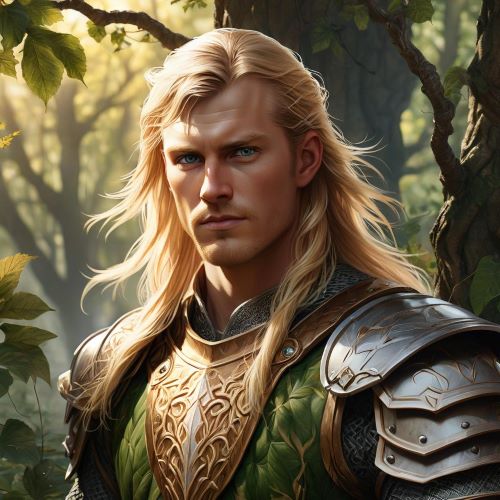
Descriptions of Vali’s physical appearance are sparse in surviving Norse texts. The ancient sources rarely dwell on detailed visual characteristics, focusing instead on the actions and symbolic roles of the gods. What defines Vali physically is his miraculous and immediate maturation. According to the Eddic poems, he grew from an infant to a fully capable warrior within a single night. This supernatural growth allowed him to fulfill his role without delay.
The myths emphasize his readiness for battle rather than his outward appearance. When Vali reached adulthood in a single day, he immediately pursued Höðr to avenge Baldr. Some verses state that he would not wash his hands or comb his hair until this act of vengeance was complete, reinforcing the idea that his entire existence revolved around fulfilling a sacred duty.
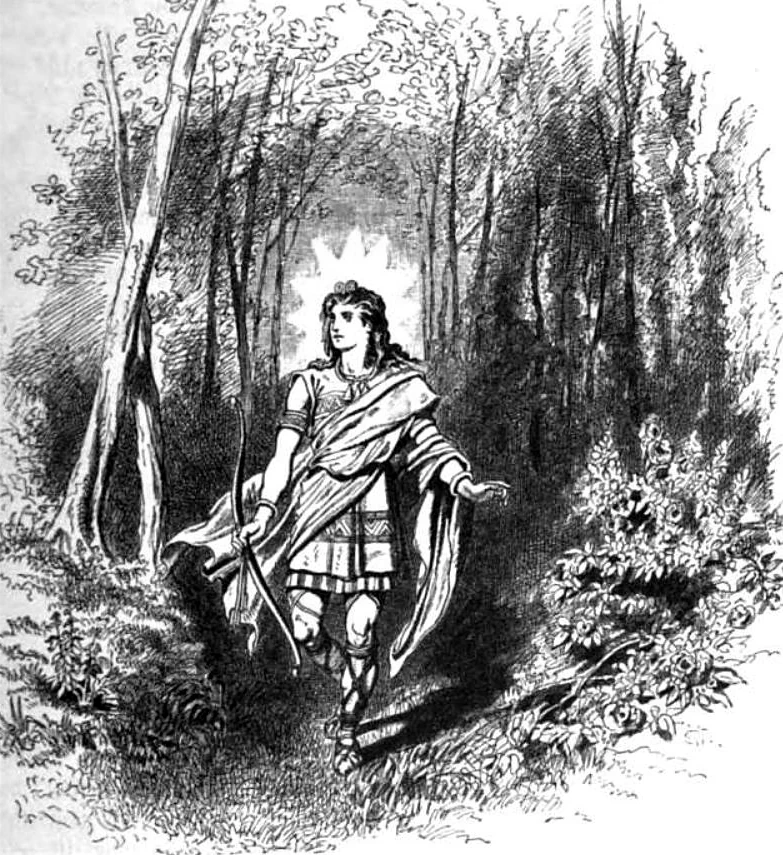
Later artistic interpretations, especially in nineteenth-century European artwork, portray Vali as a youthful warrior carrying a bow. This imagery reflects descriptions from the Prose Edda, which suggests he was an exceptionally skilled marksman. The focus on archery aligns with the broader Norse admiration for warriors who combined strength with precision.
Even though the myths do not provide detailed descriptions of his stature or clothing, the idea of a young god who becomes battle-ready within hours of birth conveys the extraordinary nature of his divine origin. Vali is therefore remembered less for his physical form and more for the unstoppable determination that defined him.
Family
Vali’s lineage connects him directly to the most powerful figures in Norse cosmology. His father is Odin, the chief of the Æsir and ruler of the gods. Odin is associated with wisdom, war, and prophecy, and his decision to father Vali was driven by the need to restore balance after Baldr’s death.
Vali’s mother, Rindr, appears in the myths as a mysterious figure. Some sources describe her as a giantess, while others portray her as a human princess. In the Gesta Danorum written by Saxo Grammaticus, she is named Rinda and appears in a more historical narrative rather than a purely mythological one. Regardless of the version, she plays a crucial role in bringing Vali into existence as the instrument of Odin’s revenge.
Through Odin, Vali is connected to many well-known Norse gods. His half-brothers include Thor, the thunder god; Baldr, whose death prompted Vali’s creation; and Víðarr, another divine avenger associated with Ragnarök. These relationships place Vali within a family where vengeance and justice often shape the destiny of the gods.
There is also a separate myth involving another figure named Vali who is described as a son of Loki and Sigyn. In that story, this Vali transforms into a wolf and kills his brother Narfi as part of Loki’s punishment. Scholars generally treat this as a distinct character who shares the same name rather than the avenger born to Odin.
Other names
The name Vali originates from Old Norse and appears consistently in the mythological texts. However, variations exist due to the transmission of Norse myths through different cultures and historical writers.
In the Prose Edda, he is sometimes referred to as Áli, which reflects a linguistic variation rather than a separate identity. The medieval Danish historian Saxo Grammaticus used the names Boe or Bous when recounting a more humanized version of the myth in the Gesta Danorum. In Saxo’s retelling, the gods appear as heroic figures from ancient history rather than divine beings.
Despite these variations, the original Old Norse form Vali remains the most widely recognized. The name is sometimes interpreted as relating to the concept of choice or selection, which fits his mythological role as a god chosen for a singular purpose.
Powers and Abilities
Vali’s abilities are closely tied to the extraordinary circumstances of his birth. His most remarkable trait is his rapid growth. Unlike ordinary beings, he matured from infancy to adulthood within a single day, allowing him to immediately carry out the task for which he was created.
The Prose Edda describes him as a fearless fighter and a highly skilled archer. This reputation as a precise marksman suggests that he possessed both physical strength and disciplined focus. These qualities would have been essential for confronting Höðr and restoring balance among the gods.
Vali’s primary mythological achievement is the killing of Höðr, which avenges Baldr and fulfills Odin’s prophecy. By carrying out this act, he restores a form of justice within the divine world, even though the chain of events leading to Ragnarök continues.
Another important aspect of Vali’s power lies in his survival. Many of the major gods perish during Ragnarök, but Vali is among the few predicted to endure. After the destruction of the old world, he is said to dwell in the renewed divine realm alongside surviving gods such as Víðarr and the sons of Thor. His survival symbolizes continuity and the rebuilding of order after cosmic catastrophe.
Modern Day Influence
Vali does not appear as frequently in modern popular culture as figures like Thor or Loki, yet his story still resonates in contemporary interpretations of Norse lore. His narrative embodies themes of justice, duty, and the inevitability of fate, ideas that continue to inspire writers and artists.
Modern retellings of Norse myths often include Vali when recounting the story of Baldr’s death. Authors such as Neil Gaiman have helped introduce broader audiences to lesser-known figures from the Norse tradition, including Vali. These retellings highlight the dramatic nature of his birth and the speed with which he fulfills his mission.
Vali also appears in various fantasy novels, comics, and video games that draw inspiration from Norse mythology. In many of these adaptations, he is portrayed as a determined warrior driven by loyalty to his family and a strong sense of justice.
In contemporary Norse pagan traditions, some practitioners view Vali as a symbol of righteous vengeance and restoration of balance. His survival after Ragnarök also gives him a symbolic role in discussions about renewal and the rebirth of the world.
Related Images



Source
Centre of Excellence. (2025, March 20). Vali in Norse mythology: Myths, powers, and symbols. https://www.centreofexcellence.com/vali-in-norse-mythology/
Wikipedia. (n.d.). Váli (son of Odin). Retrieved March 11, 2026, from https://en.wikipedia.org/wiki/V%C3%A1li_(son_of_Odin)
Vikidia. (n.d.). Váli (son of Odin). https://en.vikidia.org/wiki/V%C3%A1li_(son_of_Odin)
Encyclopedia Mythica. (1997, March 2). Váli. https://pantheon.org/articles/v/vali.html
Paganheim. (2025, January 6). Váli: The avenging son of Odin in Norse mythology. https://paganheim.com/blogs/mythology/vali-the-avenging-son-of-odin-in-norse-mythology
Viking.style. (2024, June 21). Vali Norse mythology god. https://viking.style/vali-norse-mythology-god/
Kiddle. (n.d.). Váli: Son of Odin. https://kids.kiddle.co/V%C3%A1li
Sturluson, S. (13th century/2005). The Prose Edda (A. Faulkes, Trans.). Viking Press.
Frequently Asked Questions
Who is Vali in Norse legend?
Vali is a son of Odin in Norse tradition who was born specifically to avenge the death of his half-brother Baldr. He grew to adulthood in a single day and killed Höðr, fulfilling a prophecy.
Why was Vali born in Norse myths?
Vali was conceived by Odin and Rindr to restore justice after Baldr was killed. His entire existence was tied to avenging this death.
How fast did Vali grow after birth?
According to the Eddic poems, Vali matured into a fully grown warrior within a single day, enabling him to complete his destined task immediately.
Does Vali survive Ragnarök?
Yes. Vali is one of the few gods prophesied to survive Ragnarök and help rebuild the divine world afterward.
Is Vali related to Loki?
Vali is Odin’s son and not directly related to Loki. However, another figure named Vali appears as Loki’s son in a separate myth, which sometimes causes confusion.