
Urmahlullu : The Lion-Human Guardian of Babylon
At a glance
| Description | |
|---|---|
| Origin | Babylonian Mythology |
| Classification | Hybrids |
| Family Members | N/A |
| Region | Iraq |
| Associated With | Protection, Guardian |
Mythlok Perspective
In Mythlok’s Perspective, the Urmahlullu resembles guardian figures such as the Egyptian sphinx or the Assyrian Lamassu, yet it stands apart through its unique combination of human wisdom and leonine power. Unlike creatures that simply embody strength, the Urmahlullu represents strength guided by purpose. It serves as a reminder that true protection comes not from brute force alone but from the balance of courage, wisdom, and responsibility. Across cultures, the greatest guardians are not conquerors—they are defenders of order, justice, and what is sacred.
Urmahlullu
Introduction
The Urmahlullu was not a monster to be feared but a guardian to be respected. Its very existence symbolized protection, vigilance, and divine authority. While many mythological creatures across the world are remembered for their destructive power, the Urmahlullu earned its place in Mesopotamian belief through its role as a defender against evil. Ancient people invoked its image to safeguard temples, palaces, and homes, trusting that its supernatural presence could repel hostile forces that threatened the balance between order and chaos.
Unlike legendary heroes who embarked upon grand adventures or gods who shaped the destinies of nations, the Urmahlullu worked silently in the background of Mesopotamian mythology. It stood watch over thresholds, sacred places, and vulnerable moments when evil might attempt to enter the human world. Through its lion-like strength and human awareness, it became one of the many protective beings that helped maintain harmony within the Mesopotamian cosmos.
Physical Traits
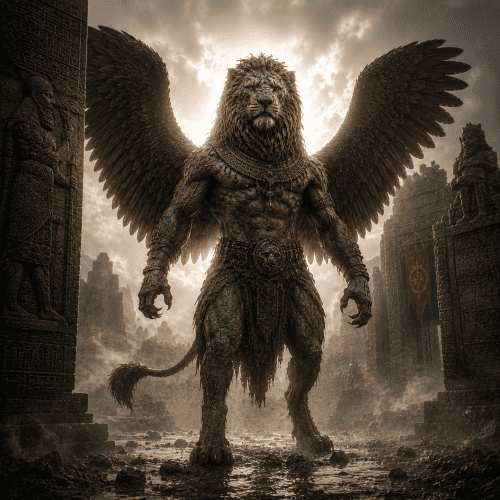
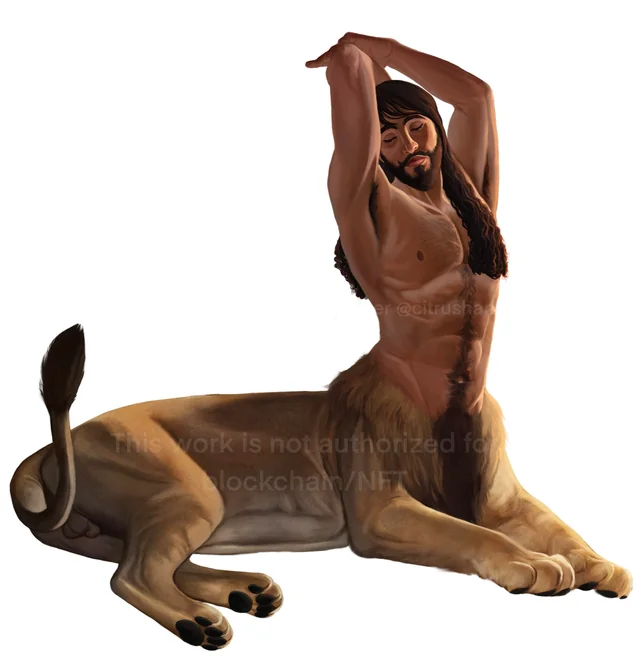
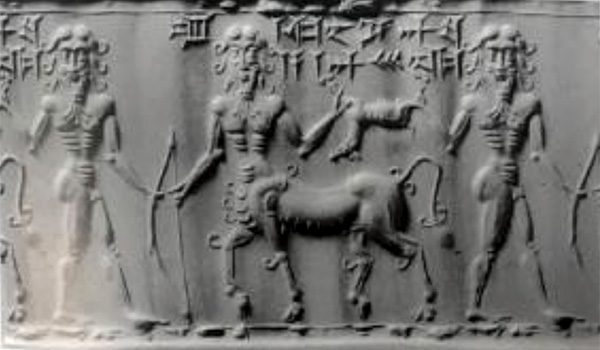
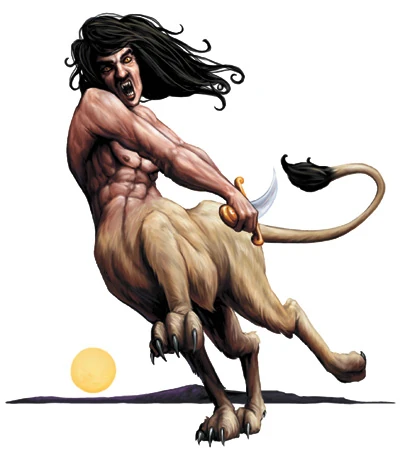
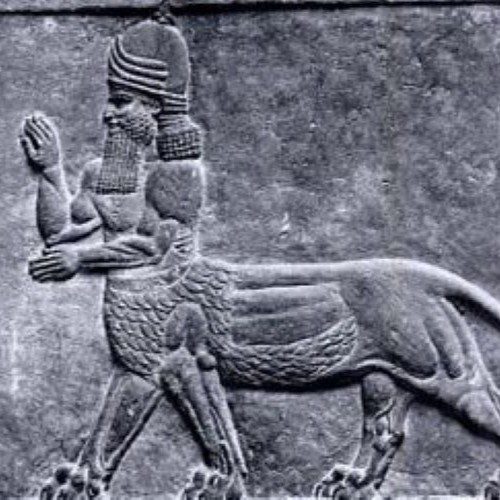
The Urmahlullu possessed one of the most distinctive appearances among the supernatural beings of Mesopotamian mythology. It was typically depicted with the upper body of a human emerging from the powerful body of a lion, creating a figure that modern audiences often compare to a lion-centaur. This unusual combination was far more than an artistic curiosity. Every aspect of the creature’s appearance carried symbolic meaning and reflected the values that Mesopotamian society associated with protection and authority.
The lion occupied a special place in the ancient Near Eastern imagination. Revered for its strength, courage, and dominance, it was often associated with royalty and divine power. Kings proudly depicted themselves hunting lions to demonstrate their bravery and legitimacy as rulers. By granting the Urmahlullu the body of a lion, Mesopotamian artists emphasized its ability to confront and overcome even the most dangerous supernatural threats.
The human portion of the creature was equally significant. Human intelligence represented reason, awareness, and the capacity to distinguish order from chaos. The combination of human and lion created a being capable of both understanding danger and possessing the strength necessary to eliminate it. The Urmahlullu was therefore not merely a beast of immense power but a guardian capable of acting with purpose and wisdom.
Ancient depictions often portray the Urmahlullu carrying a weapon such as a club or mace. These weapons reinforced its role as a defender prepared to confront hostile spirits and demonic entities. Some representations also show the creature wearing a horned crown, a common symbol of divinity in Mesopotamian art. The presence of such a crown suggests that the Urmahlullu occupied a position within the sacred hierarchy of supernatural beings rather than existing as an ordinary mythical animal.
Family
The Urmahlullu belonged to a larger family of protective supernatural beings known throughout Mesopotamian religion and magic. Among its closest mythological relatives were the Apkallu, wise guardian sages often depicted as part human and part fish or bird. The Apkallu were associated with divine wisdom and protection and were frequently represented in palace reliefs and ritual figurines.
The Urmahlullu also shared similarities with the Lamassu, the famous winged bulls or lions with human heads that guarded the entrances of Assyrian palaces. Both creatures served apotropaic functions, meaning they were intended to ward off evil and protect sacred spaces.
Other members of this protective tradition included creatures such as the Kusarikku, Ugallu, and Uridimmu. Together, these beings formed a supernatural defensive force against demons, curses, disease, and spiritual corruption. Unlike many mythological families connected through ancestry, the Urmahlullu’s “family” was defined by function. These creatures were united by their role as guardians of cosmic order rather than by bloodline or genealogy.
Other names
The name Urmahlullu originates from the Akkadian language and is generally translated as “Lion-Man” or “Lion-Human.” The name perfectly reflects the creature’s hybrid appearance and emphasizes the union of human intelligence with leonine strength. Ancient Mesopotamian names often described a being’s essential nature, and the Urmahlullu is no exception.
Modern scholars occasionally use terms such as “lion-centaur” or “leocentaur” when describing the creature to contemporary audiences. These labels help readers visualize the Urmahlullu by comparing it to better-known mythological hybrids. However, such terms are modern inventions rather than names used by the Mesopotamians themselves.
Powers and Abilities
The Urmahlullu was far more than a striking hybrid creature. In Mesopotamian belief, it was a supernatural guardian whose purpose was to defend the world of order against the forces of chaos. Unlike mythical beasts known for destruction, the Urmahlullu’s greatest strength lay in its ability to protect.
Ancient Mesopotamians believed that invisible dangers surrounded everyday life. Demons, wandering spirits, curses, and malevolent supernatural beings were thought capable of bringing illness, misfortune, and disorder into human communities. To counter these threats, priests and rulers relied upon powerful guardian entities whose presence could repel evil. The Urmahlullu was one such protector, standing as a spiritual sentinel between the mortal world and the unseen dangers lurking beyond it.
Its leonine form symbolized immense physical strength. Lions were considered among the most powerful creatures known to the ancient world, feared even by kings and warriors. By combining this strength with human intelligence, the Urmahlullu became a creature capable of recognizing supernatural threats and confronting them with both wisdom and force. This duality made it especially effective as a guardian.
One of the Urmahlullu’s most important abilities was its role in apotropaic magic, a form of protection intended to ward off evil influences. Images and figurines of the creature were believed to possess protective power in their own right. These representations were placed in homes, temples, and palaces where they could create a supernatural barrier against hostile entities. The mere presence of the Urmahlullu’s image was thought to discourage malevolent forces from entering protected spaces.
Modern Day Influence
One of the most notable modern appearances of the Urmahlullu can be found in the video game Final Fantasy XII. In the game, players encounter a creature bearing the same name, depicted as a lion-centaur warrior armed with a club and wearing a horned helmet. While the game’s interpretation takes creative liberties, it retains the creature’s intimidating leonine appearance and echoes its ancient origins as a formidable guardian.
The comic book series Fables also incorporates the Urmahlullu into its expansive mythological world. A character named Leo Lillie is portrayed as an urmahlullu and serves as a courageous warrior who opposes the forces of the Adversary. Through this character, the ancient guardian spirit is reimagined for a modern audience while preserving its association with bravery and protection.
References to the Urmahlullu have also appeared in literature, including Russell Hoban’s novel The Lion of Boaz-Jachin and Jachin-Boaz, where the creature serves as a symbol of the lion’s enduring mystery and power. Such appearances demonstrate how ancient mythological concepts continue to inspire contemporary creators.
Beyond direct references, the Urmahlullu’s influence can be seen in the broader popularity of hybrid guardian creatures within fantasy fiction. Modern audiences remain fascinated by beings that combine human intelligence with animal strength. From noble lion-warriors to magical protectors guarding sacred realms, many contemporary fantasy archetypes echo ideas that first emerged in Mesopotamian mythology thousands of years ago.
Related Images

Sources
Wikipedia contributors. (2025). Urmahlullu. Wikipedia. https://en.wikipedia.org/wiki/Urmahlullu
Wikipedia contributors. (2025). List of Mesopotamian deities. Wikipedia. https://en.wikipedia.org/wiki/List_of_Mesopotamian_deities
Encyclopaedia Britannica. (n.d.). History of Mesopotamia. Encyclopaedia Britannica. https://www.britannica.com/place/Mesopotamia-historical-region-Asia
World History Encyclopedia. (n.d.). Mesopotamian religion. https://www.worldhistory.org/Mesopotamian_Religion/
The University of Pennsylvania Museum. (n.d.). Ancient Mesopotamian gods and goddesses. Open Richly Annotated Cuneiform Corpus (ORACC). https://oracc.museum.upenn.edu/amgg/
Black, J., & Green, A. (2003). Gods, demons and symbols of ancient Mesopotamia: An illustrated dictionary. University of Texas Press.
Bane, T. (2016). Encyclopedia of beasts and monsters in myth, legend and folklore. McFarland.
Wiggermann, F. A. M. (1992). Mesopotamian protective spirits: The ritual texts. Styx Publications.
George, A. R. (2015). On Babylonian lavatories and sewers. Iraq, 77, 75–106.
Frequently Asked Questions
What is an Urmahlullu?
An Urmahlullu is a lion-human guardian creature from Mesopotamian mythology known for protecting sacred spaces from evil forces.
What does Urmahlullu mean?
The name Urmahlullu is generally translated as “Lion-Man” in Akkadian.
Was the Urmahlullu a god?
No, the Urmahlullu was a divine guardian being rather than a god.
What powers did the Urmahlullu possess?
The creature was believed to possess immense strength and the ability to ward off demons, evil spirits, and chaos.
Where was the Urmahlullu found in ancient Mesopotamia?
Images of the Urmahlullu were commonly placed in temples, palaces, and other sacred locations as protective symbols