

Cahokia Mounds : The Ancient City of the Mississippian People
At a glance
| Description | |
|---|---|
| Mythology | Native American Mythology |
| Country | United States of America |
| Closest airport | St. Louis Lambert International Airport (STL) |
| Type | Constructed |
| Accessibility | 10/10 |
Cahokia Mounds
Introduction
Cahokia Mounds, located near present-day Collinsville, Illinois, is among North America’s most important archaeological landmarks. This site, spanning roughly 2,200 acres, was once the center of a vibrant Mississippian culture that thrived from around 600 to 1400 CE. It features impressive earthworks, including ceremonial and residential mounds, offering a window into the lives, beliefs, and ingenuity of its inhabitants.
Designated as a UNESCO World Heritage Site, Cahokia Mounds attracts visitors from across the globe, eager to delve into its fascinating history. The site also holds profound spiritual significance, rooted in Native American mythology. Stories and traditions tied to the landscape reflect the deep connection between its builders and the natural world, enriching the experience of those who explore its enduring legacy.
Connection with Mythology
Cahokia Mounds is steeped in the mythology and spiritual beliefs of the Mississippian people, reflecting their deep connection to the natural and cosmic worlds. Central to their traditions is the concept of creation and balance, often illustrated in myths like that of the “Sky Woman,” a figure representing humanity’s origins and the harmony between earth and sky. These stories embody themes of interconnectedness that resonate with the landscape surrounding Cahokia.
The mounds themselves symbolize cosmic order, with Monks Mound—the largest earthen structure in the Americas—likely serving as a focal point for rituals and ceremonies. It may have housed a temple or been the residence of a spiritual leader, linking the physical and divine realms. Exploring these narratives provides visitors with a richer understanding of the beliefs that shaped the lives of Cahokia’s inhabitants and the spiritual significance imbued in this extraordinary site.
Ways to Get There
Reaching Cahokia Mounds is simple, thanks to its convenient location near Collinsville, Illinois, just a short drive from St. Louis, Missouri. The site is well-connected, offering multiple travel options for visitors.
If flying, St. Louis Lambert International Airport (STL) is the closest major airport, located about 30 minutes away. For those driving, the site is easily accessed via Interstates 55 and 70, with clear signage leading to the visitor center and mounds. Ample parking is available on-site for private vehicles.
Public transportation options include taking a train or bus to St. Louis, followed by a taxi, rideshare, or local transit to reach Cahokia. Guided tours are also available, providing an organized and insightful way to explore the historic site. Clear directions and multiple travel modes make visiting Cahokia Mounds both straightforward and flexible.
What to Look For
Cahokia Mounds features a range of remarkable structures that highlight the sophistication of the Mississippian civilization. The most prominent is Monks Mound, a massive earthen structure rising over 100 feet and covering around 14 acres, making it the largest prehistoric earthwork in North America. It is believed to have served as the political and ceremonial center of the city. Visitors who climb to the top are rewarded with expansive views of the surrounding landscape, offering a sense of the scale and organization of this ancient urban center.
Another significant feature is Woodhenge, a reconstructed circle of wooden posts that functioned as a solar calendar. The arrangement aligns with key astronomical events such as solstices and equinoxes, demonstrating the Cahokians’ understanding of celestial cycles and their importance in agriculture and ritual life. Nearby, Mound 72 provides deeper insight into the social and spiritual structure of the society. Excavations at this site have revealed elaborate burials, including high-status individuals accompanied by offerings, indicating a complex hierarchy and ceremonial tradition.
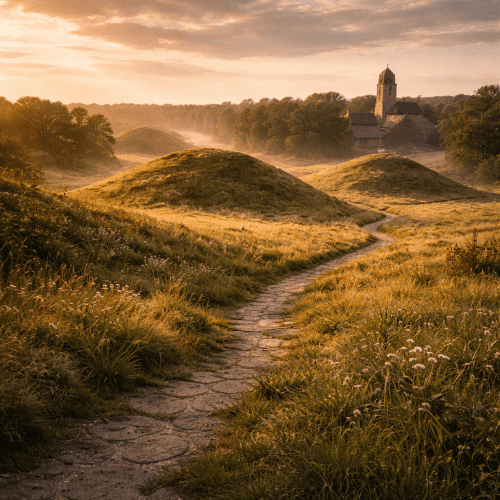
To better understand the daily life and culture of Cahokia’s inhabitants, visitors can explore the on-site Visitor Center and Museum, which houses artifacts, models, and interactive exhibits. Beyond these key locations, a network of walking trails winds through the site, allowing visitors to encounter smaller mounds and natural features across the landscape. These paths offer a more immersive experience, connecting the archaeological remains with the environment in which this once-thriving city developed.
Importance in cultural history
Cahokia Mounds stands as a remarkable testament to the ingenuity and cultural achievements of pre-Columbian North America. Once a thriving metropolis, it was home to a population of up to 20,000 at its height between AD 1050 and 1200, making it one of the largest cities in the world during its era. Its urban design and monumental earthworks demonstrate a sophisticated understanding of engineering, social organization, and resource management.
As a center of influence, Cahokia played a vital role in regional trade networks, connecting distant communities and fostering cultural exchange. The site’s impressive scale and complexity challenge outdated perceptions of indigenous societies as static, revealing instead a dynamic and interconnected civilization.
Preserving Cahokia Mounds is essential not only for understanding the Mississippian culture but also for appreciating the deep historical roots of Native American societies. The lessons embedded in this landscape remind us of the importance of cultural resilience, sustainable practices, and the enduring ties between communities and their environment.
Best time to travel
The ideal time to visit Cahokia Mounds depends on your preferences and what you hope to experience. Spring and fall are particularly popular for their mild weather and scenic beauty. In spring, blooming wildflowers and fresh greenery create a vibrant atmosphere, while fall offers striking foliage and crisp air, perfect for exploring the mounds and trails.
Summer provides longer daylight hours, making it suitable for those who enjoy spending extended time outdoors. However, the heat and humidity can be intense, so visitors should come prepared with water and sun protection. Winter, though quieter and colder, offers a serene experience, with fewer visitors and the opportunity to focus on the site’s rich history through the indoor exhibits at the Interpretive Center.
Regardless of the season, Cahokia Mounds presents a unique opportunity to connect with the history and culture of the Mississippian people, making it a compelling destination year-round.


Source
Encyclopaedia Britannica. (n.d.). Cahokia. https://www.britannica.com/place/Cahokia
UNESCO World Heritage Centre. (n.d.). Cahokia Mounds State Historic Site. https://whc.unesco.org/en/list/198/
National Park Service. (n.d.). Cahokia Mounds. https://www.nps.gov/subjects/cahokia/index.htm
World History Encyclopedia. (n.d.). Cahokia. https://www.worldhistory.org/Cahokia/
Pauketat, T. R. (2009). Cahokia: Ancient America’s great city on the Mississippi. Viking.
Young, B. (2000). Cahokia: The great native American metropolis. University of Illinois Press.
Fowler, M. L. (1997). The Cahokia atlas: A historical atlas of Cahokia archaeology. University of Illinois Press.
Pauketat, T. R., & Emerson, T. E. (1997). Cahokia and the archaeology of power. Journal of Archaeological Research, 5(1), 1–38. https://doi.org/10.1023/A:1021807202455
Frequently Asked Questions
Where are Cahokia Mounds located?
Cahokia Mounds are located in Illinois, USA, near the city of St. Louis, along the Mississippi River.
What are Cahokia Mounds?
They are a complex of large earthen mounds built by the Mississippian culture, forming one of the largest pre-Columbian cities in North America.
Why is Cahokia important?
Cahokia was a major political, economic, and religious center between 1050 and 1350 CE, demonstrating advanced urban planning and social organization.
What is Monk’s Mound?
Monk’s Mound is the largest mound at Cahokia and the biggest earthen structure in North America, believed to have been the center of political and ceremonial life.
Why was Cahokia abandoned?
The exact reason is unknown, but theories include environmental changes, resource depletion, and social or political instability.