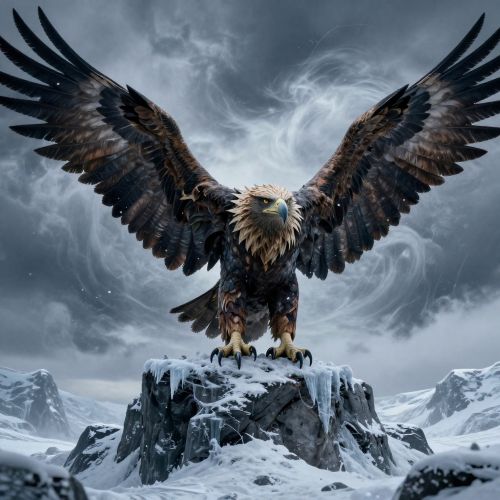


Skadi : The Norse Goddess of Winter and the Hunt
At a glance
| Description | |
|---|---|
| Origin | Norse Mythology |
| Classification | Hybrids |
| Family Members | Þjazi (Father), Njörðr (Husband), Sæmingr (Son) |
| Region | Norway, Sweden, Denmark |
| Associated With | Winter, Mountains, Hunting, Archery |
The Mythlok Perspective
In Mythlok’s Perspective, Skadi represents the spirit of the wilderness confronting the structures of divine civilization. She is not merely a winter goddess but a symbol of nature’s independence and uncompromising strength. Unlike many deities who rule from temples or halls, Skadi belongs to the mountains themselves. Her character resembles other cold-domain figures across cultures. The Slavic winter goddess Morana and the Japanese mountain spirits of the Yama-no-kami tradition share a similar connection to harsh landscapes and survival. These parallels suggest that human cultures consistently personify the wilderness as a powerful feminine force that commands both respect and caution.
Skadi
Introduction
Skadi, also spelled Skaði in Old Norse, is one of the most striking figures associated with the Norse pantheon. She stands at the intersection between the world of the gods and the realm of the giants, embodying both traditions in a single mythological identity. Known as a goddess of winter, mountains, skiing, and the hunt, Skadi represents the raw power and beauty of the northern wilderness. Her story appears mainly in the Poetic Edda, the Prose Edda, and later historical works such as Heimskringla, which preserve older Scandinavian oral traditions.
Unlike many figures in Norse belief, Skadi begins her story not as a member of the Æsir gods but as a jötunn, or giantess. She is the daughter of the powerful giant Þjazi, whose death at the hands of the gods triggered one of the most dramatic confrontations between the giants and the divine rulers of Asgard. Instead of retreating after her father’s death, Skadi marched into the realm of the gods fully armed and demanded justice.
Her confrontation with the gods did not end in war but in negotiation. The Æsir offered compensation, allowing her to choose a husband among them and attempting to make her laugh as part of the settlement. Through this unusual arrangement, Skadi became connected to the divine world while still maintaining her identity as a powerful mountain spirit.
Over time, Skadi came to represent independence, endurance, and the harsh beauty of the northern landscapes. Her myths highlight the tension between civilization and wilderness, sea and mountains, and the complicated relationships between the gods and the giants.
Physical Traits
The surviving Norse texts provide only limited direct descriptions of Skadi’s physical appearance, but the context of her stories paints a vivid image of a powerful and athletic figure shaped by the extreme environment she inhabits. She is frequently imagined as tall, strong, and strikingly beautiful, reflecting both her giant heritage and her association with untamed landscapes.
Skadi is most often depicted as a hunter moving across snowy mountains with skis or snowshoes. In Norse culture, skiing was not simply a recreational activity but an essential skill used for travel, hunting, and warfare during winter. Her mastery of skis symbolized her deep familiarity with the snow-covered terrain of Scandinavia.
She is also closely linked with archery. Many depictions show her carrying a bow and arrows, suggesting a skilled huntress capable of surviving alone in harsh wilderness. Her presence among wolves, icy winds, and towering mountains reinforces the idea that she belongs to the wild rather than the sheltered halls of the gods.
The imagery surrounding Skadi often emphasizes the contrast between elegance and severity. She is sometimes described as a radiant or “shining bride of the gods,” yet her personality reflects the unforgiving strength of winter itself. This combination of beauty and toughness makes her one of the most distinctive female figures in Norse tradition.
Family
Skadi’s family connections place her firmly within the mythological conflict between the giants and the gods. She is the daughter of the giant Þjazi, a powerful figure known for abducting the goddess Idunn, the keeper of the apples that grant the gods their youth. When the Æsir ultimately killed Þjazi during the rescue of Idunn, Skadi set out to avenge him.
Armed for battle, she traveled to Asgard prepared for war. The gods, recognizing both her strength and the danger of further conflict with the giants, chose to settle the dispute through compensation rather than violence. As part of this agreement, Skadi was allowed to choose a husband from among the gods, though she could only see their feet.
Hoping to choose the beloved god Baldr, whom she believed had the most beautiful feet, Skadi instead selected Njörðr, a Vanir god associated with the sea, wealth, and sailing. Their marriage quickly revealed a fundamental incompatibility. Njörðr preferred the sound of waves and seabirds along the coast, while Skadi loved the silent snow and high mountains of her homeland.
They attempted to live together by alternating between their homes. Nine nights were spent in the mountains at Þrymheimr, Skadi’s hall, and nine nights by the sea at Njörðr’s home. However, neither could adapt to the other’s environment. Eventually, the two separated, with Skadi returning permanently to the mountains.
Some later traditions suggest that Skadi may have had children with Odin, including the legendary ruler Sæmingr, who was believed to be an ancestor of certain Scandinavian royal lines.
Other names
The name Skadi originates from the Old Norse word Skaði, which may relate to terms meaning harm, damage, or shadow. This etymology reflects the formidable and sometimes dangerous nature associated with winter and mountainous environments.
Several titles and alternate forms of her name appear in Norse texts and later interpretations. She is sometimes referred to as Öndurguð, meaning “ski god,” or Öndurdís, meaning “ski spirit,” highlighting her unique connection to skiing and winter travel.
Anglicized versions of her name include Skadi, Skade, and Skathi, all derived from the original Old Norse spelling. Scholars have also explored a possible connection between her name and the word Scandinavia, though this link remains debated among historians and linguists.
Powers and Abilities
Skadi’s powers are closely tied to the natural forces of winter and the wilderness. As a goddess of mountains and hunting, she embodies the skills required to survive in harsh northern climates. Her expertise as an archer and hunter is one of her defining traits. In the myths, she moves confidently through frozen terrain, tracking animals across snow-covered slopes. This skill symbolizes both physical endurance and mastery over nature.
Skadi is also associated with winter itself. Her presence evokes snowstorms, icy winds, and the silent strength of mountain landscapes. Rather than controlling winter in a supernatural sense, she personifies its power and inevitability.
One of her most notable roles appears in the punishment of Loki after his role in the death of Baldr. According to the Prose Edda, Skadi helped secure a venomous serpent above the bound trickster god so that its poison would drip onto him as part of his punishment. This act highlights her role in maintaining cosmic justice. Her actions throughout the myths demonstrate independence and determination. By confronting the gods directly and negotiating compensation for her father’s death, Skadi reveals both strength and wisdom in dealing with powerful rivals.
Modern Day Influence
Skadi continues to inspire modern interpretations of Norse mythology and Scandinavian cultural identity. Her image as a fearless huntress and winter goddess resonates strongly in societies that value resilience, independence, and connection to nature.
In contemporary culture, Skadi appears in literature, video games, and television series that draw inspiration from Norse legends. Games such as Smite and Assassin’s Creed Valhalla portray her as a powerful winter deity, reflecting her mythological attributes.
She has also become a symbolic figure associated with winter sports and outdoor exploration. Because of her connection to skiing and mountainous terrain, she is often referenced in discussions about the historical roots of skiing in Scandinavia.
Beyond entertainment, Skadi is frequently interpreted as a symbol of female strength and autonomy. Her willingness to challenge the gods and maintain her independence has made her an appealing figure in modern retellings of ancient myths. Through these cultural references, Skadi remains a living part of northern storytelling traditions, continuing to represent the untamed spirit of winter landscapes.
Related Images



Source
Lindow, J. (2002). Norse mythology: A guide to gods, heroes, rituals, and beliefs. Oxford University Press.
Orchard, A. (1997). Dictionary of Norse myth and legend. Cassell.
Simek, R. (2007). Dictionary of Northern Mythology. D.S. Brewer.
Snorri Sturluson. (13th century). Prose Edda. (Translated by A. Faulkes, 1987). Everyman.
Unknown. (13th century). Poetic Edda. (Translated by H. A. Bellows, 1923). American-Scandinavian Foundation.
Mythos Anthology. (n.d.). Skadi: The giantess of winter and the hunt. https://mythosanthology.com/skadi/
Norse Mythology for Smart People. (2017, July 8). Skadi. https://norse-mythology.org/gods-and-creatures/giants/skadi/
Wikipedia. (2002, August 9). Skaði. https://en.wikipedia.org/wiki/Ska%C3%B0i
Frequently Asked Questions
Who is Skadi in Norse mythology?
Skadi is a Norse goddess and giantess associated with winter, mountains, skiing, and hunting. She is the daughter of the giant Þjazi and later married the sea god Njörðr.
Is Skadi a god or a giant?
Skadi is both. She was born a jötunn (giantess) but became associated with the gods after marrying Njörðr and interacting with the Æsir.
Why did Skadi and Njörðr separate?
Their marriage failed because they preferred different environments. Njörðr loved the sea while Skadi preferred the snowy mountains.
What is Skadi the goddess of?
Skadi is commonly associated with winter, mountains, skiing, hunting, and wilderness survival.
Is Skadi connected to Scandinavia?
Some scholars believe the name Scandinavia may be related to Skadi, though the connection remains debated.