

Mot : The Canaanite God of Death and Drought
Listen
At a glance
| Description | |
|---|---|
| Origin | Canaanite Mythology |
| Classification | Gods |
| Family Members | El (Father), Baal (Brother), Anat (Sister) |
| Region | Syria |
| Associated With | Death, Drought, Sterility, Underworld |
The Mythlok Perspective
In Mythlok’s Perspective, Mot represents the elemental truth that death is not a villain but a season. Unlike Hades, who governs an orderly realm, or Yama, who judges souls, Mot is pure environmental force. He is closer to drought itself than to a courtroom of the dead. His struggle with Baal mirrors agricultural civilizations everywhere, where survival depended on rain. Mot is not chaos. He is the silence between storms, the pause that makes renewal meaningful.
Mot
Introduction
Mot stands as one of the most formidable figures in ancient Levantine religion. His name, derived from the Semitic root mwt, literally means “death,” a meaning preserved across several related languages. Worshiped in the city of Ugarit and acknowledged in broader Canaanite and Phoenician traditions, Mot personified mortality, drought, sterility, and the silent authority of the underworld.
Mot is best known through the Baal Cycle, a series of Ugaritic tablets discovered at Ras Shamra in 1928. In these texts, he emerges as the great adversary of Baal, the storm and fertility god whose rains sustained agricultural life. Their confrontation was not merely a divine rivalry but a theological explanation of seasonal change. When Mot triumphed, the earth withered under drought. When Baal returned, rains revived the fields. In this way, Mot became the cosmic embodiment of death as a necessary, cyclical force within nature rather than an absolute annihilation. Understanding Mot is essential to understanding how ancient Canaanite society interpreted life, famine, and renewal. In a land dependent on rainfall, death was not abstract. It was seasonal, agricultural, and deeply personal.
Physical Traits
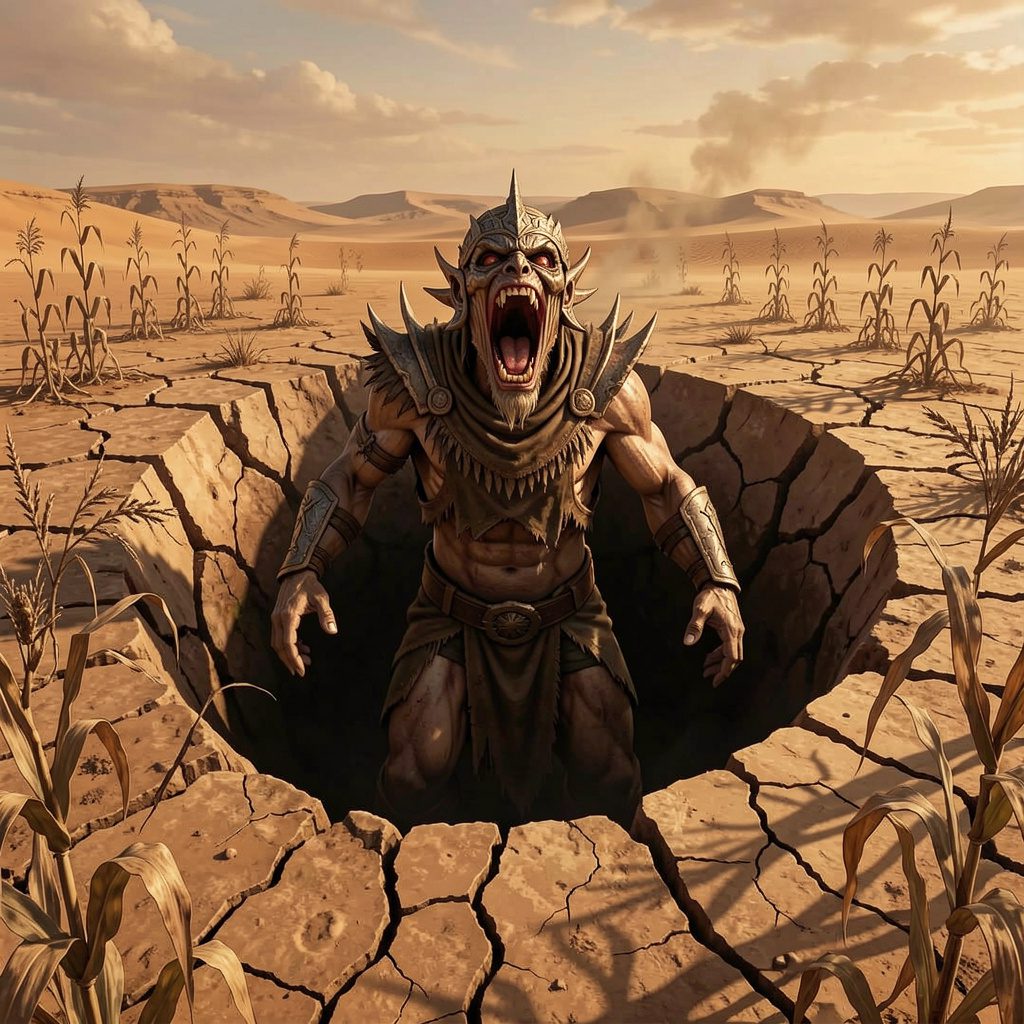
Unlike many Near Eastern deities, Mot was rarely described in refined anthropomorphic terms. Instead, the texts portray him symbolically and monstrously. He is depicted as having an enormous mouth stretching from earth to heaven, capable of swallowing gods and mortals alike. His appetite is endless, reinforcing the idea that death ultimately consumes all beings.
Mot’s dwelling is described as a pit or swamp, a realm of filth and decay. His city is associated with desolation, reinforcing his identity as ruler of the underworld. When Baal’s messengers approach him, they are warned not to draw too near lest they be devoured “like a lamb in his mouth.” Mot himself boasts of crushing Baal “like a kid in my jaws,” emphasizing his dominance and terrifying presence.
There are no surviving statues that clearly depict Mot, suggesting that his worship may have been more conceptual than image-centered. His imagery was poetic rather than sculptural, shaped by fear, drought, and the visible barrenness of the land during dry seasons.
Family
Mot was counted among the sons of El, the supreme patriarch of the Canaanite pantheon. This lineage positioned him within the highest divine hierarchy. His siblings included Baal and Anat, among others. This divine family structure reveals something profound about Canaanite cosmology. Life and death were not enemies from separate realms; they belonged to the same divine household. Mot’s rivalry with Baal was therefore an internal cosmic tension rather than an external invasion of evil. Death was not outside creation. It was part of its structure.
Phoenician sources recorded by Philo of Byblos, drawing on the earlier writer Sanchuniathon, also describe a figure named Muth, identified with Death, as a descendant of El. While these accounts were filtered through later Hellenistic interpretations, they reinforce Mot’s enduring presence in West Semitic religious memory.
Other names
Mot’s name appears in multiple Semitic languages, reflecting the shared linguistic and theological heritage of the region. In Ugaritic texts, he is written as mt. In Hebrew, the word mavet or mot means death. Arabic preserves the cognate mawt. Akkadian uses mūtu.
These linguistic parallels do not always indicate direct worship of the same deity across cultures, but they demonstrate the deep-rooted conceptual continuity of death as both a noun and a divine force. In biblical Hebrew literature, death is sometimes personified, echoing older Near Eastern traditions in which death could act, devour, and claim victims. Mot’s widespread name continuity underscores how central the concept of death was across the ancient Near East.
Powers and Abilities
Mot’s primary domain was the underworld, often called the land of no return. As ruler of this realm, he exercised authority over the dead and embodied the irreversible finality of mortality. However, his influence extended beyond the grave into the living world.
In the Baal Cycle, Mot defeats Baal after demanding submission. When Baal descends into Mot’s domain, rain ceases, crops fail, and drought grips the land. Mot’s power is therefore agricultural and environmental. He does not simply kill individuals; he withholds fertility itself. Mot’s breath is described as scorching, capable of burning the fruits of the earth. This imagery directly connects him with seasonal dryness in the Levant. His victory over Baal represents the dry summer months when storms vanish and vegetation fades.
Yet the story does not end in permanent death. Anat intervenes violently, dismembering Mot in a dramatic episode where she cuts, burns, grinds, and scatters him. Eventually, with the help of Shapash, Baal returns from the underworld. Mot later reappears, and the two gods battle again before reaching a resolution. This cycle mirrors the agricultural year. Mot is not destroyed forever. Nor is Baal. Their conflict symbolizes seasonal alternation rather than ultimate conquest. Death and fertility coexist in rhythm.
Modern Day Influence
Mot’s direct worship ended with the decline of Ugarit and the transformation of Levantine religion. However, his conceptual legacy persisted. In the Hebrew Bible, the word mavet appears frequently and is occasionally personified. Scholars note parallels between the Baal-Mot conflict and later biblical themes in which a sovereign deity controls both drought and rain. While Israelite religion rejected Canaanite polytheism, linguistic and symbolic traces of earlier traditions remained embedded in the text.
Modern scholarship continues to examine Mot within comparative religion. His role has been compared to Hades and Yama, though important differences exist. Unlike Hades, who governs the dead with order, Mot is raw desolation. Unlike Yama, who judges souls, Mot primarily embodies consumption and drought. Archaeological discoveries at Ugarit transformed biblical and Near Eastern studies in the twentieth century, allowing scholars to reconstruct the worldview in which Mot once stood as a central cosmic force.
Related Images
Source
Del Olmo Lete, G. (2015). Canaanite religion according to the liturgical texts of Ugarit (2nd English revised ed.). Ugarit-Verlag.
McAfee, M. (2019). An analysis of words for “death” in Ugaritic. In Life and mortality in Ugaritic: A lexical and literary study (pp. 125-190). Penn State University Press. https://doi.org/10.1515/9781646020386-006
Mullen, E. T., Jr. (1980). The cosmogonie conflicts: The kingship of Ba’l, Yamm, and Môt. In The divine council in Canaanite and early Hebrew literature (pp. 46–84). Brill. https://doi.org/10.1163/9789004387065_007
Smith, M. S. (2001). The origins of biblical monotheism: Israel’s polytheistic background and the Ugaritic texts. Oxford University Press.
The Baal Cycle. (n.d.). In Ugaritic texts from Ras Shamra. Retrieved from ancient sources via https://en.wikipedia.org/wiki/Mot_(god)
Daccache, J. (2021). Mot. In Encyclopedia of the Bible and its reception online. De Gruyter. https://doi.org/10.1515/ebr.mot
Philo of Byblos. (c. 64–141 CE). Phoenician history (Paraphrase by Eusebius). In Praeparatio evangelica (Book 1).
Cross, F. M. (1973). Canaanite myth and Hebrew epic: Essays in the history of the religion of Israel. Harvard University Press.
Frequently Asked Questions
Who was Mot in Canaanite religion?
Mot was the Canaanite god of death, drought, and the underworld, primarily known from the Ugaritic Baal Cycle.
Was Mot considered evil?
Mot was not purely evil but represented the necessary force of death and seasonal dryness within the cosmic order.
How did Mot defeat Baal?
In the Baal Cycle, Mot swallows Baal, causing drought and the temporary death of fertility in the land.
Is Mot mentioned in the Bible?
While Mot is not directly worshiped in the Bible, the Hebrew word for death, mavet, shares linguistic roots and sometimes appears personified.
What does Mot symbolize?
Mot symbolizes mortality, desolation, drought, and the cyclical balance between death and renewal.