

Mezu : The Horse-Headed Guardian of the Japanese Underworld
Listen
At a glance
| Description | |
|---|---|
| Origin | Japanese Mythology |
| Classification | Hybrids |
| Family Members | N/A |
| Region | Japan |
| Associated With | Underworld, Guardian |
Mezu
Introduction
In Japanese Buddhist cosmology, Mezu (馬頭), meaning “Horse Head,” stands as one of the most formidable guardians of the underworld. Operating under the authority of Enma Daiō, the Great King of Hell, Mezu functions as a demon general tasked with enforcing karmic justice upon the dead. Alongside his inseparable counterpart Gozu, the Ox-Head demon, Mezu ensures that no soul escapes judgment once it enters Jigoku, the realm of punishment.
Unlike purely folkloric monsters, Mezu represents a moral force rooted in Buddhist teachings. His presence reinforces the belief that actions in life directly shape one’s fate after death. The figure of Mezu entered Japan through the transmission of Buddhist ideas from India to China and then to Japan, where it merged with indigenous oni imagery and Shinto-influenced notions of spirits and retribution. Over time, Mezu became a recognizable symbol of inevitability, embodying the inescapable consequences of karma rather than arbitrary cruelty.
Physical Traits
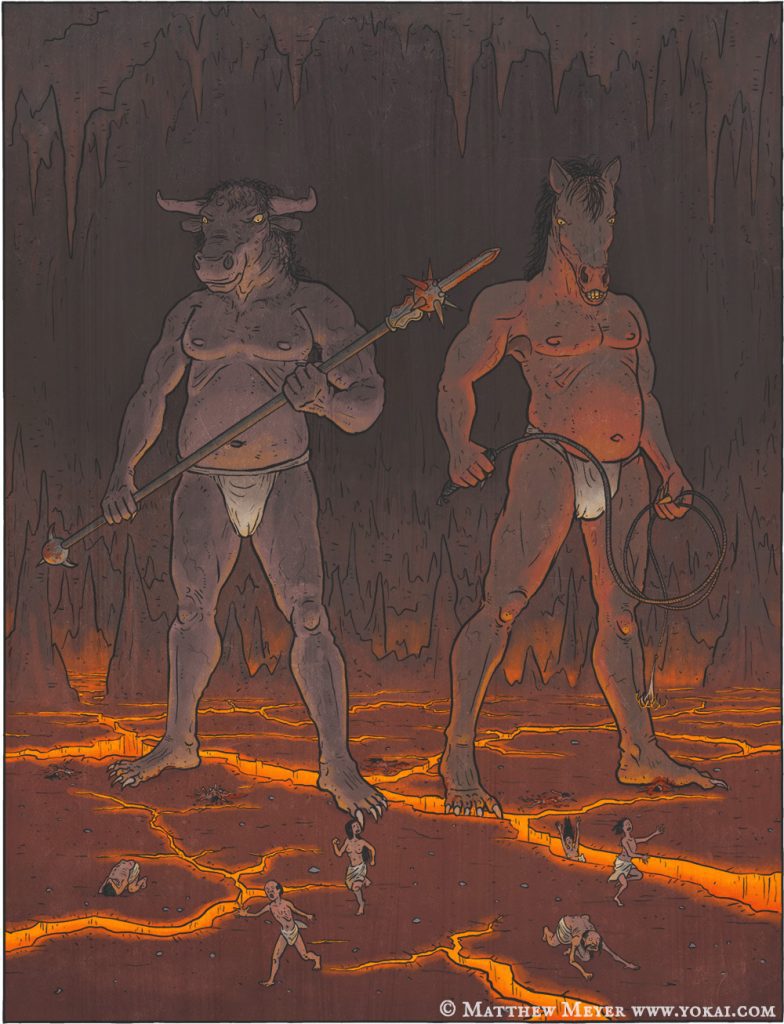
Mezu is traditionally portrayed as a towering oni with the muscular body of a man and the unmistakable head of a horse. His equine skull is elongated and fierce, marked by flared nostrils, bared teeth, and wide, unblinking eyes that convey constant vigilance. A wild mane often flows from his head, emphasizing both motion and menace, while his skin is depicted in dark or infernal tones associated with Jigoku.
In classical scroll paintings and temple art, Mezu is frequently armed with heavy iron clubs, chains, or spiked maces—tools designed not merely to punish but to restrain souls attempting resistance. His physical form conveys speed and pursuit rather than sheer endurance, distinguishing him visually from Gozu’s broader, ox-like strength. The horse head is symbolic: in East Asian belief systems, horses represent relentless movement, duty, and the ability to cross boundaries, making Mezu an ideal guardian of hell’s thresholds.
Family
Mezu does not possess a familial lineage in the human sense. Instead, his identity is defined by function and hierarchy. His closest and most constant association is with Gozu, with whom he forms a dual guardianship that appears throughout Japanese Buddhist literature and visual culture. Together, they act as enforcers directly subordinate to Enma Daiō, who presides over the judgment of the dead.
This pairing reflects balance within the underworld’s order. Where Gozu represents immovable force and endurance, Mezu embodies speed, precision, and capture. In some traditions, the two are depicted among a wider group of animal-headed demons serving different punitive roles, but Mezu and Gozu remain the most prominent. Their bond is functional rather than emotional, reinforcing the impersonal nature of karmic justice in Buddhist thought.
Other names
Mezu is also widely known as Mezuki (馬頭鬼), a term that emphasizes his identity as a horse-headed demon. When referenced alongside his counterpart, the pair are collectively called Gozu-Mezu (牛頭馬頭), a phrase commonly used in Buddhist texts and popular culture to signify the guardians of hell.
Beyond Japan, Mezu corresponds closely to the Chinese underworld figure Mǎmiàn (Horse-Face), who appears with Niú Tóu (Ox-Head) in Chinese Buddhist and Taoist traditions. These shared identities illustrate the cross-cultural movement of religious imagery across East Asia. In medieval Japanese literature such as the Konjaku Monogatari-shū, horse-headed demons appear as agents of punishment, further solidifying Mezu’s role within Japan’s mythic imagination.
Powers and Abilities
Mezu’s abilities are inseparable from his duty as an enforcer of karmic law. He possesses immense physical strength, capable of restraining violent or defiant souls with ease. However, his most defining trait is relentless pursuit. Once a soul is marked for punishment, Mezu ensures it cannot flee, tracking escapees across the realms of Jigoku with tireless speed.
Mezu is also immortal, existing outside the cycles of birth and rebirth that govern mortal beings. He carries out punishments repeatedly, overseeing torments designed to correspond precisely to the crimes committed in life. In Buddhist belief, these acts are not fueled by malice but by necessity. Mezu does not judge; he executes the sentence already determined by Enma Daiō. In this way, Mezu personifies inevitability—the certainty that no action escapes consequence.
Modern Day Influence
In modern Japan, Mezu remains a powerful cultural image, appearing in manga, anime, video games, and horror-themed attractions. He frequently appears as a fearsome gatekeeper or boss-level adversary, drawing directly from traditional depictions of Mezuki. Popular franchises such as Shin Megami Tensei and Nioh reinterpret Mezu as a summonable demon or battlefield guardian, introducing him to global audiences.
Beyond entertainment, Mezu’s symbolism persists in philosophical and psychological interpretations. He is often referenced as a metaphor for accountability, representing the inescapable results of one’s actions. During festivals like Setsubun, oni imagery resembling Mezu is used to dramatize the expulsion of moral and spiritual corruption. Through these evolving representations, Mezu continues to bridge ancient Buddhist cosmology with contemporary storytelling, maintaining relevance in both sacred and secular spaces.
Related Images


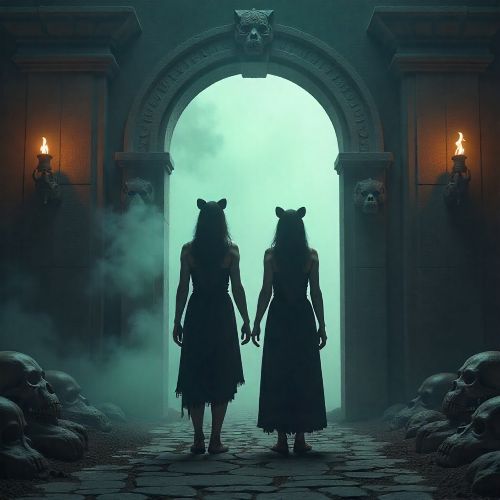
Source
Foster, M. D. (2023, January 8). Mezu. Yokai.com. https://yokai.com/mezu/
Foster, M. D. (2023, January 8). Gozu. Yokai.com. https://yokai.com/gozu/
Meyer, M. (2016, October 15). A yokai a day: Gozu & Mezu. Matthewmeyer.net. https://matthewmeyer.net/blog/2016/10/15/a-yokai-a-day-gozu-mezu/
Wikipedia contributors. (2024, January 12). Ox-Head and Horse-Face. Wikipedia. https://en.wikipedia.org/wiki/Ox-Head_and_Horse-Face
Localiiz. (2022, December 27). Chinese mythology 101: Ox-head and Horse-face. Localiiz.com. https://www.localiiz.com/post/culture-local-stories-chinese-mythology-101-ox-head-horse-face
Roberts, J., & Yenne, B. (2010). Japanese mythology A to Z (2nd ed.). Facts On File.
Ashkenazi, M. (2008). Handbook of Japanese mythology. ABC-CLIO.
Turnbull, S. (2014). Japanese warrior monasticism: The way of the ninja, monk and samurai. Amberley Publishing.
Frequently Asked Questions
Who is Mezu in Japanese Buddhist tradition?
Mezu is a horse-headed demon who serves under Enma Daiō as a guardian and enforcer of karmic punishment in the Japanese underworld.
What is the relationship between Mezu and Gozu?
Mezu and Gozu operate as paired guardians of hell, representing speed and strength while preventing souls from escaping judgment.
Is Mezu considered evil in Buddhism?
Mezu is not evil but a necessary enforcer of karmic law, carrying out punishment without personal malice.
Where did the figure of Mezu originate?
Mezu originated from Indian Buddhist concepts transmitted through Chinese mythology before being adapted into Japanese religious tradition.
How does Mezu appear in modern culture?
Mezu appears in anime, video games, festivals, and horror media as a symbol of justice, punishment, and moral consequence.