
Likho : The One-Eyed Spirit of Slavic Folklore
At a glance
| Description | |
|---|---|
| Origin | Slavic Mythology |
| Classification | Spirits |
| Family Members | N/A |
| Region | Russia, Ukraine, Belarus, Poland |
| Associated With | Misfortune, Bad luck, Suffering, Poverty, Fear, Fate, Sickness |
The Mythlok Perspective
In Mythlok’s Perspective, Likho is one of the purest mythological representations of unavoidable human suffering. Unlike dragons, demons, or war gods that threaten through force, Likho destroys through inevitability. The spirit reflects an ancient fear that bad fortune can enter a person’s life without warning and slowly consume everything around them. Its single eye symbolizes imbalance, incomplete destiny, and the terrifying awareness of doom approaching. What makes Likho especially powerful in folklore is its psychological nature. It is less a monster of violence and more a manifestation of despair itself. Similar figures exist in many cultures, such as the Greek Cyclops or the Celtic banshee, but those beings often serve narrower mythic roles. Likho instead acts as the embodiment of fate turning against humanity, making it one of the darkest symbolic spirits in Slavic tradition.
Likho
Introduction
Likho is one of the most unsettling figures in Slavic Mythology. Unlike gods, heroes, or protective spirits, Likho represents pure misfortune and unavoidable suffering. Across Russian, Ukrainian, Belarusian, and Polish folklore, the creature appears as a living embodiment of bad luck that follows people into ruin. Its name itself became synonymous with disaster, which is why many Slavic proverbs still use the word “Likho” to describe danger or calamity.
In many folk tales, Likho appears when humans become greedy, reckless, or overly curious. The creature does not usually hunt people in the traditional sense. Instead, it enters a person’s life like a curse, slowly destroying happiness, wealth, health, and hope. This symbolic role made Likho one of the most feared supernatural beings in Eastern European storytelling traditions.
The figure is especially important because it reflects how ancient Slavic communities understood fate. Misfortune was often seen as a force that could attach itself to a person without warning. Likho became the physical representation of that fear. Rather than ruling an underworld or commanding armies of spirits, it simply existed as a reminder that suffering can arrive unexpectedly and remain impossible to escape.
Folklore scholars often compare Likho to personifications of doom found in other cultures. However, its uniquely Slavic identity comes from the way it blends fear, fate, morality, and superstition into a single haunting figure.
Physical Traits
Likho is almost always described as a one-eyed being. This single eye is the creature’s defining characteristic and appears consistently across different Slavic regions and folk traditions. Because of this feature, many modern writers compare Likho to the Cyclops of Greek mythology, though the two beings are very different in symbolism and behavior.
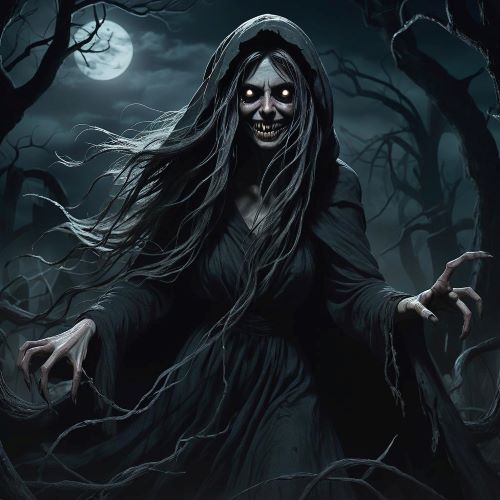
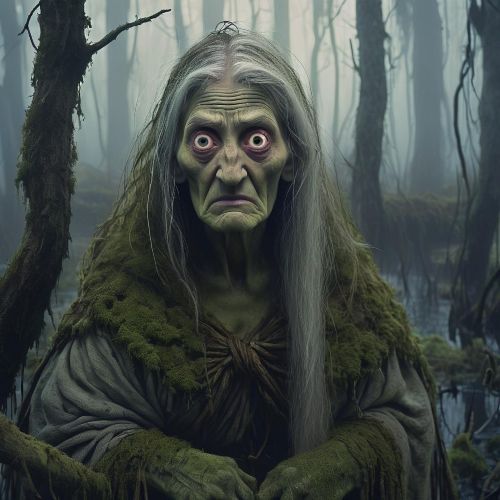
The most common depiction presents Likho as a tall, skeletal old woman dressed in torn black clothing. Her body is unnaturally thin, with long arms and sharp fingers that resemble claws. In some tales, she appears almost corpse-like, reflecting starvation, grief, and decay. Her lone eye is often described as glowing or staring with unnatural intensity.
Other stories portray Likho as a monstrous forest goblin or a shadowy humanoid creature lurking among trees and abandoned places. Some legends even describe the spirit as gigantic, towering above forests like a living omen of catastrophe. Despite these variations, the one-eyed appearance always remains unchanged, reinforcing the creature’s symbolic role as a being tied to imbalance and incomplete fate.
The dark clothing associated with Likho also carries symbolic meaning. Black garments in Slavic folklore were often connected to mourning, death, and evil spirits. This visual imagery helped storytellers immediately identify Likho as a creature tied to doom rather than ordinary supernatural activity.
Family
Likho is not part of a structured divine family or pantheon. Unlike major Slavic gods connected through mythology and ancestry, it exists as an isolated spirit associated with suffering and evil fate. Most traditions treat the creature as a solitary supernatural force rather than the child or servant of another deity.
Some pre-Christian beliefs loosely connected Likho to spirits of death and misfortune. In certain interpretations, the creature was seen as a servant or companion of death itself. Folklore also associates Likho with Nav spirits, restless entities linked to the dead and the darker side of the spiritual world in Slavic belief systems.
Linguistically, Likho is sometimes connected to “Likhoradka,” a term associated with fever and illness in Slavic traditions. This connection strengthened the idea that disease and suffering were extensions of the same destructive spiritual force represented by Likho. Rather than possessing relatives or descendants, Likho belongs to a broader category of symbolic spirits that personified fear, famine, illness, and despair in ancient folklore.
Other names
The name Likho appears in several forms across Slavic languages. In Russian and Ukrainian traditions, the being is called “Лихо,” which directly translates to “bad luck” or “misfortune.” In Polish folklore, the variation “Licho” can refer to evil or something ominous, while Belarusian forms carry similar meanings connected to suffering and disaster.
One of the most famous expressions connected to the creature is the Russian proverb, “Не буди лихо, пока оно тихо,” meaning “Do not wake Likho while it is quiet.” The saying warns people against provoking trouble unnecessarily. Another well-known Polish phrase, “Licho wie,” translates loosely as “Only Likho knows,” reflecting uncertainty and dread.
These expressions demonstrate how deeply embedded the figure became in Slavic culture. Likho was not simply a monster from stories. It evolved into a cultural symbol for unavoidable hardship and dangerous uncertainty.
Powers and Abilities
Likho’s greatest power is its ability to spread misfortune. Wherever the spirit appears, suffering follows. In folklore, victims encounter poverty, sickness, failed harvests, personal tragedy, and emotional despair after crossing paths with the creature.
Unlike many mythological beings, Likho rarely relies on weapons or direct violence. Its presence alone is enough to destroy lives. This made the spirit especially frightening because there was often no clear way to fight or escape it. Misfortune became inevitable once Likho attached itself to someone.
Several stories describe the creature clinging to a victim’s back or neck like a parasitic curse. The person gradually loses hope and stability while the spirit feeds on fear and misery. Some legends suggest victims eventually destroy themselves trying to flee from Likho’s influence.
Likho is also strongly connected to greed and reckless curiosity. Many tales involve individuals searching for fortune or forbidden knowledge, only to discover Likho waiting for them. These stories served as moral warnings against selfish ambition and arrogance.
Ancient Slavic rituals occasionally involved burning symbolic one-eyed figures to drive away illness and evil luck. While historians debate the exact origins of these practices, they demonstrate how deeply people feared supernatural misfortune in traditional communities.
Modern Day Influence
Likho continues to influence modern interpretations of Slavic folklore. The creature frequently appears in fantasy literature, horror stories, folklore studies, and video games inspired by Eastern European mythology. Modern creators often use Likho as a symbol of psychological fear, hopelessness, and inevitable tragedy.
The 2025 horror game One-Eyed Likho helped introduce the figure to international audiences interested in Slavic folklore and dark fantasy. Other modern fantasy works adapt the creature into witches, demons, or cursed spirits while preserving the iconic single eye.
In language, the word “Likho” still survives as a cultural expression linked to danger and bad luck. Proverbs using the term remain recognizable across parts of Eastern Europe, showing how folklore can survive through everyday speech even after older religious beliefs fade away.
Artists and writers also continue comparing Likho with other mythological embodiments of doom, especially the Cyclops of Greek mythology and certain death spirits from Northern European traditions. Despite these comparisons, it remains uniquely Slavic because it represents fate itself rather than brute strength or monstrous violence.
Related Images


Blogs & Opinions

Glorious Epics
Mythical Events
Source
Afanas’ev, A. N. (1973). Russian fairy tales. Pantheon Books.
Ivanits, L. J. (1989). Russian folk belief. M.E. Sharpe.
Morteshka. (2025). One-eyed Likho [Video game]. Steam. https://fullsync.co.uk/chatting-with-one-eyed-likho-dev/
Myth and Folklore Wiki. (n.d.). List of Slavic creatures. https://mythus.fandom.com/wiki/List_of_Slavic_creatures
Perper, T., & Corrie, M. (Eds.). (2015). Slavic folklore: A handbook. Greenwood.
Valve Corporation. (n.d.). Lich – Dota 2. https://www.dota2.com/hero/lich
Wikipedia contributors. (2024). Likho. Wikipedia. https://en.wikipedia.org/wiki/Likho
Zguta, R. (1978). Russian miners and the supernatural. Slavica Publishers.
Frequently Asked Questions
Who is Likho in Slavic folklore?
Likho is a one-eyed spirit of bad luck and misfortune feared in Russian, Ukrainian, and other Slavic folk traditions.
What does the name Likho mean?
The name Likho means “bad luck,” “evil fate,” or “misfortune” in several Slavic languages.
Is Likho a god or a demon?
Likho is usually classified as a spirit or folkloric demon rather than a god within Slavic mythology.
Why does Likho have one eye?
Its single eye symbolizes imbalance, doom, and unnatural fate in Slavic folklore traditions.
Is Likho still present in modern culture?
Yes. Likho appears in modern horror games, fantasy stories, folklore studies, and Slavic-inspired media.