

Midwinter Ceremony : The Haudenosaunee New Year Festival
At a glance
| Description | |
|---|---|
| Location | New York, Wisconsin, Oklahoma, Ontario and Quebec |
| Country | United States and Canada |
| Dedicated To | The Creator, Creation |
| Duration | 8 to 21 days |
| Time of Year | January to early February |
Mythlok Perspective
In Mythlok’s Perspective, the Midwinter Ceremony represents one of humanity’s most powerful examples of renewal through gratitude rather than conquest. While many New Year celebrations focus on personal ambition or future success, the Haudenosaunee tradition begins by acknowledging relationships already in place between people, nature, and the spiritual world. This worldview closely parallels the winter festivals of northern Europe, where seasonal darkness symbolized transformation and rebirth. Like the ancient Norse Yule or the Japanese New Year traditions that emphasize purification, the Midwinter Ceremony uses the turning of the season as a sacred moment to restore balance. Its enduring relevance lies in reminding communities that survival depends not only on individual achievement but also on reciprocity, memory, and collective responsibility.
Midwinter Ceremony
Introduction
The Midwinter Ceremony is the most significant annual religious observance of the Haudenosaunee Confederacy, also known as the Iroquois Confederacy. Celebrated among the Mohawk, Oneida, Onondaga, Cayuga, Seneca, and Tuscarora nations, the ceremony marks the beginning of the Haudenosaunee New Year and serves as a period of spiritual renewal, communal healing, and thanksgiving.
Unlike the fixed-date New Year celebrations common in many parts of the world, the Midwinter Ceremony is determined through traditional observations of the natural world. The appearance of the new moon after the winter solstice and the position of the Pleiades star cluster help determine when the celebrations begin. This connection between celestial movements and community life reflects the deep relationship the Haudenosaunee maintain with the rhythms of nature.
Held primarily in Longhouses, the ceremony can last from several days to more than two weeks depending on local traditions. Throughout this period, families gather to offer gratitude, renew responsibilities, share teachings, and prepare spiritually for the year ahead. More than a festival, the Midwinter Ceremony is a living expression of Haudenosaunee identity and worldview.
Connection with Mythology
The Midwinter Ceremony is deeply rooted in Haudenosaunee cosmology and creation traditions. Central to these beliefs is the story of Sky Woman, who fell from the Sky World onto the back of a great turtle, helping establish life on Earth. Her descendants and the forces they represented shaped the natural and spiritual worlds that continue to guide Haudenosaunee life today.
The ceremony reflects the belief that humans exist within a vast network of relationships that includes animals, plants, celestial bodies, waters, and spiritual beings. Through songs, prayers, and traditional speeches, participants acknowledge these relationships and reaffirm their responsibilities toward Creation.
The Pleiades star cluster also holds both practical and symbolic significance. Its position in the winter sky has long helped determine the ceremonial calendar, while its presence in traditional stories reinforces the connection between the heavens and earthly life. As the old year ends and a new one begins, the Midwinter Ceremony reminds participants that life moves in cycles of renewal rather than linear progression.
Many of the teachings shared during the celebration emphasize balance between opposing forces, respect for natural laws, and gratitude for the gifts provided by the Creator. These themes have remained central to Haudenosaunee spirituality for centuries.
Main Activities
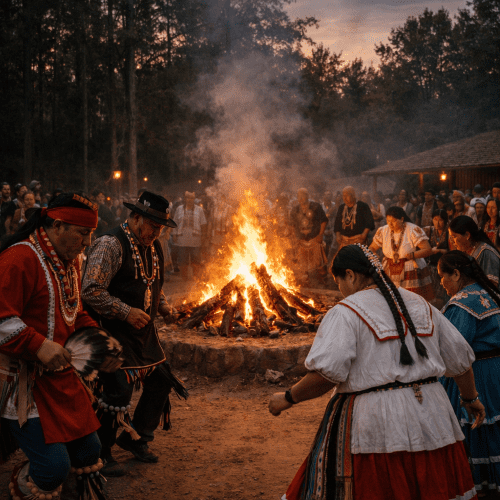
The Midwinter Ceremony consists of numerous sacred rituals designed to restore harmony within individuals, families, and the wider community. One of the first major events is the Thanksgiving Address, a ceremonial expression of gratitude that acknowledges every aspect of Creation. Through this address, participants recognize the interconnectedness of all living things and begin the new year with a spirit of appreciation.
Traditional dances form another important part of the celebration. The Feather Dance is often performed as a New Year observance, bringing people together through music, drumming, and movement. The Bear Dance is associated with healing and spiritual renewal, while other ceremonial dances strengthen communal bonds and preserve cultural knowledge.
A distinctive ritual known as the Stirring of the Ashes symbolizes the renewal of Mother Earth. Ashes from winter fires are turned and refreshed, representing the preparation of the world for another cycle of life and growth. Healing ceremonies are also central to Midwinter. Individuals may seek spiritual guidance, personal cleansing, or community support during this period. Traditional medicines, prayers, and sacred rituals are used to promote wellbeing and restore balance.
Naming ceremonies are sometimes conducted for children, formally welcoming them into the community and strengthening their connection to family, clan, and cultural heritage. Communal feasts accompany many of these activities, allowing participants to share food while reinforcing the values of generosity and reciprocity.
Another important feature is the Bowl Game, a traditional contest that combines recreation with ceremonial significance. Like many aspects of the festival, it serves both social and spiritual purposes. Although specific customs vary among different Haudenosaunee nations, all observances share the common goal of beginning the new year in a state of harmony, gratitude, and collective strength.
Importance in Cultural History
For generations, the Midwinter Ceremony has served as one of the primary institutions preserving Haudenosaunee culture. Through repeated annual observance, it safeguards songs, speeches, rituals, and teachings that might otherwise have been lost.
The ceremony also reinforces the political and social structure of the Haudenosaunee Confederacy. Clan members, leaders, Faithkeepers, and families gather to renew responsibilities and strengthen relationships that support community life throughout the year.
During periods of colonial expansion, forced assimilation, and missionary activity, many Indigenous traditions faced severe challenges. The continued practice of the Midwinter Ceremony became an act of cultural resilience, ensuring that ancestral knowledge survived despite external pressures.
The teachings of Handsome Lake, the Seneca spiritual leader who developed the Gai’wiio’ or “Good Word” in the late eighteenth century, further influenced many Longhouse traditions. His message encouraged moral renewal while helping communities preserve key ceremonial practices during times of profound social change.
Today, the Midwinter Ceremony remains one of the strongest symbols of Haudenosaunee continuity, demonstrating the enduring strength of Indigenous knowledge and governance systems.
International Appeal
Interest in the Midwinter Ceremony has expanded well beyond Haudenosaunee communities. Anthropologists, historians, educators, and Indigenous studies scholars frequently examine the ceremony as an example of how spirituality, environmental knowledge, and social governance can function as an integrated system.
The festival is particularly valued for its sophisticated understanding of seasonal cycles and its reliance on direct observation of the natural world. As discussions about sustainability and ecological stewardship grow worldwide, many people view Haudenosaunee traditions as important sources of insight.
Museums, universities, and cultural organizations often include information about the Midwinter Ceremony in educational programs designed to promote understanding of Indigenous cultures. At the same time, Haudenosaunee communities continue to control how their traditions are presented, ensuring that sacred teachings remain protected while appropriate cultural knowledge is shared.
The ceremony’s emphasis on gratitude, healing, responsibility, and respect for nature resonates across cultures. These universal themes have contributed to growing international recognition while highlighting the importance of preserving Indigenous traditions in the modern world.

Source
George-Kanentiio, D. (2018, January 10). The Haudenosaunee ceremony of Midwinter. Utica Phoenix. Retrieved from https://uticaphoenix.net/the-haudenosaunee-ceremony-of-midwinter/.
Le Porte dell’Anno. (n.d.). Midwinter festival (Iroquois). Retrieved from https://www.leportedellanno.unito.it/4_eng_ind_riti_irochesi.html.
Onondaga Nation. (2014, February 17). Ceremonies. Onondaga Nation. Retrieved from https://www.onondaganation.org/culture/ceremonies/.
Haudenosaunee Confederacy. (2021, June 8). Ceremonies. Haudenosaunee Confederacy. Retrieved from https://www.haudenosauneeconfederacy.com/ceremonies/.
Smithsonian Institution. (n.d.). Haudenosaunee: Guide for educators [PDF]. Smithsonian National Museum of the American Indian. Retrieved from https://americanindian.si.edu/sites/1/files/pdf/education/HaudenosauneeGuide.pdf.
McGill University Health Sciences Education. (2023, April 5). Sarah Konwahahawi Rourke teaches about the Haudenosaunee ceremony Midwinter. Retrieved from https://www.mcgill.ca/healthsciences-education/article/sarah-konwahahawi-rourke-teaches-about-haudenosaunee-ceremony-midwinter.
Soaring Eagles. (n.d.). Haudeshaune, Iroquois, Midwinter Ceremony. Retrieved from http://soaringeagles.americanindiansource.com/sentinel/iroquoismidwinter.html.
Frequently Asked Questions
What is the Midwinter Ceremony?
The Midwinter Ceremony is the Haudenosaunee New Year celebration focused on gratitude, healing, renewal, and spiritual balance.
When is the Midwinter Ceremony celebrated?
It is usually held between January and early February, beginning after the first new moon following the winter solstice.
Who celebrates the Midwinter Ceremony?
The ceremony is observed by the Haudenosaunee Confederacy, including the Mohawk, Oneida, Onondaga, Cayuga, Seneca, and Tuscarora nations.
Why is the Pleiades important to the Midwinter Ceremony?
The Pleiades star cluster helps determine ceremonial timing and holds significance within Haudenosaunee cosmology.
How long does the Midwinter Ceremony last?
Depending on the nation and Longhouse tradition, celebrations typically last between eight and twenty-one days.