

The Cosmic Philosophy of Purusha and Prakriti and the Origin of the Universe
Indian philosophical traditions often describe the universe not as a random accident but as the outcome of an eternal relationship between two fundamental principles. These principles are known as Purusha and Prakriti. Together they represent one of the most profound ideas in Indian thought: the interaction between consciousness and nature.
Across classical texts and philosophical schools, Purusha and Prakriti appear as the forces that explain how existence unfolds. They are not merely characters in a story but symbolic concepts that reveal how life, matter, awareness, and cosmic order come into being. Understanding Purusha and Prakriti is therefore essential to understanding how Indian philosophy interprets the universe itself.
The Meaning of Purusha and Prakriti
The terms Purusha and Prakriti come from Sanskrit and represent two distinct but interconnected realities. Purusha refers to pure consciousness. It is the observing principle that witnesses existence but does not act directly within it. Purusha is often described as timeless, unchanging, and beyond physical form. It represents awareness itself, the silent observer behind all experiences.
Prakriti, on the other hand, represents nature. It is the dynamic, creative force responsible for the material universe. Everything that changes, evolves, grows, and transforms belongs to Prakriti. Matter, energy, mind, and even emotions are considered expressions of Prakriti.
In simple terms, Purusha is consciousness and Prakriti is creation. Without consciousness there would be nothing to perceive existence, and without nature there would be nothing to perceive. Their interaction is therefore seen as the foundation of reality.
Origins in Indian Philosophical Thought
The idea of Purusha and Prakriti is most clearly developed in the Samkhya philosophical tradition, one of the oldest systems of Indian philosophy. Samkhya describes the universe as the result of the interaction between these two eternal principles.
In this worldview, Purusha exists as countless individual consciousnesses, each observing the world. Prakriti exists as a single cosmic nature composed of three fundamental qualities known as the gunas: sattva (balance and clarity), rajas (activity and passion), and tamas (inertia and darkness).
When Purusha becomes aware of Prakriti, the balance of these gunas begins to shift. This disturbance triggers the process of creation. From this unfolding emerge the elements, the senses, the mind, and eventually the entire physical universe. This concept does not describe a single moment of creation but an ongoing process in which consciousness and nature interact continuously.
The Cosmic Dance of Creation
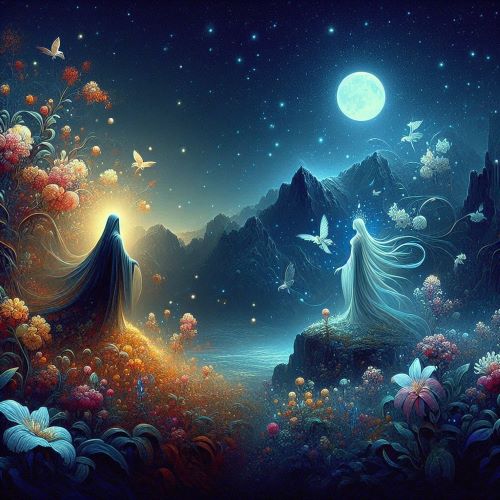
Purusha and Prakriti are often described as participating in a cosmic dance. This metaphor illustrates the dynamic relationship between awareness and manifestation. Prakriti is active and constantly transforming. It generates the world of forms, including planets, living beings, and the subtle layers of thought and emotion. Purusha remains still, observing everything without becoming entangled in it.
Yet the presence of Purusha is what gives meaning to Prakriti’s activity. Without a witness, creation would have no awareness. Similarly, without Prakriti, Purusha would have nothing to observe. This delicate balance between stillness and movement mirrors many symbolic traditions within Indian thought. It reflects the broader idea that reality exists through harmony between complementary forces.
Symbolism in Indian Mythic Tradition
Although Purusha and Prakriti originate as philosophical ideas, their symbolism appears throughout Indian cultural and mythic traditions. Many narratives reflect the idea of complementary cosmic forces. Masculine principles are often associated with awareness or stillness, while feminine principles represent creativity, fertility, and transformation. This symbolic pairing echoes the philosophical relationship between Purusha and Prakriti.
In artistic and spiritual traditions, this relationship can also be understood as the balance between the inner self and the external world. Human life unfolds when these two aspects interact. Rather than depicting conflict, this relationship emphasizes harmony. Creation arises not through domination but through cooperation between consciousness and nature.
Purusha and Prakriti in Human Experience
The concept of Purusha and Prakriti is not limited to cosmic philosophy. It also provides a framework for understanding human existence. Within each individual, Purusha represents the witnessing awareness that observes thoughts, emotions, and experiences. Prakriti represents the body, mind, senses, and the constantly changing patterns of life.
From this perspective, many spiritual practices seek to help individuals recognize the difference between these two aspects. When a person realizes that their true nature is the observing consciousness rather than the changing mind and body, they gain a sense of clarity and liberation. This idea plays an important role in several Indian philosophical and spiritual traditions, where self-knowledge is seen as a path to freedom from suffering.
The Timeless Relevance of the Concept
The idea of Purusha and Prakriti continues to resonate in modern discussions about consciousness, psychology, and the nature of reality. Philosophers and scholars often compare the concept to debates about the relationship between mind and matter. In many ways, Purusha and Prakriti offer an ancient framework for exploring questions that remain central to modern thought.
The concept also highlights the importance of balance. Just as the universe unfolds through harmony between consciousness and nature, human life flourishes when awareness and action exist in equilibrium. For this reason, Purusha and Prakriti remain powerful symbols of cosmic order. They remind us that existence is not merely material or purely spiritual, but a dynamic relationship between both.
Conclusion
Purusha and Prakriti form one of the most influential philosophical ideas in Indian tradition. Together they describe how consciousness and nature interact to create the universe and shape human experience. Rather than presenting creation as a single event, this concept reveals existence as an ongoing process of balance between observation and manifestation. Purusha provides awareness, while Prakriti provides form.
Their relationship offers a profound reminder that life emerges through harmony between stillness and movement, spirit and matter, observer and creation. Understanding Purusha and Prakriti therefore opens a window into one of the deepest insights of Indian philosophical thought: the universe itself is a dialogue between consciousness and nature.


No posts were found.