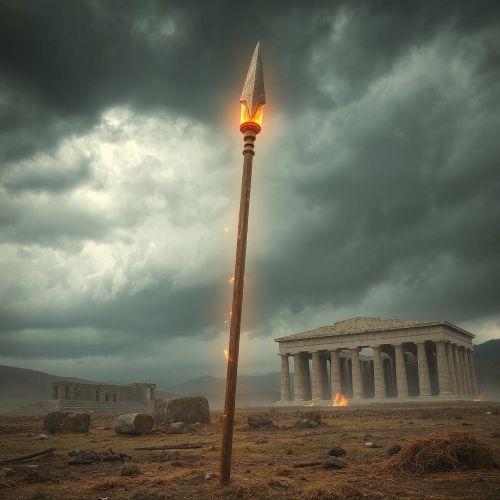
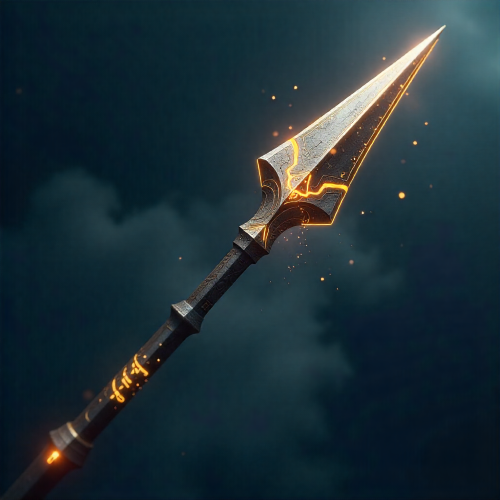
Rhongomyniad : The Sacred Spear of King Arthur
At a glance
| Description | |
|---|---|
| Mythology | Welsh Mythology |
| Type | Carried |
| Power | 08/10 |
Mythlok Perspective
In Mythlok’s View, Rhongomyniad represents authority in its purest form, not spectacle but certainty. Unlike Excalibur’s mythic brilliance, this spear reflects a quieter, older idea of kingship rooted in responsibility and decisive action. Similar to Odin’s spear Gungnir in Norse tradition or the spear of Lugh in Celtic lore, Rhongomyniad embodies precision and inevitability. Across cultures, the spear often symbolizes focused power, suggesting that true leadership is not about display, but about knowing when and where to strike.
Rhongomyniad
Introduction
Rhongomyniad stands as one of the most important yet often overlooked weapons in early Arthurian tradition. While Excalibur dominates later medieval romances, older Welsh sources present Rhongomyniad as equally central to King Arthur’s identity. Known by variants such as Rhongomiant or simply Ron, the spear represents precision, authority, and lethal certainty in battle. Its name is commonly understood as “Slaying Spear” or “Striking Spear,” reflecting its role as a weapon of decisive force rather than spectacle.
In contrast to later chivalric storytelling, early Welsh narratives portray Arthur not as a romantic king but as a warrior leader defending Britain against both human and supernatural threats. Within this framework, Rhongomyniad is not just a weapon but a symbol of kingship and divine mandate. It belongs to a sacred triad of arms alongside Caledfwlch and Carnwennan, reinforcing Arthur’s role as a ruler chosen to protect and command.
Origins
The earliest references to Rhongomyniad appear in the Welsh tale Culhwch and Olwen, one of the oldest surviving Arthurian narratives, preserved in medieval manuscripts such as the Red Book of Hergest and White Book of Rhydderch. In this text, Arthur lists the spear among the possessions he refuses to give away, highlighting its immense personal and symbolic value.
The name Rhongomyniad derives from Welsh linguistic roots. The element “rhon” refers to a spear or lance, while “myniad” conveys the act of striking, piercing, or slaying. Together, the name evokes a weapon designed for decisive impact. Over time, interpretations have varied slightly, with translations ranging from “Cutting Spear” to “Striking Spear,” but all retain the sense of lethal precision.
When Geoffrey of Monmouth adapted Arthurian legends into Latin in Historia Regum Britanniae, he shortened the name to Ron. This simplified form influenced later retellings, including those by Layamon, but the original Welsh name preserves the weapon’s deeper cultural resonance.
Powers
Rhongomyniad occupies a unique space among legendary weapons because its power is often implied rather than explicitly described. In early Welsh tradition, it is not portrayed as overtly magical in the way later Arthurian objects become. Instead, its strength lies in what it represents.
In its original context, the spear is a masterwork weapon belonging to a king whose authority borders on the divine. The Welsh Triads describe it as one of the sacred weapons granted to Arthur, suggesting that its power comes from divine sanction rather than enchantment. This positions Rhongomyniad as a tool of rightful rule, not just combat.
Some interpretations suggest that the spear was effectively unstoppable in battle, capable of piercing any defense. However, this idea emerges more from symbolic reading than explicit textual description. The weapon’s true “power” is its certainty. It does not dazzle or transform reality. It ends conflict with finality.
In modern reinterpretations, particularly in fantasy media, Rhongomyniad has been expanded into a cosmic or reality-defining weapon. These versions depict it as a “Holy Lance” with immense energy and world-altering abilities. While visually compelling, these interpretations move far beyond the grounded tone of early Welsh sources.
Owners/Users
Rhongomyniad is inseparable from King Arthur. Across early Welsh literature, it is exclusively his weapon. Unlike other arms that circulate among knights, this spear remains tied to Arthur’s personal identity as king and warrior.
In Culhwch and Olwen, Arthur explicitly refuses to lend Rhongomyniad, even to assist in a heroic quest. This moment reinforces the idea that the spear is not merely valuable but essential to his role. It is part of what defines him.
Some later traditions and speculative interpretations suggest that Arthur may have inherited the spear from Uther Pendragon, but this detail is not firmly established in early Welsh sources. The strongest and most consistent tradition remains clear: Rhongomyniad belongs to Arthur alone.
In modern fiction, alternative versions of Arthur, such as gender-swapped or reimagined figures, sometimes wield the spear. These portrayals expand its myth but do not replace its original identity as the king’s personal weapon.
Instances used
Unlike Excalibur, which is surrounded by dramatic scenes and symbolic rituals, Rhongomyniad appears more subtly in early texts. Its presence is often stated rather than vividly described, which aligns with the grounded tone of Welsh storytelling.
In Culhwch and Olwen, the spear is listed among Arthur’s treasured possessions, establishing its importance without detailing its use in battle. This moment is crucial because it confirms the weapon’s status within Arthur’s court and identity.
In later accounts, particularly those influenced by Geoffrey of Monmouth, Arthur carries the spear Ron during the Battle of Badon, one of the defining conflicts of his reign. Here, it functions as a weapon of war rather than a symbolic object, reinforcing its martial purpose.
Some traditions suggest that Rhongomyniad may have been used in Arthur’s final confrontation with Mordred, though this varies depending on the version of the legend. In many retellings, the sword takes precedence in this scene, but the spear remains part of the broader narrative of Arthur’s battles.
The Welsh Triads further imply that Rhongomyniad was used in numerous campaigns that are no longer fully recorded. Its legacy survives not through detailed episodes but through its consistent association with victory and authority.


Source
Wikipedia contributors. (2021, May 23). Rhongomyniad. Wikipedia. https://en.wikipedia.org/wiki/Rhongomyniad
Wikipedia contributors. (2002, October 19). Mabinogion. Wikipedia. https://en.wikipedia.org/wiki/Mabinogion
Shapes, Inc. (n.d.). Goddess Rhongomyniad FAQ. https://shapes.inc/goddessrhongomyniad/faq
TYPE-MOON Wiki contributors. (2026, January 8). Goddess Rhongomyniad. Fandom. https://typemoon.fandom.com/wiki/Goddess_Rhongomyniad
Bromwich, R. (1978). Trioedd Ynys Prydein: The Welsh triads (2nd ed.). University of Wales Press.
Davies, S. (2007). The Mabinogion. Oxford University Press.
Geoffrey of Monmouth. (1996). The history of the kings of Britain (L. Thorpe, Trans.). Penguin Classics.
Loomis, R. S. (1927). Celtic myth and Arthurian romance. Columbia University Press.
Frequently Asked Questions
What is Rhongomyniad in Arthurian legend?
Rhongomyniad is King Arthur’s sacred spear from early Welsh tradition, symbolizing divine authority and lethal precision in battle.
Did King Arthur use Rhongomyniad in battle?
Yes, later traditions suggest he carried it in major battles like Badon, though early texts focus more on its symbolic value.
Is Rhongomyniad more powerful than Excalibur?
In Welsh sources, Rhongomyniad is equally important, though less magical, representing authority rather than enchantment.
Where does Rhongomyniad first appear?
It first appears in Culhwch and Olwen, one of the oldest Arthurian tales in Welsh literature.
What does the name Rhongomyniad mean?
The name translates roughly to “Slaying Spear” or “Striking Spear,” emphasizing its deadly purpose.