


Kware : The Creator Goddess of Huli Tradition
At a glance
| Description | |
|---|---|
| Origin | Huli Mythology |
| Classification | Gods |
| Family Members | Dindi (Husband) |
| Region | Papua New Guinea |
| Associated With | Creation of humans, Fertility, Marriage |
The Mythlok Perspective
In Mythlok’s Perspective, Kware represents a universal archetype of the life-giving force that bridges divine creation and human continuity. She is not defined by power in the dramatic sense but by presence, making her one of the most quietly essential figures in Huli belief. Her role reflects a worldview where creation is sustained, not completed. When compared globally, Kware shares conceptual similarities with figures like Gaia from Greek tradition and Prithvi from Indian belief. Like them, she embodies fertility and origin, yet unlike many earth goddesses, she remains less personified and more functionally spiritual, highlighting the unique abstraction within Huli cosmology.
Kware
Introduction
The mythology of the Huli people from the highlands of Papua New Guinea is built on sacred oral traditions known as bi mana, or “true talk.” These narratives are not casual stories but ritual recitations performed in ceremonial spaces, often by trained specialists. Within this spiritual framework, Kware holds a central role as a life-giving force tied directly to human origins.
Kware is best understood as the divine figure responsible for shaping human existence after the world itself came into being. While the supreme deity Dindi is credited with creating the earth and cosmic order, he remains distant and removed from everyday life. Kware, by contrast, is closely tied to human experience, particularly fertility, relationships, and continuity of lineage.
Her presence in Huli belief reflects a broader worldview where creation is not a single act but an ongoing process sustained through ritual, memory, and ancestral connection. In this sense, Kware is not just a creator but a continuing force that keeps life moving forward across generations.
Physical Traits
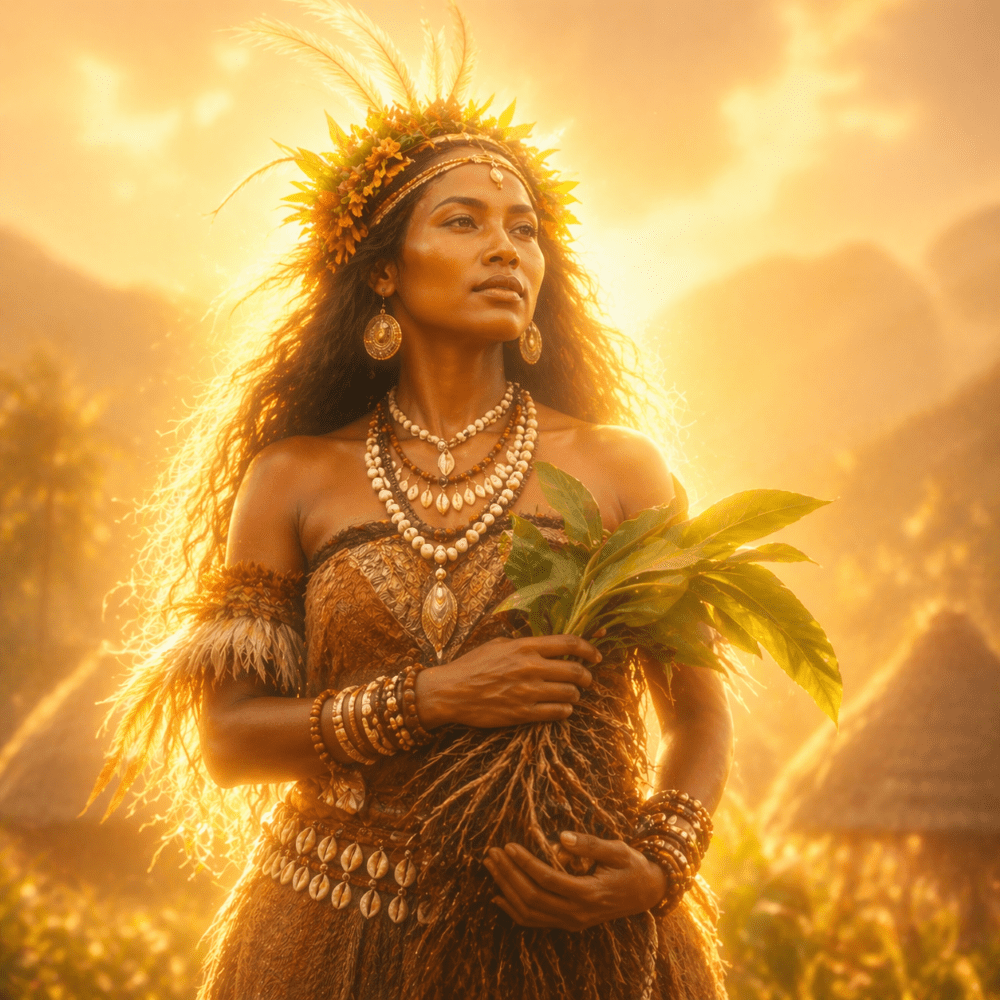
Unlike many mythological figures across the world, Kware is not described in visual or physical terms within preserved Huli traditions. This absence is not accidental but reflects the nature of Huli storytelling itself.
In bi mana, emphasis is placed on what a figure does rather than how they appear. Kware’s identity is therefore defined through her actions and influence rather than a fixed form. This makes her presence more symbolic and universal, allowing her to represent fertility, creation, and continuity without being limited to a human-like depiction.
This approach contrasts with other figures in Huli belief, such as Wogabe, who may be associated with recognizable tools like weapons. Kware, however, exists beyond such imagery, reinforcing her role as an unseen but ever-present force in human life.
Family
Kware’s most important relationship is with Dindi, the supreme creator deity of Huli belief. Together, they form a complementary pair that defines the structure of existence. Dindi is associated with the formation of the earth and the broader cosmic order. He represents authority, distance, and the origin of the physical world. Kware, on the other hand, represents closeness, life, and human continuation. She is credited with creating the first Huli man and woman, establishing the direct ancestral link between the divine and the Huli people.
There are no consistent references to children or extended divine family structures connected to Kware. Instead, her legacy is expressed through humanity itself. Every generation becomes part of her extended lineage, making her less a figure within a family tree and more the origin of it.
Other names
There are no widely accepted alternative names for Kware in Huli mythology. Across recorded oral traditions and anthropological documentation, she is consistently referred to by this single name.
This consistency is significant. In many cultures, deities evolve across regions and time, gaining multiple titles or identities. Kware’s stable naming reflects the structured and ritualized nature of Huli oral transmission, where accuracy and continuity are essential. It is also important to avoid confusion with similarly sounding terms from other cultures or languages. These are unrelated and do not connect to Kware’s identity within Huli belief.
Powers and Abilities
Kware’s powers are deeply tied to creation, fertility, and the continuation of human life. She is not a distant or abstract deity but one whose influence directly affects everyday existence. Her most significant role is the creation of the first human beings. This act places her at the center of Huli origin narratives and establishes her as a foundational figure in the identity of the people themselves.
Beyond creation, Kware is closely associated with fertility and marriage. She is invoked during life-cycle rituals, including unions, initiations, and transitions into adulthood. These ceremonies are not merely symbolic but are believed to maintain balance and ensure the success of individuals and the community.
Her influence is also connected to the concept of Amb Koramane, a form of ancestral life force or spiritual power that flows through generations. Through this connection, Kware becomes part of a larger spiritual system where ancestors, rituals, and divine forces work together to sustain life.
Modern Day Influence
The Huli people today live in a rapidly changing world shaped by education, technology, and the spread of Christianity. Despite these changes, traditional beliefs have not disappeared. Instead, they have adapted and continue to exist alongside modern influences.
Kware does not often appear in modern written narratives or popular culture, but her influence remains embedded in cultural practices. Ritual gatherings known as sing-sings, ceremonial pig exchanges, and initiation traditions still reflect the deeper belief systems in which she plays a role.
Institutions like the Haroli bachelor cult have transformed over time, evolving into practices such as “wig schools,” where young men continue to learn cultural identity and tradition. Even within these modern adaptations, the underlying ideas of fertility, growth, and continuity—central to Kware—remain intact.
In many communities, traditional beliefs are also reinterpreted through new religious frameworks, showing that figures like Kware are not erased but reshaped within evolving cultural narratives.
Related Images

Source
Frankel, S. (1986). The Huli response to illness. Cambridge University Press.
Glasse, R. M. (1969). Huli religion and cosmology. In Gods, spirits, and men: Themes in Polynesian mythology (pp. 32-45). A.H. & A.W. Reed.
Goldman, L. (n.d.). Speech categories in Huli oral tradition.
Lacey, R. (1978). Religious change in a pre-colonial era. Point, 2, 159-205.
Meshanko, R. (n.d.). Huli mythology. The Huli Museum. https://huliculture.com/ethnography/huli-mythology/
Pugh-Kitingan, J. (2011). An ethnomusicological discussion of bì té. In Sung tales from the Papua New Guinea Highlands. ANU Press.
Soul-O-Travels. (2024, January 18). Tribe profile: The Huli Wigmen of Papua New Guinea. https://soul-o-travels.com/2024/01/18/tribe-profile-the-huli-wigmen-papua-new-guinea/
Frequently Asked Questions
Who is Kware in Huli belief?
Kware is the goddess of creation, fertility, and marriage who created the first humans in Huli tradition.
What is Kware known for?
She is known for creating humanity and guiding fertility and life-cycle rituals.
Is Kware the supreme deity?
No, Dindi is the supreme creator, while Kware focuses on human life and continuity.
Does Kware have a physical form?
Huli tradition does not describe her appearance, focusing instead on her role and influence.
Is Kware still relevant today?
Yes, her influence continues through rituals and cultural practices among the Huli people.