

Minokawa : The Giant Bird That Swallows the Sun and Moon
At a glance
| Description | |
|---|---|
| Origin | Philippine Mythology |
| Classification | Animals |
| Family Members | N/A |
| Region | Philippines |
| Associated With | Eclipses, Celestial devouring |
The Mythlok Perspective
In Mythlok’s Perspective, the Minokawa is less a creature and more a manifestation of cosmic imbalance. It represents humanity’s fear that the order of the universe can be disrupted at any moment. Unlike protective or guiding beings, it embodies inevitability and hunger. When compared to figures like the Norse wolf Fenrir or the Chinese celestial dragon that devours the sun, the Minokawa reflects a shared global anxiety about the fragility of light and life. Yet its solitary nature makes it uniquely stark, a reminder that not all forces in myth are meant to be understood or controlled.
Minokawa
Introduction
The Minokawa is one of the most fascinating and terrifying beings in Philippine tradition, rooted deeply in the oral narratives of the Bagobo people of Mindanao. This colossal bird exists not merely as a creature of imagination but as an explanation for one of nature’s most dramatic events—eclipses. Early documentation of the Minokawa comes from anthropologist Laura Watson Benedict, who studied the Bagobo in the early 20th century and recorded their “story of the eclipse.”
In Bagobo belief, the Minokawa lives beyond the visible sky, at the eastern horizon, where it waits patiently for celestial bodies to pass. When it manages to seize the moon or sun, an eclipse occurs. The myth was not just a story but a lived cultural response, as communities would create loud noises using gongs and instruments to frighten the creature into releasing its prey.
The Minokawa stands apart from many mythological beings because it is not tied to morality or divine hierarchy. It does not judge, protect, or guide humanity. Instead, it represents a cosmic threat—an unstoppable force driven by hunger. This makes it one of the most primal and elemental figures in Philippine narratives, embodying fear of the unknown and the fragility of cosmic balance.
Physical Traits
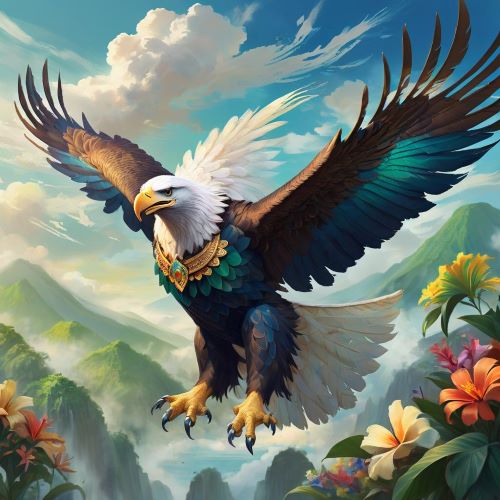
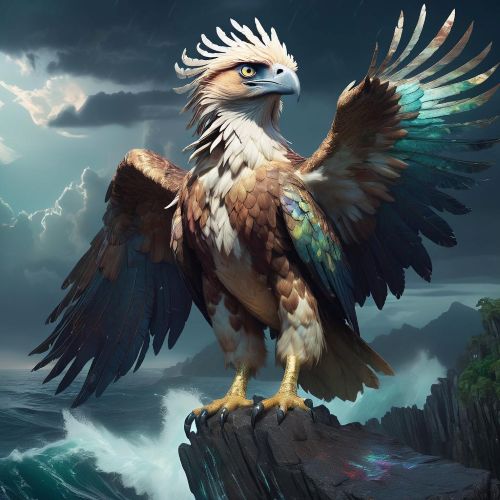
The Minokawa is described as a creature of overwhelming scale and presence, often compared to the size of entire islands such as Negros or Bohol. Its sheer magnitude places it beyond anything terrestrial, reinforcing its role as a cosmic predator rather than a natural animal.
Its body is both organic and metallic in nature. Each feather is said to be as sharp as a sword, giving the impression of a creature covered in blades rather than plumage. Its eyes shine like mirrors, reflecting light in a way that makes it appear otherworldly and unknowable. The beak and talons are described as being made of steel, emphasizing both its indestructibility and its ability to tear through celestial bodies.
The Minokawa does not inhabit mountains, forests, or oceans. Instead, it resides outside the sky itself, positioned at the eastern horizon. From this vantage point, it watches the movements of the moon and sun, waiting for the perfect moment to strike. This placement reinforces its identity as a boundary creature—one that exists between worlds rather than within them.
Family
Unlike many mythological beings that are tied to genealogies, pantheons, or divine lineages, the Minokawa exists in complete isolation. There are no recorded accounts of its parents, offspring, or kin within Bagobo tradition.
This absence of familial connection is significant. It positions the Minokawa not as a character within a larger mythological system but as a singular force of nature. It does not belong to a race, tribe, or divine order. Instead, it exists as a standalone entity, defined entirely by its actions and purpose. The lack of relational context also contributes to its mystery. Without origin stories or connections, the Minokawa feels timeless and eternal, as though it has always existed and always will.
Other names
While the Minokawa is specific to the Bagobo people, similar eclipse-causing creatures appear across different regions of the Philippines under various names. These include the Arimaonga among the Maranao, the Bannog or Ban-og in Iloko and Tinguian traditions, and the Baua or Bawa in Pampangan, Tagalog, and Hiligaynon narratives.
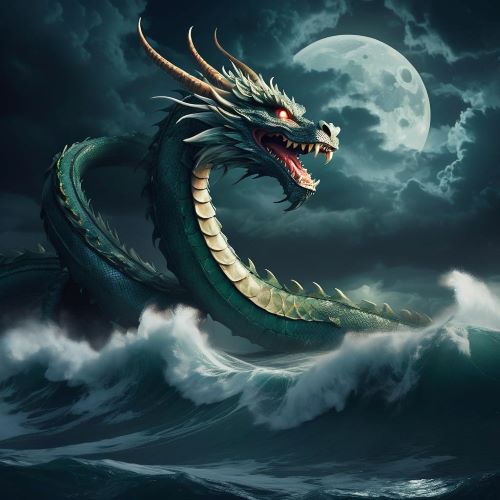
These regional variations share a common theme: a powerful being that attempts to devour the sun or moon, causing eclipses. However, the form of the creature may differ. Some are bird-like, like the Minokawa, while others take on more serpentine or dragon-like appearances.
The existence of these parallels suggests a shared cultural attempt to interpret celestial events through storytelling. Each culture adapted the idea to its own environment and symbolic language, resulting in a diverse yet interconnected set of myths across the archipelago.
Powers and Abilities
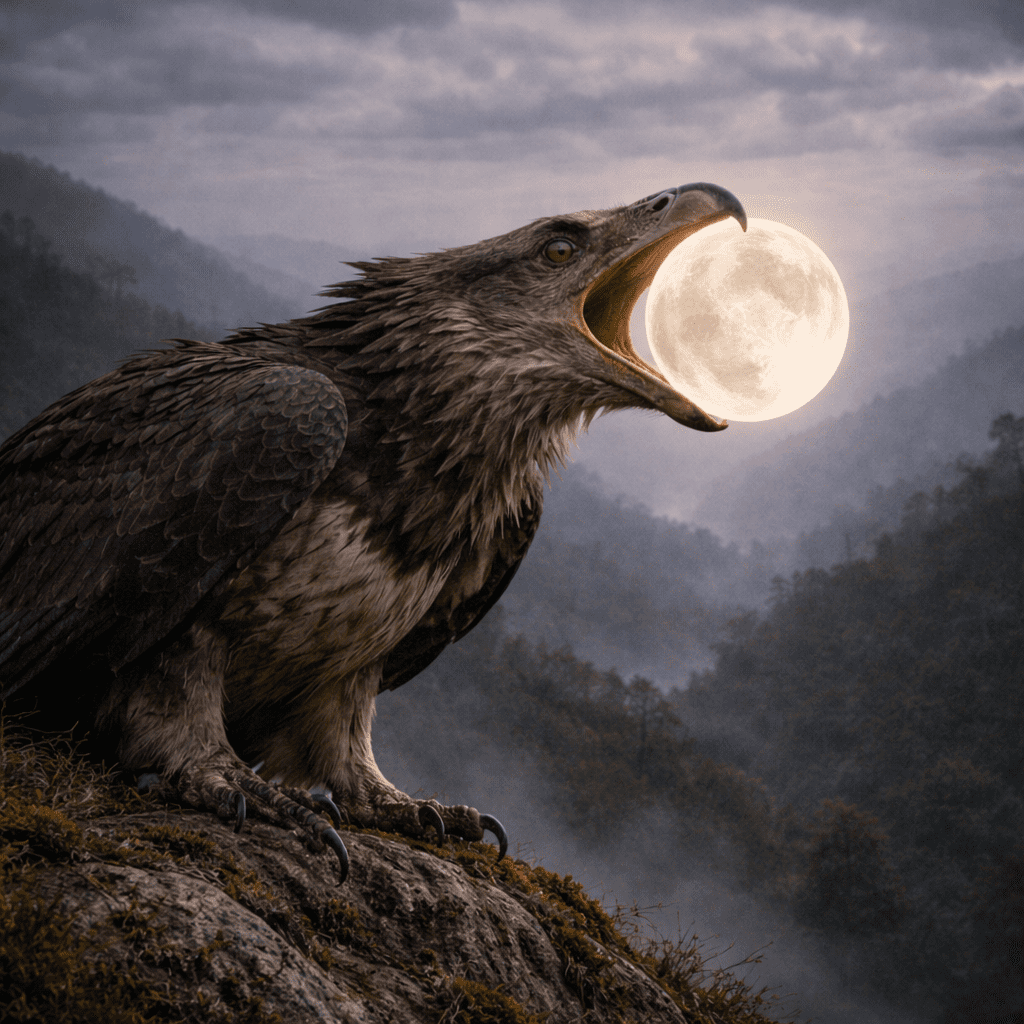
The defining ability of the Minokawa is its capacity to devour celestial bodies. When it catches the moon, a lunar eclipse occurs. When it reaches for the sun, it causes a solar eclipse. These events are not random but are seen as direct consequences of the creature’s actions.
According to Bagobo belief, the Minokawa’s ultimate goal is far more catastrophic. After consuming the moon and sun, it is said that the creature will descend to Earth and devour everything in existence. This looming threat transforms the Minokawa from a natural explanation into an existential danger.
Despite its immense power, the Minokawa is not invincible. It can be startled or distracted by loud noises. This belief led to communal rituals during eclipses, where people would bang gongs and create as much sound as possible to force the creature to release the moon.
Another intriguing aspect of the myth is the moon’s method of escape. It is said to use multiple entry and exit points along the horizon, confusing the Minokawa and making it difficult to capture consistently. This introduces a subtle balance between predator and prey, suggesting that even cosmic forces are not entirely one-sided.
Modern Day Influence
The Minokawa continues to influence modern Philippine culture, though often in more subtle ways than more widely known creatures. It appears in television series such as Encantadia, where it is reimagined as a powerful and dangerous creature within a fantasy narrative.
Beyond media, the Minokawa has become a symbol in art, literature, and design. Its imagery is used to represent strength, mystery, and cosmic power. Contemporary artists often reinterpret the creature, blending traditional descriptions with modern aesthetics to keep the legend alive.
Scholars and cultural groups have also taken an interest in preserving such myths, recognizing their importance in understanding indigenous knowledge systems. The Minokawa, in particular, serves as a reminder of how ancient communities engaged with the natural world, using storytelling to explain and cope with phenomena that were otherwise inexplicable.
Related Images
Blogs & Opinions

Glorious Epics
Mythical Events

Source
Benedict, L. W. (1913). Bagobo myths. Journal of American Folklore, 26(102), 284-291.
Ramos, M. D. (1971). Creatures of Philippine lower mythology. University of the Philippines Press.
Aswang Project. (2022, June 2). MINOKAWA | Mindanao’s eater of the sun & moon. https://www.aswangproject.com/minokawa/
A Book of Creatures. (2021, March 15). Minokawa. https://abookofcreatures.com/2021/03/15/minokawa/
Wikipedia. (n.d.). Minokawa. Retrieved March 25, 2026, from https://en.wikipedia.org/wiki/Minokawa
Mythical Encyclopedia. (2024, January 6). Minokawa: Mythical creature. https://mythicalencyclopedia.com/minokawa/
Elliott, A. J. (1954). The mythology of Rizal’s novels. University of Santo Tomas Press.
Scott, W. H. (1968). A preliminary report on an archaeological survey of Mindanao. National Museum, Republic of the Philippines.
Frequently Asked Questions
What is the Minokawa in Philippine lore?
The Minokawa is a mythical bird believed to cause eclipses by swallowing the sun or moon.
Which culture does the Minokawa come from?
It originates from the Bagobo people of Mindanao in the Philippines.
Why do eclipses happen according to the Minokawa myth?
Eclipses occur when the Minokawa captures and attempts to devour the moon or sun.
How do people stop the Minokawa?
Traditional belief says loud noises, such as banging gongs, can scare it into releasing the moon.
Is the Minokawa related to other creatures like Bakunawa?
Yes, both are eclipse-causing beings, but the Minokawa is bird-like while others, like Bakunawa, are serpent-like.