


Umqäqäi : The Chukchi Hero of the Arctic Spirit World
At a glance
| Description | |
|---|---|
| Origin | Chukchi Mythology |
| Classification | Mortals |
| Family Members | N/A |
| Region | Russia |
| Associated With | Survival |
The Mythlok Perspective
In Mythlok’s Perspective, Umqäqäi represents a powerful storytelling tradition where the hero is not divine but deeply human. Arctic mythologies often emphasize endurance rather than godlike power, reflecting the realities of life in extreme environments. The hero survives through intelligence and courage instead of supernatural abilities. This archetype appears in many cultures. The Inuit hero Kiviuq also journeys through a dangerous spirit-filled world, while in Norse tradition the explorer figures who venture beyond known lands face similar supernatural trials. These parallels show that across cultures, human resilience itself becomes the greatest mythic power.
Umqäqäi
Introduction
Umqäqäi is a human protagonist who appears in the oral traditions of the Chukchi people of northeastern Siberia. His story was documented in the early twentieth century by ethnographer Waldemar Bogoras, whose extensive research preserved many narratives from Chukchi folklore. Unlike major supernatural figures such as the creator Raven or powerful spirit beings that dominate Arctic cosmology, Umqäqäi stands out because he is fundamentally human. His story represents the experiences of an ordinary individual confronting the dangers of a world filled with spirits, monsters, and unpredictable natural forces.
Chukchi cosmology describes a universe inhabited by numerous supernatural entities known as ke’let. These beings include dangerous spirits, shape-shifting creatures, and cannibalistic monsters that interact with humans in unpredictable ways. In many traditional stories, humans must survive by intelligence, courage, and respect for spiritual forces rather than by brute strength. Umqäqäi embodies this theme perfectly. He is not a divine warrior but a determined traveler whose survival depends on wit and resilience.
The tale of Umqäqäi reflects the harsh Arctic environment in which the Chukchi people lived for centuries. Their lives revolved around reindeer herding, hunting, and navigating vast tundra landscapes shaped by extreme weather. Stories about human heroes overcoming supernatural threats often functioned as moral lessons. They emphasized courage, cooperation with the spirit world, and the ability to adapt to difficult circumstances. In this way, Umqäqäi represents a cultural archetype rather than a god or demigod.
Although the narrative is not among the most famous Chukchi myths, it holds ethnographic importance. It illustrates how indigenous Arctic storytelling often centers on human endurance rather than divine intervention. The story also highlights the Chukchi belief that the physical world and the spiritual world constantly overlap. Humans like Umqäqäi must therefore navigate both realms in order to survive.
Physical Traits
Traditional Chukchi stories rarely provide detailed descriptions of human characters. Instead of focusing on appearance, the narratives emphasize actions and experiences. This pattern applies to Umqäqäi as well. Ethnographic records do not describe him with distinctive physical features or supernatural traits. He appears as an ordinary Chukchi man whose identity is defined by his journey rather than his appearance.
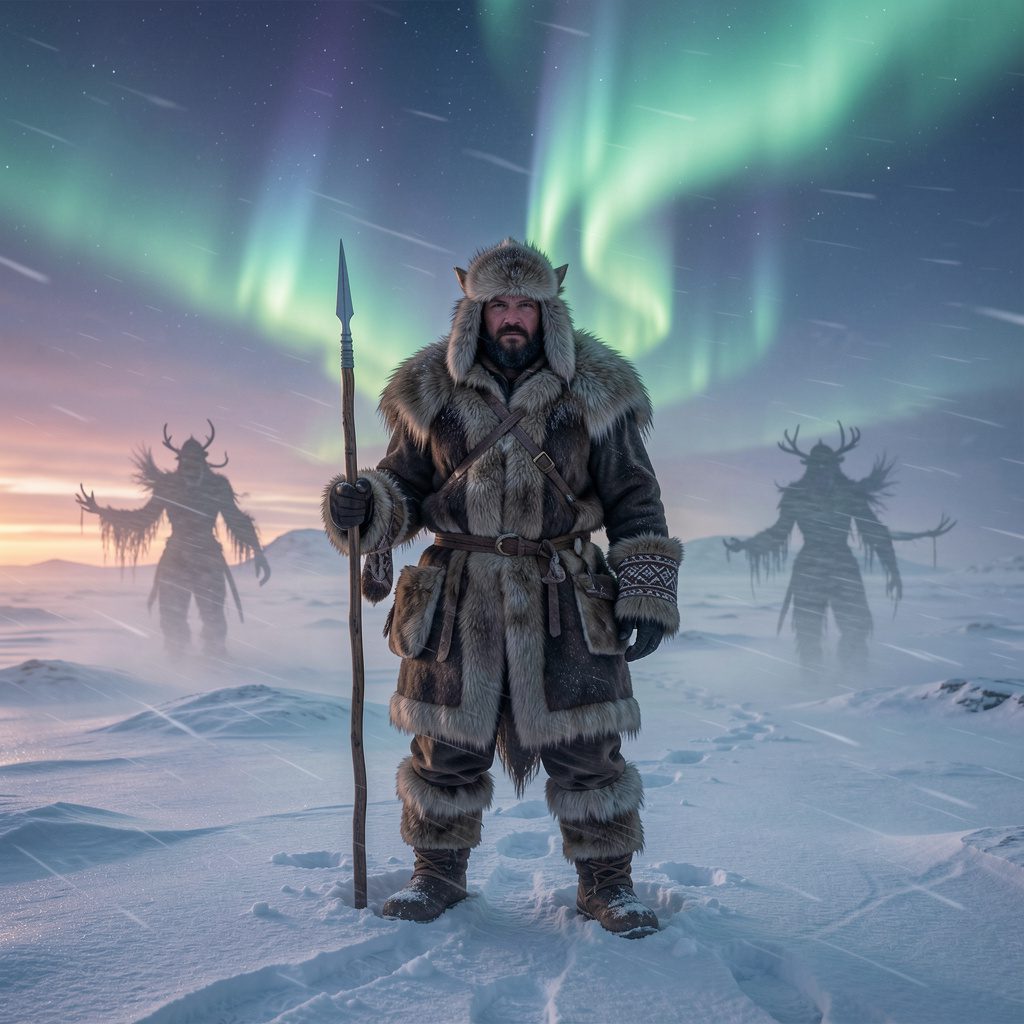
Based on the cultural context of the stories recorded by Bogoras, Umqäqäi likely resembles a typical Arctic hunter or reindeer herder. Such individuals would have worn heavy fur clothing designed to withstand extreme cold. Their daily life required physical endurance, skill in tracking animals, and the ability to travel long distances across frozen landscapes. Tools such as spears, knives, sleds, and dog teams were essential for survival.
Unlike the ke’let spirits, who often appear as monstrous giants, shapeshifters, or animals with supernatural powers, Umqäqäi remains unmistakably human. This contrast is important because it reinforces the core theme of the story. The narrative is not about a powerful god defeating monsters but about a vulnerable human confronting forces far beyond his control.
The absence of elaborate physical descriptions also reflects the nature of oral storytelling. Listeners were expected to imagine the hero based on familiar members of their own community. In this sense, Umqäqäi could represent any hunter or traveler who ventures beyond the safety of the camp into the unknown.
Family
Chukchi mythology often includes references to family relationships and clan structures, but the surviving accounts of Umqäqäi do not provide information about his relatives. The narrative focuses primarily on his personal adventure rather than on a broader genealogical background.
This absence of family details is not unusual in Arctic folklore. Many stories follow a solitary hero who leaves the safety of the community to face supernatural challenges. These narratives highlight individual courage and personal responsibility. The hero must rely on intelligence and resourcefulness rather than on help from relatives.
In some Chukchi stories, characters interact with animal spirits or spirit beings who act as guides or adversaries. These encounters sometimes function as symbolic relationships that replace conventional family structures within the narrative. For example, a hunter might form a temporary alliance with a helpful spirit or receive advice from a shamanic figure.
Because the available ethnographic sources do not mention parents, siblings, or a spouse for Umqäqäi, his family status remains unknown. He appears primarily as a lone traveler whose journey represents the challenges faced by individuals living in the Arctic environment. The emphasis on solitude reinforces the idea that survival often depended on personal skill and determination.
Other names
The name Umqäqäi appears mainly in the transliterations recorded by Waldemar Bogoras during his research among the Chukchi people. Because the Chukchi language was originally transmitted through oral tradition rather than written scripts, different scholars sometimes recorded the name with slight variations in spelling.
Some publications reproduce the name as U’mqäqäi or similar phonetic forms that attempt to represent the original pronunciation. These variations arise from differences in how Russian and Western linguists interpreted Chukchi sounds when converting them into the Latin alphabet.
Despite these minor spelling differences, the name remains relatively consistent across ethnographic sources. Unlike many mythological figures who acquire numerous titles or epithets over time, Umqäqäi does not appear to have alternate names associated with specific powers or domains.
This lack of multiple titles further reinforces his role as a human hero rather than a supernatural being. In many mythological traditions, gods accumulate different names reflecting their divine attributes or regional worship. Umqäqäi, by contrast, retains a single identity tied specifically to his story.
Powers and Abilities
Umqäqäi does not possess supernatural powers in the traditional sense. His abilities are rooted in the practical skills necessary for survival in the Arctic. These include endurance, adaptability, and clever thinking when confronted with dangerous situations.
In Chukchi stories, human heroes often encounter ke’let spirits that threaten travelers and hunters. These beings can take many forms, including cannibalistic giants, shape-shifting creatures, or malevolent spirits inhabiting the wilderness. When facing such enemies, a human hero must rely on intelligence rather than magical strength.
Umqäqäi demonstrates the qualities admired by Arctic communities. He shows courage when confronting supernatural threats and uses strategy to escape danger. Knowledge of the natural environment plays a critical role in these stories. Understanding the behavior of animals, the patterns of weather, and the geography of the tundra can mean the difference between life and death.
The narrative therefore emphasizes human resilience. While shamans in Chukchi culture possessed spiritual abilities and could communicate with spirits, ordinary people like Umqäqäi relied on practical wisdom and courage. His victories illustrate that survival depends on respect for nature and awareness of the spiritual forces that inhabit it.
Modern Day Influence
Today, Umqäqäi remains primarily known through the ethnographic work of Waldemar Bogoras and other researchers who documented Chukchi folklore in the early twentieth century. These records form an important part of the historical preservation of indigenous Arctic cultures.
While some mythological figures from Siberia have entered popular culture, Umqäqäi has largely remained within academic and folklore studies. His story appears in collections of Chukchi myths and in scholarly discussions of Arctic cosmology and shamanistic traditions.
Even though the character is not widely recognized in global media, the narrative still holds cultural significance. It reflects the worldview of a society that depended on cooperation with nature and spiritual awareness to survive in one of the harshest environments on Earth.
Modern interest in indigenous traditions has also renewed attention to stories like that of Umqäqäi. Anthropologists, historians, and cultural preservationists continue to study these narratives because they provide insight into how Arctic communities understood the relationship between humans and the spirit world.
Related Images


Source
Bogoras, W. (1909). Chukchee mythology. In The Chukchee (Vol. 7 of Memoirs of the American Museum of Natural History, Jesup North Pacific Expedition). G.P. Putnam’s Sons. Retrieved from https://sacred-texts.com/asia/cm/index.htm
Siimets, U. (2006). The sun, the moon and firmament in Chukchi mythology and folklore. Folklore, 32, 123-140.
https://www.folklore.ee/folklore/vol32/siimets.pdf
Wikipedia. (2007). Kutkh. https://en.wikipedia.org/wiki/Kutkh
Cosmovisions.shop. (2024, March 3). The fly agaric in Chukchi cosmology. https://cosmovisions.shop/blogs/psychedelic-plants/the-fly-agaric-in-chukchi-cosmology
Erudit.org. (2007). The diffusion of Chukchi “magic words” in Chukotkan and St. Lawrence Island Yupik folklore texts. Études/Inuit/Studies, 31(1-2). https://www.erudit.org/en/journals/etudinuit/2007-v31-n1-2-etudinuit2570/019722ar.pdf
Balzer, M. M. (1999). The Tenacity of Ethnicity: A Siberian Saga in Global Perspective. Princeton University Press.
Czaplicka, M. A. (1914). Aboriginal Siberia: A Study in Social Anthropology. Oxford University Press.
Vakhtin, N. (1992). Native Peoples of the Russian Far North. Minority Rights Group.
Frequently Asked Questions
Who is Umqäqäi in Chukchi tradition?
Umqäqäi is a human hero featured in a Chukchi folktale recorded by ethnographer Waldemar Bogoras. His story involves encounters with dangerous spirits and reflects themes of survival and resilience in Arctic culture.
Is Umqäqäi a god or spirit?
No. Umqäqäi is portrayed as a mortal human rather than a divine figure. His story highlights the struggles of ordinary people navigating a world filled with supernatural beings.
What creatures does Umqäqäi encounter in the story?
The hero confronts ke’let, which are dangerous spirits or monsters in Chukchi cosmology. These beings can appear as giants, cannibalistic ogres, or shape-shifting entities.
Why are stories like Umqäqäi important in Arctic folklore?
Such stories teach survival values such as courage, respect for nature, and awareness of spiritual forces that are believed to inhabit the natural world.
Where was the story of Umqäqäi recorded?
The narrative was documented in the early twentieth century by ethnographer Waldemar Bogoras during his research among the Chukchi people of northeastern Siberia.
