

How Myth shaped the meaning of a Word (Part 1)
How were the meanings of words formed? In our opinion, humanity owes the formation of numerous meanings of words in languages to early religious and worldview myth. That is, — mythology.
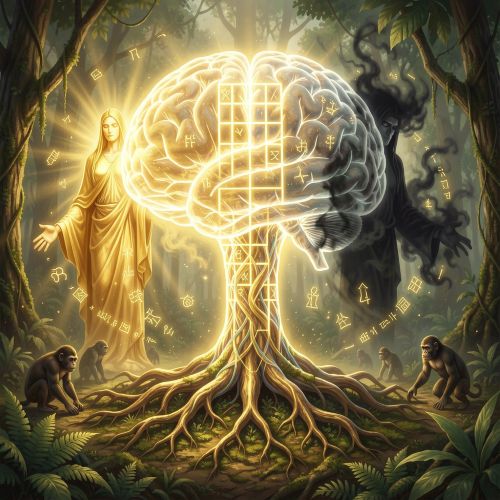
Here is a brief summary of the idea we propose. When, at a certain stage of evolutionary development, the computational capacity of the brain of human ancestors increased sufficiently, a mathematical object in the form of an elongated rectangle with addressable memory cells for words was formed in the brain. That is, a language matrix was formed in the form of a ribbon-grid.
Later, an urgent need arose to give each individual address cell of the memory some specific word meaning so that the system could appear informationally capable. It was then that evolution needed an early religious and worldview myth (mythology).
According to the early worldviews of ancient people, the Universe and everything in it were created by ‘’good spirits’’ (gods) — the Creators, and everything that was destroyed and ruined was done by “evil spirits” (“gods”) — the Destroyers. In other words, without the confrontation between Good and Evil, there is no world mythology. The concepts of Good and Evil, or God and the Devil< clearly defined the conceptual and semantic width of the linguistic matrix (grid-ribbon). Therefore, everything created by the Creator gods was called in human language by their names, and everything destroyed and annihilated was called by the names of the Destroyer gods. In other words, the early religious worldview of ancient people found its logical reflection in human language.
And this means that when people today pronounce any word in any language, they, without realizing it, each time invoke the names of certain deities and gods.
The great mystery of mythology is, what was the name of the first god (spirits, deities)? To answer this key question, we must learn the name(s) of the First God. Hesiod also sought to learn about this secret when he addressed the gods in his “Theogony” with the words: “Glory to you, children of Zeus! || … oh Muses, who dwell in the house of Olympus, and tell me which of them arose first”.
In our opinion, answer to this key question is provided by the myth of the “Tree of Life”, because this myth is known to the ancestors of all (without exception) peoples of the world, which indicates its unconditional primacy in world mythology.
Back in 2007-2008, we published in Ukraine our theoretical idea that the distant ancestors of humans, hominid primates, were the first to worship trees. After all, over millions of years of primate evolution, the tree itself protected them in every way from terrestrial predators, constantly providing them with food and water, and natural “medicines”.
Somewhat surprisingly, in 2011, German primatologists from Leipzig, from the Max Planck Society, first documented, using hidden video cameras in the jungles of West Africa, strange behavior of chimpanzees, which was in no way related to finding food, reproduction, etc. The unprecedented behavior of chimpanzees consisted of chimpanzees bringing stones from afar and throwing them into hollows and cavities of old trees with a loud cry. Researchers have put forward several working hypotheses regarding the strange behavior of chimpanzees. One hypothesis says that a religious cult (religion) is emerging in chimpanzees, and the hollows inside the tree serve as something like “primitive temples” for chimpanzees.
It was also interesting to note that local tribes living in west Africa still have a religious cult of veneration of deified trees, to which people also bring stones.
The early pagan religious cult of veneration of sacred trees (Tree-god) was also known to the ancestors of all peoples of the world, as it was the basis of the world-famous myth of the “Tree of Life”.
We have come to the theoretical conclusion that the distant ancestors of humans, primates, living for many millions of years mainly in trees, used vocal signals with which they marked the territory of their habitat (trees) as the first simple proto-words and which were already phonetically different from the beginning, in order to designate “their” trees. That is, in each separate group of primates, the vocal signal was phonetically distinct, but all those vocal signals (proto-words) meant the same object of living nature — a tree.
In other words, all the first proto-words were semantic. And this is our extremely important theoretical conclusion for understanding the entire further evolution of human language(s). It is this idea of the semantics of proto-words that will later be laid by evolution as the foundation of the universal human informational and communicative linguistic system (language).
Later, after the spontaneous emergence of the original religious cult (religion) of veneration of sacred trees, imaginary mythical entities (spirits, deities), who, according to the ideas of distant ancestors of people, lived in hollows and cavities of old trees, were called by the names of the trees in which they “dwelt”. However, with such a semantic transition (change in meaning) of the name of the tree into the name of a spirit (deity, god), the words continued to retain a phonetic similarity to the names of the trees.
This is another key moment in the evolution of language, because from this time on, the principle of mythological modeling of reality began to operate in language. This principle consists in the concept of combining into a single whole the fundamentally incompatible, that is, myth with reality. For example, the claim that “tree spirits” (“gods”) live in the tree is, of course, a myth, but the reality here is that in human language the names of these spirits (gods) have a phonetic similarity to the names of the trees in which they supposedly “reside”.
Later, in the process of language evolution, the plots of early floral religious myth modeled objective reality in language in such a way that they combined into a single coherent logical system what at first glance was fundamentally incompatible: myth (fiction, fantasy) with reality (the meaning of words in languages). That is, myth gave all words in all the languages of the peoples of the world their current numerous meaning, which modern humanity has no idea about.
However, in order to see for yourself the truth of what has just been said, you only need to take a few simple steps. It is necessary to graphically depict the human language matrix in the form of an elongated rectangle. That is, to visually show only a certain small segment of the single universal human language network-ribbon. In other words, to be able to see the big in the small.
To create a language matrix model with addressable word cells, we will place key words from the plot of any early creation myth (“Creator’s algorithm”) on the vertical “Y” axis (ordinate) in sequential logical order. Such an algorithm of creation in all myths will be clearly limited by the concepts of “Good” and “Evil”, that is, — God and the Devil. And therefore, graphically, the “Y” axis will also be clearly limited in its width.
In turn, on the horizontal axis “X” (abscissa) we will respectively place the names of trees (general or specific) and phonetically similar mythical names of creator deities (good spirits, gods-primordial creators). The “X” axis will be limited in length only by the number of tree names and the corresponding number of names mythical creatures from world mythology.
(to be continued)