

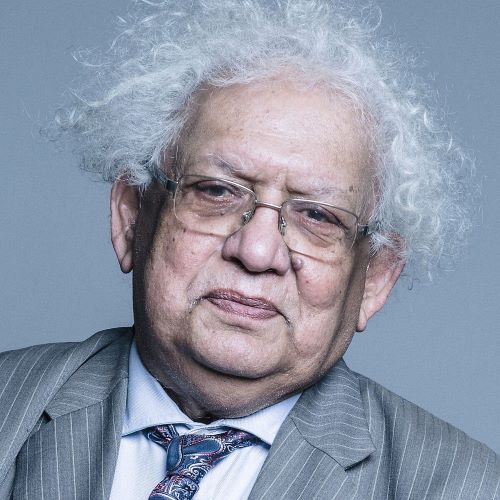
Meghnad Desai : Interpreter of Indian Epics and Civilisational Thought
Mythlok Perspective
From the Mythlok perspective, Meghnad Desai represents a modern intellectual who treated Indian epics not as frozen religious texts but as evolving mythic frameworks capable of political, ethical, and cultural reinterpretation. His readings of the Mahabharata positioned myth as a tool for understanding power, conflict, and human choice rather than divine morality. In this sense, Desai stands closer to figures like Joseph Campbell or Georges Dumézil, interpreting myth as a living civilisational language rather than sacred instruction.
Meghnad Desai
Introduction
Meghnad Desai, is an Indian-born British economist, politician, and writer known for his wide-ranging contributions to economics, political science, and mythology. Born on July 10, 1940, in Vadodara, Gujarat, he became a naturalized British citizen and played a significant role in the Labour Party. Beyond his influence in economics and politics, Desai has gained recognition for his fresh interpretations of ancient Indian epics, bringing a unique perspective to mythology and literature.
Area of Expertise
Meghnad Desai, though best known as an economist, has also explored mythology with a critical and interdisciplinary approach, particularly focusing on the Mahabharata and the Ramayana. He applies his analytical skills to reinterpret these ancient epics, examining their historical and social contexts while questioning traditional narratives. By integrating insights from economics, politics, and history, Desai offers fresh perspectives on the motivations of key characters like Lord Krishna and the broader themes within these stories. His work challenges conventional interpretations, encouraging readers to view mythology through a modern lens.
Books & Publications
Meghnad Desai has written extensively on mythology, with notable works like Who Wrote the Bhagavadgita? and Mayabharata: The Untold Story Behind the Death of Lord Krishna. In the former, he examines the Bhagavad Gita as a secular text, arguing that it evolved over time with contributions from multiple authors. Mayabharata is a fictionalized exploration of events after the Kurukshetra War, weaving mythology with historical and cultural influences, including connections to the Mayan civilization.
Beyond mythology, Desai has an extensive body of work spanning economics, politics, and history, with over 200 academic articles and regular columns in publications like Business Standard, Indian Express, and Financial Express. His ability to blend scholarly research with fresh interpretations has solidified his reputation as a versatile thinker.
Research & Contributions
Meghnad Desai’s approach to mythology involves reexamining ancient texts through an analytical and multidisciplinary lens. By integrating economics, history, and politics, he challenges conventional interpretations and encourages a secular, critical perspective. His research delves into topics such as the scale of destruction in the Mahabharata, questioning historical population figures, and the representation of women, particularly the resilience of Draupadi in Mayabharata.
One of his more unconventional theories links Mayasura, a key figure in Hindu mythology, to the Mayan civilization, suggesting cross-cultural influences in ancient storytelling. This perspective broadens the discourse on mythology, highlighting its evolving nature and global connections. Desai’s work not only reinterprets traditional narratives but also invites readers to explore mythological epics beyond their religious and cultural boundaries.
Awards & Recognitions
Meghnad Desai’s impact across multiple disciplines has earned him prestigious accolades. In 2008, he received the Padma Bhushan, India’s third-highest civilian award, for his contributions to literature and education. His achievements were further recognized in 1991 when he was made Lord Desai of St Clement Danes. Additionally, he was honored with the Bharatiya Pravasi Puraskar in 2004, celebrating his influence on global economics and his engagement with Indian culture. These distinctions highlight his lasting contributions to academia, politics, and mythology, cementing his reputation as a thought leader.
Social Media Profiles
Meghnad Desai maintains an online presence through various platforms, where he shares insights on economics, politics, and mythology. While his personal social media accounts may not always be publicly listed, the Meghnad Desai Academy of Economics (MDAE) actively updates its LinkedIn page with news on academic programs and research. Additionally, his involvement with organizations like OMFIF (Official Monetary and Financial Institutions Forum) offers opportunities to follow his professional engagements and perspectives.
Bibliographic Sources
Meghnad Desai, Baron Desai. (n.d.). In Wikipedia. Retrieved February 6, 2026, from https://en.wikipedia.org/wiki/Meghnad_Desai,_Baron_Desai
Ramakrishnan, T. (2012, October 7). Meghnad Desai: Lord of the lies. The Hindu.
https://www.thehindu.com/opinion/op-ed/meghnad-desai-lord-of-the-lies/article3968930.ece
Desai, M. (2022, October 27). Meghnad Desai. The Globalist. https://www.theglobalist.com/contributors/meghnad-desai/
Public Broadcasting Service (PBS). (2000, July 12). Commanding heights: Lord Meghnad Desai
https://www.pbs.org/wgbh/commandingheights/shared/minitext/int_desai.html
Bloomsbury Publishing. (2024). Meghnad Desai. Bloomsbury Publishing (US).
https://www.bloomsbury.com/us/author/meghnad-desai/

Frequently Asked Questions
Was Meghnad Desai a mythologist?
Meghnad Desai can be described as a mythological interpreter and epic thinker rather than a traditional folklorist. His work engaged deeply with Indian epics such as the Mahabharata, analysing them as cultural and civilisational narratives.
What mythological texts did Meghnad Desai work on?
Desai is best known for his engagement with the Mahabharata, particularly through modern retellings and analytical interpretations that explored moral ambiguity, power, and political psychology within the epic.
How did Meghnad Desai interpret Indian mythology?
He approached mythology as a dynamic narrative system shaped by history and human agency, arguing that epics evolve with society and should be read contextually rather than literally.
Did Meghnad Desai combine mythology with modern thought?
Yes. Desai blended mythic storytelling with modern political, economic, and cultural analysis, using epic narratives to comment on leadership, conflict, and ethical complexity.
Why is Meghnad Desai relevant to contemporary myth studies?
His work demonstrates how ancient epics remain relevant by offering frameworks for interpreting modern social, political, and moral dilemmas, reinforcing mythology’s role as a living tradition.