

Curupira : The Forest Guardian of Brazilian Folklore
Listen
At a glance
| Description | |
|---|---|
| Origin | Brazilian Mythology |
| Classification | Spirits |
| Family Members | N/A |
| Region | Brazil |
| Associated With | Forest protection, Wildlife guardianship, Illusion, Misdirection |
The Mythlok Perspective
In Mythlok’s Perspective, the Curupira is less a character and more a principle. It represents the forest defending itself. Many cultures create sky gods to command lightning or sea gods to rule oceans, but the Curupira belongs to the ground beneath our feet. It resembles figures like the Slavic Leshy or the Celtic Green Man, yet it is uniquely Amazonian in its moral clarity. Where modern law struggles to control deforestation, folklore created a guardian long ago.
Curupira
Introduction
The Curupira stands as one of the most enduring figures in Brazilian folklore, especially within the traditions of the Tupi-Guarani peoples of the Amazon. Known primarily as a supernatural guardian of the forest, Curupira punishes hunters, woodcutters, and anyone who exploits nature without respect. Unlike distant gods of the sky or sea, this being belongs to the dense green heart of the jungle.
Early written references to the Curupira appear in the 16th century, including accounts by the Jesuit missionary José de Anchieta, who described indigenous beliefs about forest spirits that misled and tormented wrongdoers. Over time, indigenous narratives blended with colonial and regional storytelling traditions, but the core identity of the Curupira remained intact: a fierce protector of wildlife and trees.
The name Curupira is generally traced to the Tupi language, often interpreted as referring to a “boy’s body” or a being with unusual physical characteristics. Regardless of linguistic variations, the legend consistently reflects a deep ecological philosophy. The Curupira is not evil. It is corrective. It exists to restore balance where greed disrupts harmony.
Physical Traits
The most defining feature of the Curupira is its backward-facing feet. Its heels point forward and its toes face behind, creating footprints that lead trackers in the wrong direction. Hunters attempting to follow the creature end up walking deeper into confusion. This single anatomical inversion is the symbol of the Curupira’s power: the forest itself cannot be navigated through violence or arrogance.
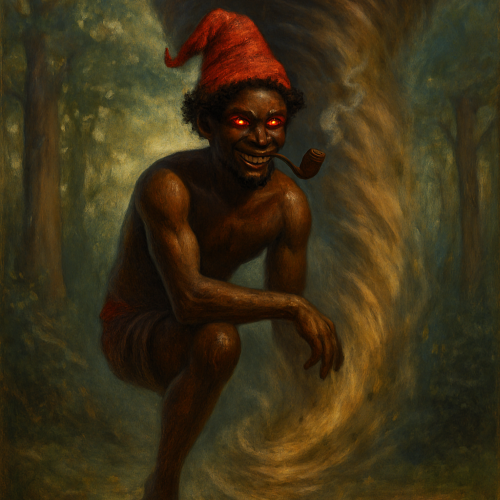
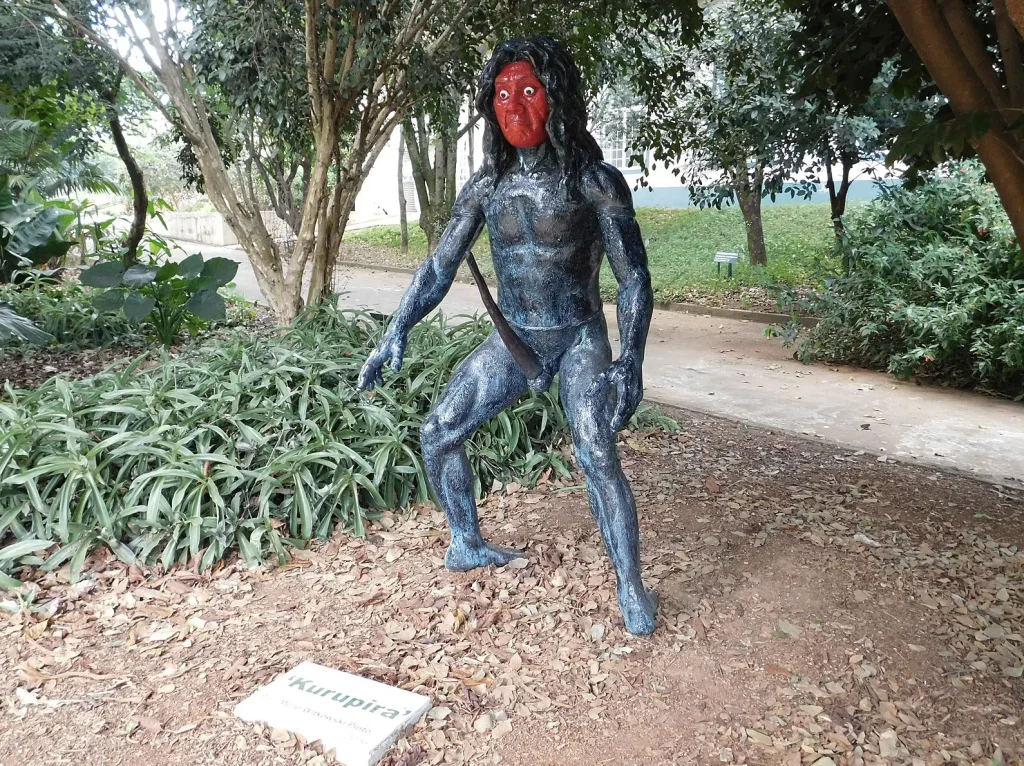
In most depictions, the Curupira appears as a small humanoid figure, often resembling a child or dwarf. It typically has bright red or flame-colored hair, sometimes described as glowing like fire in the shadows of the jungle. Certain regional traditions describe greenish or dark skin, while others portray it with exaggerated features such as large ears or sharp teeth.
In Amazonian variations, it may ride a wild boar known as a peccary. Some stories portray the being as male, others as female, and a few accounts describe it as shapeshifting. Despite regional differences, the backward feet and fiery hair remain consistent markers across Brazil.
Family
In core Tupi-Guarani traditions, the Curupira does not belong to a structured divine family. It is primarily a solitary forest spirit rather than a god with genealogy. Unlike mythological pantheons where deities are defined by lineage, the Curupira’s identity comes from territory. The forest is its domain and its purpose.
Some regional tales introduce a wife or companion, occasionally linking the Curupira to other forest beings such as Caipora. However, these associations vary widely across Brazil and are not universally accepted. In most foundational narratives, the Curupira stands alone as a guardian spirit, accountable only to the laws of nature.
Other names
The Curupira appears under several regional variations, including Currupira and Korupira. These differences reflect linguistic diversity across Brazil and neighboring regions influenced by Tupi-Guarani languages.
It is sometimes confused with Caipora, another forest spirit associated with wildlife protection. While both figures defend the forest, Caipora is usually depicted without backward feet and may ride animals such as peccaries. Over time, local storytelling traditions occasionally merged their identities, but folklorists generally treat them as distinct beings.
Powers and Abilities
The Curupira’s abilities center on deception, protection, and punishment. Its backward feet create misleading trails that send hunters in circles. But physical misdirection is only the beginning.
The Curupira is said to produce piercing whistles that echo through the forest. Those who hear the sound may become dizzy, disoriented, or overwhelmed with fear. Many tales describe intruders wandering helplessly for days, unable to find their way home.
Illusion is another key power. It can distort perception, alter sounds, and create phantom movements among trees. Some legends attribute supernatural speed and strength to the being, allowing it to chase down offenders. In extreme stories, the Curupira transforms predators into prey or turns their weapons useless.
Importantly, the Curupira does not punish subsistence hunting or respectful use of resources. Its wrath is directed toward excess. Hunters who kill animals carrying young, loggers who cut without need, and exploiters driven by greed become its targets. The Curupira embodies ecological ethics long before modern environmental law.
Modern Day Influence
The legend of Curupira remains highly relevant in contemporary Brazil. As deforestation and illegal logging threaten the Amazon, the Curupira has become a cultural symbol of environmental resistance. Environmental campaigns frequently invoke its image as a reminder that the forest has its own guardian.
In modern media, the Curupira gained international attention through the Netflix series Invisible City, where the character Iberê is revealed to be a manifestation of the forest spirit. The portrayal blends folklore with urban fantasy, presenting Curupira as a complex guardian navigating modern environmental crises.
The figure has also appeared in children’s books, educational materials, and regional festivals. July 17, celebrated in Brazil as Forest Protection Day, is often symbolically associated with the Curupira. In schools, the legend is used to teach environmental responsibility, demonstrating how folklore can shape civic values.
The Curupira’s transformation from oral myth to environmental icon reflects the adaptability of indigenous narratives. Rather than fading into obscurity, the legend evolved into a living symbol of conservation.
Related Images




Blogs & Opinions

Urban Legends


Mythical Events

Mythology Movies

Source
Myth and Folklore Wiki. (n.d.). Curupira. https://mythus.fandom.com/wiki/Curupira
New Cryptozoology Wiki. (n.d.). Curupira. https://new-cryptozoology.fandom.com/wiki/Curupira
Spooklorepedia. (2024, June 29). Legend of Curupira: The forest guardian of Brazilian folklore.
https://spooklorepedia.com/territories/south-american-folklore/brazilian-folklore/curupira/
Enchanted Chronicles. (2025, December 6). The legend of Curupira: Guardian of the forests.
https://enchanted-chronicles.com/curupira-guardian-of-the-forests/
New Cryptozoology Wiki. (2026, January 8). Curupira. https://new-cryptozoology.fandom.com/wiki/Curupira
Crow, J. (2000). The encyclopedia of monsters. Running Press.
De Sousa’s Mauricio. (2000). Turma da Mônica Lendas Brasileiras – Curupira (ISBN 85-3942-213-5).
RTL Today. (2025, November 10). COP30 has a mascot: The fiery-haired guardian of Brazil’s forest.
https://today.rtl.lu/news/science-and-environment/cop30-has-a-mascot-the-fiery-haired-guardian-of-brazils-forest-2353562
Câmara Cascudo, L. (1984). Superstições e costumes. Rio de Janeiro: Editora Civilização Brasileira.
Monteiro, J. (1994). The Curupira and Brazilian Folklore. Journal of Latin American Folklore, 12(3), 45–62.
Prandi, R. (2000). Mitologia dos orixás. São Paulo: Companhia das Letras.
Frequently Asked Questions
What is the Curupira in Brazilian folklore?
The Curupira is a forest guardian spirit from Brazilian and Tupi-Guarani traditions known for protecting wildlife and punishing those who exploit nature.
Why does the Curupira have backward feet?
Its backward feet confuse hunters by creating misleading footprints, symbolizing the idea that the forest cannot be conquered through force.
Is the Curupira good or evil?
The Curupira is neither purely good nor evil. It protects the forest and punishes greed, acting as a moral force rather than a villain.
What powers does the Curupira have?
The Curupira can create illusions, emit disorienting whistles, move at supernatural speed, and mislead or punish exploiters of nature.
Is the Curupira still relevant today?
Yes. The Curupira is widely used in environmental campaigns and modern media in Brazil, representing resistance against deforestation.