

Nguni Bigfoot : The Shadow Giant of Central African Lore
| Description | |
|---|---|
| Origin | Congo |
| Classification | Cryptid |
| Demeanour | Elusive |
| Habitat | Forest |
| Status | Not Proven |
Mythlok Perspective
In Mythlok’s Perspective, the Nguni Bigfoot is less about an undiscovered ape and more about humanity’s instinct to personify the wilderness. The Congo rainforest represents one of Earth’s last great unknowns, and cultures across the world create guardians for such spaces. Much like the Himalayan Yeti or North America’s Sasquatch, the Nguni Bigfoot embodies the fear and reverence inspired by vast forests. Where the Yeti stands in frozen mountains and Sasquatch roams pine woods, the Nguni Bigfoot belongs to humid equatorial shadow. The archetype remains constant, only the landscape changes.
Nguni Bigfoot
Introduction
The legend of the Nguni Bigfoot is often described as Central Africa’s answer to Sasquatch. Said to inhabit the dense rainforests of the Congo Basin, this towering, ape-like being occupies the blurred boundary between folklore and cryptozoology. Unlike the North American Bigfoot, however, the Nguni Bigfoot is not supported by a single unified tribal tradition under that exact name. Instead, it appears to be a modern label applied to several African “wild man” stories, particularly from the Democratic Republic of Congo and neighboring regions.
The Congo Basin is one of the most biodiverse and least explored ecosystems on Earth. It is home to lowland gorillas, chimpanzees, forest elephants, and countless undocumented species. In such a setting, it is not surprising that stories persist of something larger, more elusive, and strangely human. Reports describe a massive, bipedal forest being that walks upright, avoids villages, and vanishes into swamp and canopy before it can be studied. Whether misunderstood wildlife, cultural archetype, or undiscovered primate, the Nguni Bigfoot continues to intrigue researchers and storytellers alike.
Importantly, there is no verified zoological classification for a creature formally called “Nguni Bigfoot.” The term is largely used in online cryptid communities to group Central African wild-man legends into a familiar Bigfoot framework.
Physical Attributes
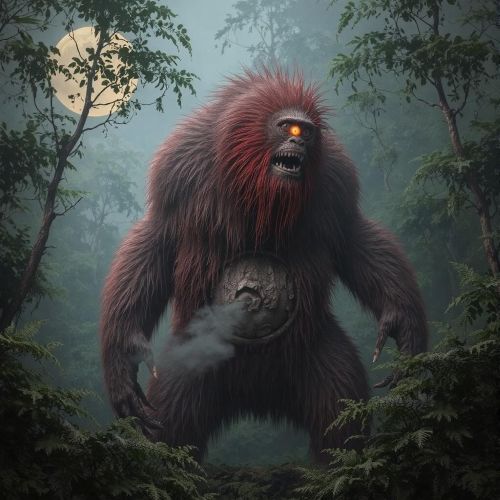
Descriptions of the Nguni Bigfoot share similarities with global wild-man traditions. Witnesses claim it stands between seven and ten feet tall, with a heavily muscled build adapted to dense jungle terrain. Its body is reportedly covered in dark brown or black hair, sometimes described as coarse and matted like that of a gorilla, but longer across the shoulders and back.
The creature is said to move upright with a human-like gait, though slightly hunched. Arms reportedly extend lower than those of an average human, suggesting climbing strength. Footprints attributed to it measure up to eighteen inches long, with five distinct toes and a deep heel impression. Some accounts describe a pronounced brow ridge, a flat nose, and eyes that appear reflective at night when caught in firelight or torchlight.
A strong musky odor is frequently mentioned, often compared to that of large primates. This detail parallels global Bigfoot reports but also matches the scent of male gorillas during certain seasons. Skeptics argue that many Nguni Bigfoot sightings may stem from misidentified gorillas, especially in low-visibility forest environments where scale and posture can be misjudged. No skeletal remains, hair samples with confirmed unknown DNA, or verified photographs have been scientifically validated.
First Sighting/Reporting
Unlike modern cryptids with a documented “first sighting,” the Nguni Bigfoot does not trace back to a single event. Instead, its origins lie in oral traditions among various Bantu-speaking communities in Central Africa. Elders in forest regions have long told stories of large, human-like forest beings that avoid settlements and appear at dusk near rivers.
European explorers in the late nineteenth and early twentieth centuries recorded stories of mysterious forest giants. However, these reports were often vague and sometimes conflated with early Western confusion about gorillas before they were widely studied. Explorers such as Paul du Chaillu helped introduce gorillas to Western audiences in the 1800s, and early fear-based narratives about apes may have contributed to myth expansion.
In the twentieth century, African “wild man” stories were occasionally grouped alongside legends like Mokele-Mbembe, though Mokele-Mbembe itself is described as a reptilian lake creature, not an ape-man. The blending of legends likely reflects how cryptid enthusiasts categorize unexplained beings rather than strict traditional folklore divisions. The term “Nguni Bigfoot” appears to be a modern construction rather than an ancient indigenous name.
Other Names
The Nguni Bigfoot does not possess one universally recognized indigenous title. Instead, similar beings are referred to by local names that translate loosely to “forest man,” “great ape,” or “hairy giant.” These names vary by dialect and region within the Congo Basin and neighboring territories.
Some online sources connect the legend to terms like Kikomba or Mulahu, though these are inconsistently documented and lack widespread academic backing. In southern Africa, stories of the Otang or Waterbobbejaan are sometimes compared to the Congo’s wild-man narratives, but they arise from different cultural contexts. This fluid naming pattern reflects how oral traditions evolve. Rather than one defined creature, the Nguni Bigfoot may represent a cluster of regional forest-being stories later unified under a global Bigfoot label.
Modus Operandi
Accounts consistently portray the Nguni Bigfoot as nocturnal and elusive. Most sightings allegedly occur at twilight or during the night. It is said to emit deep howls, knock on tree trunks, or shake branches as territorial displays. Such behaviors mirror documented primate communication patterns, especially among gorillas.
The creature is rarely described as directly aggressive. Instead, it is said to intimidate intruders and then retreat. Some local stories claim it steals livestock or food stores, but these events could plausibly be attributed to known wildlife.
Interestingly, encounters are sometimes interpreted spiritually. In certain communities, seeing a forest giant may be viewed as a warning or omen tied to environmental imbalance or disrespect toward nature. In this way, the Nguni Bigfoot functions as both creature and symbol.
Pop Culture References
Compared to Bigfoot in North America, the Nguni Bigfoot remains obscure. It appears occasionally in online cryptozoology forums, independent documentaries, and speculative fiction focused on African wilderness mysteries.
Unlike globally commercialized cryptids, it has not become a major film franchise figure or mainstream horror icon. Its relative absence from global pop culture reinforces its status as a regional legend amplified primarily through internet communities.
Current Status
As of today, the Nguni Bigfoot is unproven. No scientific expedition has confirmed the existence of an unknown giant primate species in the Congo Basin. Wildlife researchers working in Central Africa have documented gorillas, chimpanzees, and bonobos extensively, and no verified evidence supports a hidden hominid population of the reported size.
However, the Congo Basin remains vast and partially inaccessible in some regions. While science leans strongly toward misidentification explanations, the legend persists as part of local storytelling and global cryptid culture. The Nguni Bigfoot ultimately resides in the realm of folklore and speculative zoology rather than established biology.


Source
Cordier, H. (1920s). Accounts of the kikomba in eastern Congo.
Gatti, A. (1930s). Explorations in the Ituri Rainforest: The mulahu.
Patterson, G. (2015). Beyond the secret elephants. Penguin Random House. https://www.penguinrandomhouse.com/books/
BigFootFund. (2023). Bigfoot anatomy and behavior. http://bigfootfund.com/bigfoot-anatomy-behavior.html
Bernotaite, I., & Smith, E. A. (2025, December 16). Fact or folklore? 20 urban legends that could be chillingly real. Bored Panda. https://www.boredpanda.com/fact-or-folklore-urban-legends
Wikipedia contributors. (2026). List of urban legends. In Wikipedia. https://en.wikipedia.org/wiki/List_of_urban_legends
Legends and Myths from the Republic of Congo. (2025). African Folklore Archive. https://www.africanfolklorearchive.org/congo-legends
Radford, B. (2010). Bigfoot: The real story behind the legend. Skeptical Inquirer. https://skepticalinquirer.org/2010/07/bigfoot-real-story
Heuvelmans, B. (1965). On the track of unknown animals. Hill and Wang. https://archive.org/details/ontrackunknownanimals
Frequently Asked Questions
What is the Nguni Bigfoot?
The Nguni Bigfoot is a cryptid said to inhabit the Congo Basin, described as a large ape-like humanoid similar to Sasquatch.
Is there scientific proof of the Nguni Bigfoot?
No verified scientific evidence supports the existence of the Nguni Bigfoot.
Why is it called Nguni Bigfoot?
The name appears to be a modern cryptid label rather than a traditional indigenous term.
Could the Nguni Bigfoot be a gorilla?
Many researchers believe sightings may be misidentified gorillas observed under low-visibility forest conditions.
Where is the Nguni Bigfoot said to live?
Reports place it in the dense rainforests and river regions of Central Africa, especially within the Congo Basin.